
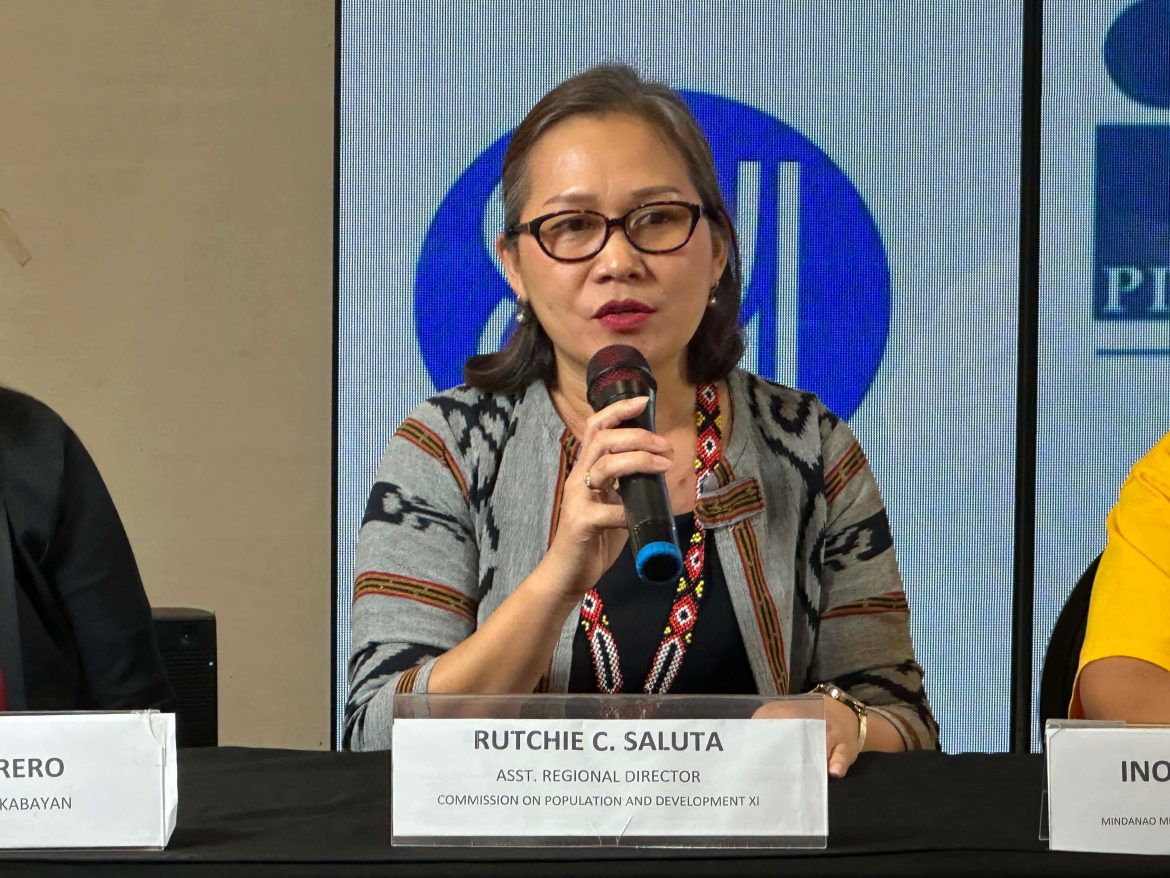
PHOTO BY KIRSON CASTANOS/DSSC Intern
THE COMMISSION on Population and Development (CPD) XI is actively pushing for the implementation of the Registry of Barangay Inhabitants and Migrants (RBIM) to address internal migration challenges.
Rutchie Saluta, CPD XI assistant regional director, said undetected internal migrants do not receive the same benefits and services from the government as the inhabitants.
“We are pushing that with the RBIM, ‘yung mga barangay that can be a good source not just for monitoring population, but even for the delivery of basic services. Ensuring that lahat talaga ng mga tao, not just ‘yung mga inhabitants, but including the internal migrants, are also provided accordingly with the services that they need,” Saluta said during the Kapehan sa Davao on Monday.
Saluta said RBIM serves as a critical database to help local governments identify service gaps and formulate targeted policies and development interventions, particularly for internal migrants.
While certain national policies, such as the Urban Development and Housing Act and the Local Government Code, mandate tracking the movement of people, she noted that RBIM adoption across all local government units is not yet mandatory.
Some LGUs would prefer the Community-Based Monitoring System (CBMS) or a national census. However, it is conducted every five years, and the migration history is not taken into account.
Saluta stressed that the RBIM is designed to be managed directly by barangay officials, enabling real-time data updates.
“We are training the barangay officials on how to conduct, how to manage, and how to conduct the analysis, for their consumption,” she said.
The database has already seen successful implementation in other regions during emergencies for the efficient distribution of relief goods, citing the case in Typhoon Yolanda.
Within Davao Region, a saturation of the RBIM has been completed in the municipality of Kiblawan in Davao del Sur, with validation ongoing.
The tracking system is also currently halfway through implementation in Asuncion, Davao del Norte, while training is scheduled to begin in Panabo City this August.
Currently, Davao City has not yet adopted the RBIM system due to its large geographic size and population, which has delayed local approval.
CPD Region XI is preparing to pitch the tracking system directly to the local government of Davao City Population Division and possibly partner for long-term monitoring and implementation.