

BY ALEX ALAGON

BY ALEX ALAGON

MEMORIES are like the stray cats I used to feed. Always sitting by the gate or waiting in ambush from under the car. And I am the old rat, always caught unaware. I admit, these sly feline-like memories leave one a bit woozy sometimes, especially whenever one’s guard is down.
At times, before one drifts off to sleep, instead of sheep to be counted, they come dancing on my mind’s stage as though it’s show time. Us aging rats, we remember it may have been different long time ago during the early years, when they just simply had no chance at distracting our pubescent minds.
While for still-active competitors in the rat race, this mushy thing called sentimentality, defined by Wiki as “that shallow, uncomplicated emotion at the expense of reason,” never really has any chance at success. For older people, it’s a deadly sniper lying in wait.
For the young, as they rush about their day-to-day with nary a care in the world, sentimentality is just laughable. Looking back now, that precisely might have been one of the follies of our youth, not looking back, ignoring a little pause at times. But not to be too harsh, surely there were few and far in between tender times we might have recollections. Just too embarrassed to admit it.
In the old days, school retreats, usually held during Holy Week or near graduations, might perhaps be a few of them. However, as many can relate, these were imposed activities and unpopular unlike these spontaneous sniping by cat-like memories preying on unsuspecting old geezers.
I’ve an old friend from college who now lives in Germany. With both sons already living separate lives, the divorcee in her had for a while, thought she’d find peace living alone. Then, when her mom passed away here, her only reason to visit was gone forever and she found that memories proved to be sad companions.
So now, she never fails to hit the road whenever she can. I’d not even be surprised if she booked a flight to the moon. I once asked, what happens when loneliness and old memories come in the night? They only stay a few hours, she had said. And that’s one source of inspiration right there.
I guess in the end, we take in what we can and live with that. Like her, I wish to eventually move in with both these feline memories, and what’s left of my demons. A guy on IG just explained it so clearly. Life is nothing but an hourglass. You cannot do any thing about the sand already at the bottom. It is the past. Neither can you control the portion still at the top. It is the future. The ones at the middle, as they slowly fall, is your present. Though fleeting, it is for you to enjoy while they last.
While it may be too late to turn hedonistic now, seize the day might as well be it for me. I’ve already gone way beyond eat, drink and be merry… Tomorrow is another day.
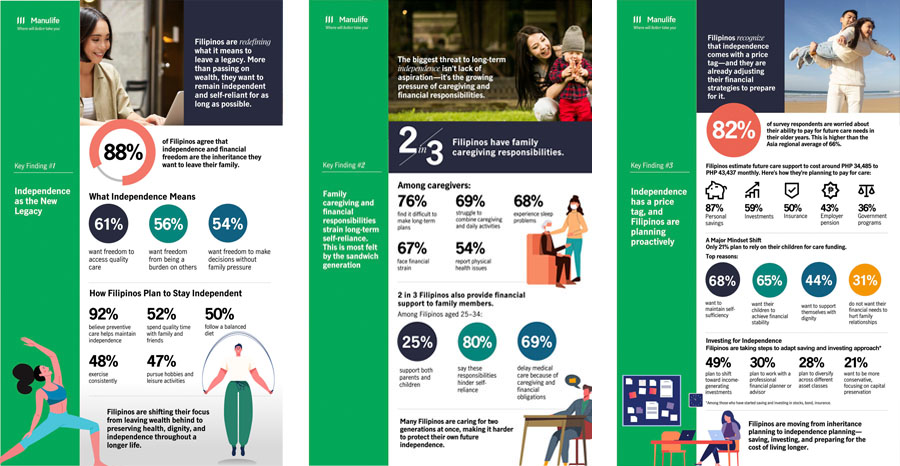
MANILA—As Filipinos prepare for longer lives, many are placing greater importance on maintaining their independence as they age, according to the latest findings from the Manulife Asia Care Survey 2026: Independence as the New Legacy. The study found that Filipinos increasingly view self-reliance, financial freedom, and the ability to avoid becoming a burden on loved ones as the legacy they can leave their families.
The survey, which gathered insights from more than 9,000 respondents across Asia, including 1,000 in the Philippines, explores attitudes toward longevity, health, caregiving, retirement preparedness, and financial well-being.
Independence as the New Legacy
The results build on a broader trend that Manulife has observed in recent years. As conversations around longevity have evolved, Filipinos have increasingly shifted their focus from simply living longer to living healthier, more fulfilling lives. The latest survey suggests this aspiration is becoming more defined: remaining physically, financially, and emotionally independent for as long as possible.
“For many Filipinos, legacy has always been deeply connected to family. What we are seeing is that people increasingly view legacy not only as what they leave behind, but also as the choices they make to stay healthy, independent and able to enjoy life for longer,” said Rahul Hora, President and Chief Executive Officer, Manulife Philippines.
Hora added, “This is especially important as Filipinos face more complex health, care, and financial needs as they age. At Manulife, we are committed to helping them prepare for the future through trusted advice, protection, and health and wealth solutions that enable greater confidence, dignity, and financial security in the years ahead.”
Health as the Foundation of Independence
The survey found that Filipinos broadly understand the role of health in protecting their independence, with 92% agreeing that preventive care and self-care habits help extend years of independence.
Spending time with family and friends (52%), following a balanced diet (50%), and maintaining a consistent exercise routine (48%) emerged as the leading self-care habits among respondents. However, only 29% are proactively building and maintaining social circles to combat isolation, and only 26% have taken early screenings and preventive care to avoid chronic illness.
Sandwich Generation Pressures Test Path to Independence
While Filipinos aspire to remain independent throughout their later years, the study found that many are already navigating responsibilities that may make that goal more difficult to achieve. Family caregiving and financial obligations have become a defining reality for a large segment of the population, often competing with their own long-term plans for health and financial security.
“The findings show us where the gaps are, and where support is most needed. Filipinos caught in these dual responsibilities should not have to choose between caring for their families and securing their own future. That is precisely the kind of challenge we want to help them navigate,” Hora added.
Planning for the Cost of Independence
These pressures are driving financial anxiety, with 82% of Filipinos worried about affording future care, well above the 66% regional average. On average, respondents estimate they would need PHP34,485 per month to cover their future care needs. Most plan to rely on personal savings (87%) and investments (59%), while only 21% expect support from their children, reflecting a stronger need for self-sufficiency and desire to let the next generation build their own lives.
“Financial independence is becoming an essential part of how Filipinos define a secure and dignified future,” said Aira Gaspar, President and Chief Executive Officer, Manulife Investments Philippines. “As people live longer, many are thinking more intentionally about how they can support their retirement, care needs, and life goals through savings and investments, while remaining self-sufficient and giving their children the freedom to pursue their own goals.”
The survey also shows that Filipinos who have started saving and investing for their financial well-being are taking practical steps to adapt their strategies. Nearly half plan to shift toward income-generating investments, while 30% intend to work with a professional financial planner or advisor. Another 28% plan to diversify across asset classes, and 21% want to take a more conservative approach focused on capital preservation.
Gaspar added, “At Manulife Investments Philippines, we help bridge the gap between intention and action by offering professionally managed unit investment trust funds (UITFs) as well as expert guidance and resources that make long-term financial planning more accessible and relevant to Filipinos at different life stages.” Access the full report and download the white paper via the company’s website: Manulife Asia Survey 2026: “Independence as the New Legacy”. The insights uncovered in this year’s survey align with the Manulife Longevity Institute, a global research, thought leadership, innovation, advocacy, and community investment platform that drives action to help people thrive at every age. Learn more about Manulife’s Longevity research and insights at: manulife.com/longevity.
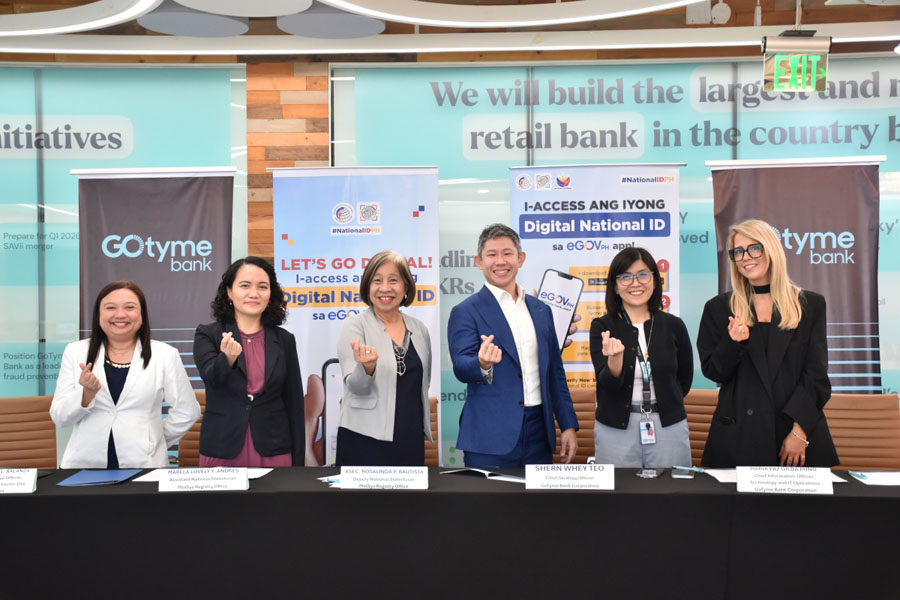
From Left to Right: Maria Celeste D.L. Balanza – Chief Administrative Officer, Financial and Private Sector Use Cases Division (PhilSys), Marela Lovely Y. Andres – Assistant National Statistician (PhilSys), Rosalinda P. Bautista – Assistant Secretary, Deputy National Statistician (PhilSys), Shern Whey Teo – Chief Strategy and Proposition Officer (GoTyme Bank), Maria Paz Gilda Puno – Chief Information Officer (GoTyme Bank), Cathriona Nolan – Chief Marketing Officer (GoTyme Bank)
Direct integration with the Philippine Identification System enables Filipinos to open a GoTyme Bank account in as little as five minutes with fewer verification steps.
GoTyme Bank has announced a partnership with the Philippine Statistics Authority (PSA), becoming one of the first banks in the Philippines to integrate directly with the National ID Authentication Services (NIDAS) at a system-level. This development fundamentally changes how Filipinos access banking services by allowing customers to open an account without the traditional requirement of scanning or uploading physical identity documents. It marks another step in GoTyme Bank’s mission to simplify and democratize banking by removing unnecessary barriers and making financial services easier to access for every Filipino.
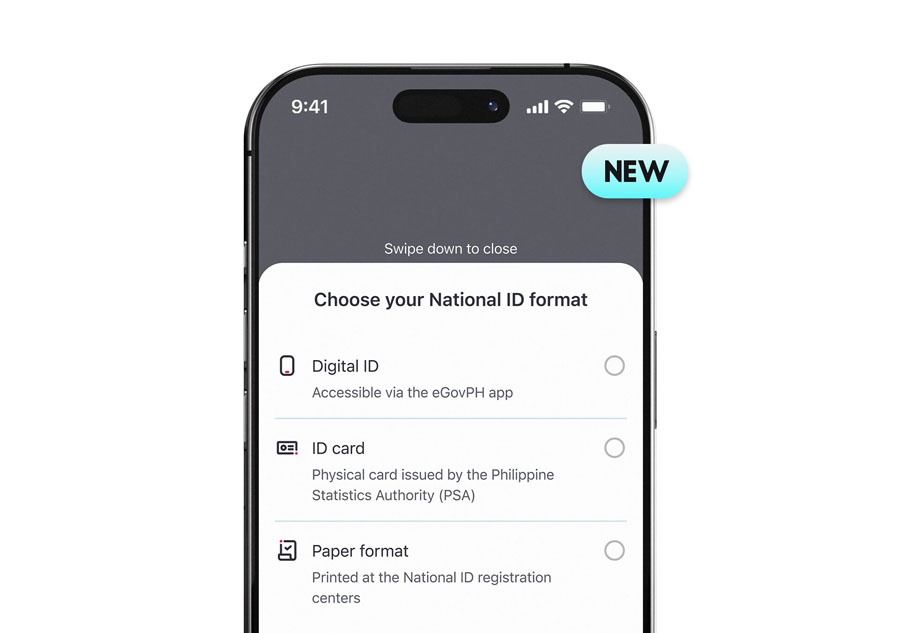
While various financial institutions across the country accept the PhilSys card as a valid form of identification, GoTyme Bank is among the first to achieve direct, system-level integration. This integration completely removes the dependency on document capture during the digital account opening process. Instead, individuals can verify their identity using three flexible options: the QR code on their physical, digital, or paper PhilSys ID, their PhilSys Card Number (PCN), or a simple name and date of birth entry. By giving customers more ways to verify their identity, GoTyme Bank helps them complete account opening in as little as five minutes, with even fewer verification steps for those using PhilSys.
Breaking down barriers to financial inclusion
According to data from the Bangko Sentral ng Pilipinas (BSP), approximately half of Filipino adults remain unbanked or underbanked, with the lack of a verifiable ID cited as a primary barrier to formal bank account ownership. While over 94 million Filipinos have registered with PhilSys, digital account opening friction—specifically the document capture step—often causes potential users to abandon the process out of uncertainty regarding document validity.
By removing this friction at its source, GoTyme Bank’s account opening process provides immediate utility to the millions who hold a PhilSys record, particularly benefiting unbanked individuals, Overseas Filipino Workers (OFWs), and residents in areas with limited access to physical bank branches—all while helping customers continue opening an account in as little as five minutes through a simpler verification experience.
“With our direct integration into the National ID Authentication Services, GoTyme Bank can verify a customer’s identity against official government records in real time, making account opening simpler, faster, and more secure. What this means is the ability to open a GoTyme Bank account in as little as five minutes, with fewer steps. We are simplifying banking and making it easier for more Filipinos to access the financial services they need, unlocking the full potential of every Filipino.” said Shern Teo, Chief Strategy & Proposition Officer at GoTyme Bank.
A milestone for digital public infrastructure
The partnership proves the real-world value of digital public infrastructure, demonstrating how private sector innovation can build upon government systems to expand access to essential services. It establishes a precedent for PhilSys to operate not merely as a static, accepted document, but as an active, digital enabler of financial access.
As adoption of digital public infrastructure continues to grow, integrations such as this demonstrate how government-issued digital identity can help expand access to formal financial services. For GoTyme Bank, this integration represents another step toward making banking more accessible, secure, and easier to use for more Filipinos.

THE DAVAO City Police Office (DCPO) conducted unannounced field inspections of deployed mobile patrol units on Monday morning, July 27, in line with its commitment to maintaining active community presence.
Led by DCPO chief PCOL Peter Bauzon Madria, the on-the-spot inspection and correction began at 10:35 a.m. to evaluate operational readiness, enforce strict personnel discipline, and maximize police visibility along key arterial routes in the city.
The spot check targeted Mobile Patrol Unit (MPU) teams assigned to strategic bypasses and major intersections:
Enforcing the 90-10 deployment strategy
The surprise evaluation aligns with DCPO’s operational directive to maintain 90 percent of police personnel on active field duty.
During the inspection, Madria reiterated the importance of proactive policing in deterring criminal acts and ensuring rapid emergency response across residential and commercial sectors.
“Proactive and visible policing plays a vital role in deterring crime and upholding peace and order,” Madria stated, urging patrollers to remain vigilant, approachable, and actively engaged with local residents to strengthen public trust.
Madria further instructed adjacent patrol units to refine their inter-unit coordination and communication protocols to guarantee rapid mobilization during law enforcement operations and critical incidents.
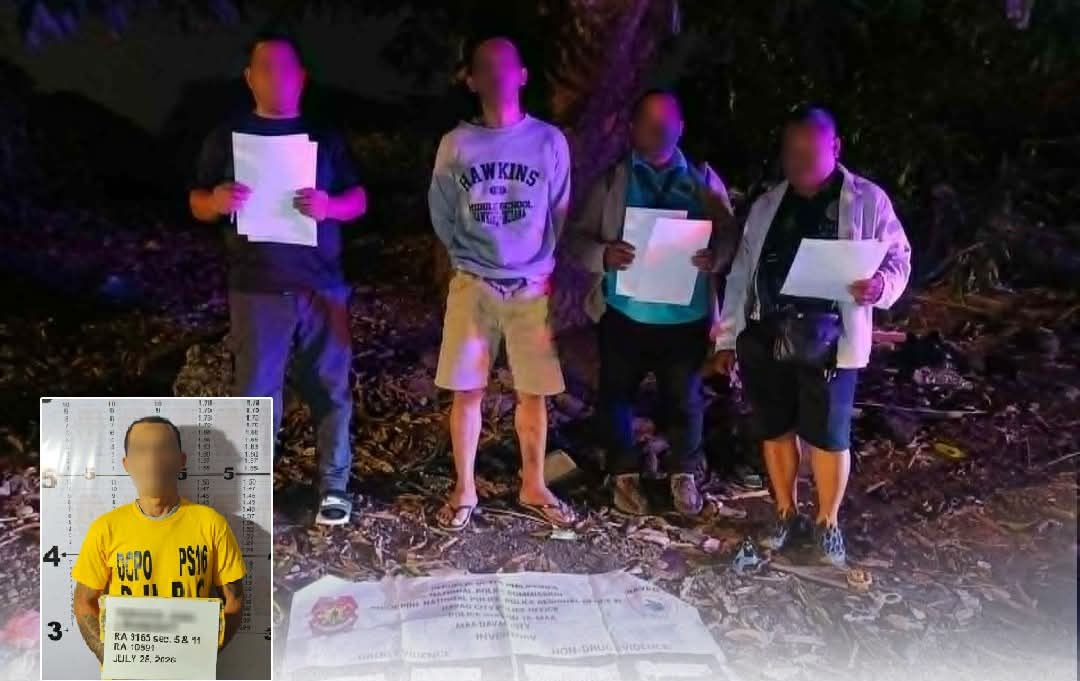
OPERATIVES of the Davao City Police Office (DCPO) arrested a high-value individual and confiscated an estimated ₱238,000 worth of suspected shabu along with an unlicensed firearm during an anti-illegal drug operation in Barangay Ma-a on Tuesday evening, July 28, 2026.
The joint buy-bust operation was conducted at around 6:33 p.m. in Purok 42, Midland Village, Barangay Ma-a, by personnel of DCPO Police Station 16 (Ma-a), led by station commander PMAJ Philip Dave A. Uddin, in close coordination with the Philippine Drug Enforcement Agency (PDEA) XI.
During the operation, undercover law enforcers successfully transacted with the suspect, leading to his immediate arrest at the scene.
A search following the arrest yielded approximately 35 grams of suspected shabu with a standard drug price value of ₱238,000 and a .38 caliber revolver.
The suspect, whose identity is being withheld pending the formal filing of charges, was classified by law enforcement as a high-value drug personality operating within the city.
Commitment to City Security
DCPO director PCOL Peter Bauzon Madria commended the operating team for the swift execution of the buy-bust, highlighting the ongoing collaboration between local police units and PDEA XI.
Madria reaffirmed the DCPO’s commitment to conducting relentless, intelligence-driven operations to curb the illegal drug trade and maintain peace and safety across Davao City’s barangays.
The arrested suspect is currently under police custody and will face charges for violation of Republic Act 9165 (Comprehensive Dangerous Drugs Act of 2002) and Republic Act 10591 (Comprehensive Firearms and Ammunition Regulation Act).

MANILA, Philippines — CashKO, a subsidiary of Philippine InsurTech company RuralNet, now protects over 6.1 million underserved Filipinos across 81 provinces through its affordable microinsurance network, driving a critical shift toward grassroots financial resilience.
This comes as the company deploys its “made-to-measure” insurance offering to directly address the country’s growing healthcare and protection gap. Unlike traditional one-size-fits-all insurance products that remain financially out of reach for low-income families, CashKO’s coverage is structured to address final medical liabilities and funeral expenses. Because terminal illnesses frequently drain a family’s entire life savings before a loss occurs, these tailored life policies act as an immediate financial shock absorber, protecting vulnerable households from falling into deep poverty before other financial support can arrive.
This safety net coincides with a shifting landscape in public health anxieties in the country. About 67% of adult Filipinos identify staying healthy and avoiding illnesses as their most urgent personal concern, outranking immediate economic worries. Yet, a protection gap remains, with the latest national insurance penetration remaining low at 2%. For the informal sector and rural communities, the sudden economic shock of a severe illness frequently forces families into predatory debt cycles, effectively resetting their economic progress to zero.
Lolita Lugasan, a market vendor, shares how she utilized CashKO through a local lending partner after the sudden passing of her husband. With the family’s savings exhausted by prior medical care, Lugasan noted that immediate financial assistance arrived within days, allowing her to cover urgent costs while preserving half of the funds to sustain her small business and protect her family’s livelihood.
“Makalipas ang ilang araw matapos mamatay ang asawa ko, mabilis kong nakuha ang claim. Ramdam mo na may nag-aalaga sa iyo, may malasakit (Just a few days after my husband passed away, I received the insurance claim quickly. It makes you feel like someone is truly looking after you and genuinely cares),” said Lugasan.
“‘Yung nakuha ko sa CashKO, kinabukasan, nataon na birthday niya. Hinati ko ‘yun. Yung kalahati, ipinanghanda ko. Pero yung kalahati, inilagay ko sa negosyo ko para may umiikot akong puhunan (The payout I received from CashKO arrived just in time for his birthday the next day. I split the money—half went toward preparing a meal for his birthday, and the other half I invested back into my business so I would have capital to keep it running),” she continued.
CashKO’s tailored plans are co-designed alongside local institutions such as rural banks, cooperatives, and microfinance lenders to match the unique income patterns and risk exposure of specific communities.
“Financial protection should be within everyone’s reach. It should not be a luxury, but a necessity. Our microinsurance service is tailored to the unique needs of Filipino households, moving away from rigid, traditional insurance and instead co-designing ‘made-to-measure’ plans with local institutions. By leveraging technology, we are helping more Filipino families build genuine financial resilience and long-term peace of mind, so that losing a breadwinner doesn’t mean starting back at zero,” said Justin Arcenas, founder & CEO of RuralNet Inc.
A key driver of CashKO’s scalability and impact is RuralNet’s proprietary digital infrastructure. The platform has streamlined the end-to-end claims process to maintain a 97% claims approval rate while turning around payouts 75% faster than the industry average. This speed proves to be critical for low-income beneficiaries who require immediate liquidity to avoid high-interest emergency loans.
By enabling rural banks, cooperatives, and microfinance institutions to integrate insurance into their existing services, CashKO has expanded its reach through a robust network of more than 5,000 partner branches across 81 provinces. Today, CashKO serves as the foundational financial and operational core of RuralNet’s tech-driven ecosystem, lowering operational overhead and eliminating the traditional distribution and trust barriers that have limited the rural insurance sector.
With a proven track record of handling over 6.1 million covered lives, CashKO’s tailored life microinsurance solutions form a vital safety net for the country’s most vulnerable sectors in the Philippines.
For more information, you may visit ruralnet.ph or micro.cashko-insurance.com.

THE UNIVERSITY of Mindanao-Institute of Popular Opinion (UM-IPO) conducted a survey from July 16, 2026 to July 26, 2026 to gather the opinions of 1,200 Dabawenyos across three districts regarding the safety and security measures implemented in schools across the City.
Specifically, the survey assessed student, parent, and guardian perceptions regarding school safety and security within Davao City. It examined accountability ownership, attitudes toward lowering the minimum age of criminal liability, and contributing factors to violent behavior among learners. Finally, it gathered stakeholder recommendations to enhance local school security measures.
Since the survey was conducted online via sponsored ads on Meta Platforms (Facebook, Messenger, and Instagram), including email, IPO relied heavily on online, pre-defined, targeted social media users who met the inclusion criteria and were contacted within the defined geographical radius. Respondents were defined as parents/guardians, students aged 18 or older, with valid/active email addresses, and residents of Davao City. The survey was done at a 95% confidence level and a +/- 2.83% margin of error.
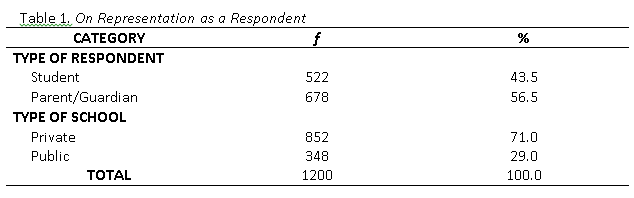
Among the 1200 respondents, parents/guardians made up the majority (n=678, 56.5%), with students comprising the remainder (n=522, 43.5%). When asked about schools where the children/students were affiliated, three-fourths (71.0%) of the respondents were affiliated with private schools while the remaining 29.0% were affiliated with public schools.
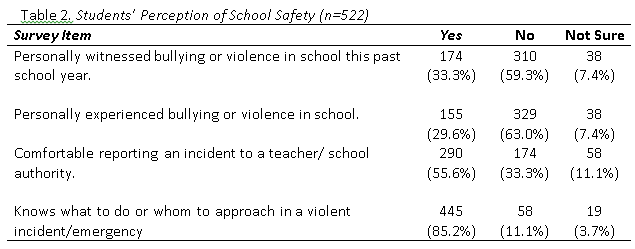
When asked about their perceptions of school safety, roughly 3 out of 10 students (n=174, 33.3%) reported having witnessed bullying or violence at school, and 3 out of 10 (n=155, 29.6%) reported having personally experienced it. Approximately 9 of the 10 respondents (n=445, 85.2%) said they know what to do or whom to approach during a violent incident or emergency; however, approximately 6 out of every 10 students (n=290, 55.6%) expressed confidence in reporting an incident to a teacher or school authority.
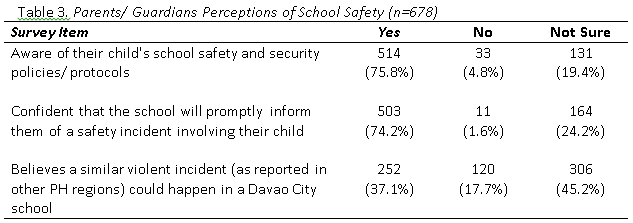
When parents/guardians were asked about their awareness of school safety protocols, approximately 8 out of 10 (n=514, 75.8%) responded that they were aware, and 7 out of 10 parents/guardians were confident that schools would promptly notify them of a safety incident (n=503, 74.2%). Moreover, 4 out of 10 parents/guardians (n=252, 37.1%) believed that a similar violent incident to those reported elsewhere in the Philippines could happen in a Davao City school.
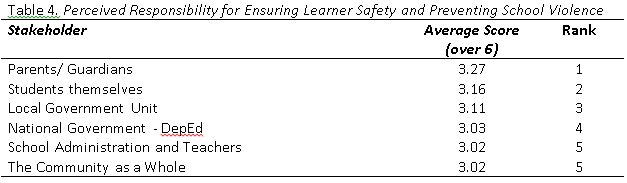
When asked who holds the highest responsibility for learner safety, respondents ranked parents/guardians first and students themselves second. The local government unit ranked third, followed by the Department of Education as fourth, and by the least accountable: school administration and teachers, and the community as a whole, which both obtained a mean score of 3.02.
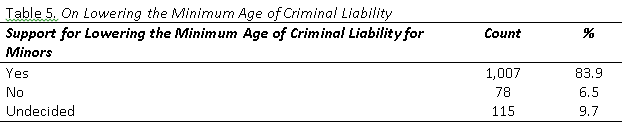
When asked about their support for lowering the minimum age of criminal liability, 8 out of 10 respondents (n=1007, 83.9%) expressed their support.
Of those who supported the call for lowering the minimum age of criminal liability, 6 out of 10 Dabawenyos preferred to lower it to 12-14 years old (n=562, 55.8%) while approximately 3 out of 10 Dabawenyos (n=348, 34.6%) preferred 9 to 11 years old and the remaining 1 out of 10 Dabawenyos preferred to lower it to below 9 years old (n=97, 9.6%).

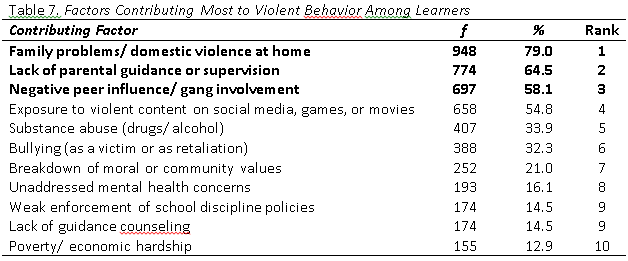
When asked about their perception of the contributing factors to the violent behavior among learners, family-level factors dominate the perceived causes: family problems or domestic violence at home ranked first (n=948, 79.0%), and lack of parental guidance or supervision ranked second (n=774, 64.5%). Negative peer influence/ gang involvement ranked third (n=697, 58.1%), while exposure to violent content on social media, games, or movies (n=658, 54.8%) and substance use (n=407, 33.9%) ranked fourth and fifth, respectively.
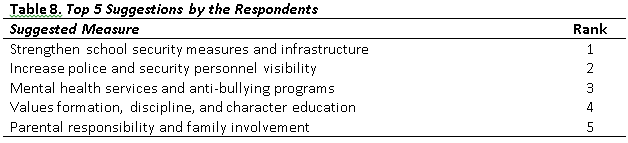
Lastly, respondents were asked qualitatively about their suggestions for improving the safety and security of schools within Davao City; strengthening school security measures and infrastructure ranked first, followed by increasing police and security personnel visibility. Mental health services, anti-bullying programs, and values formation, discipline, and character education were among the most suggested measures. Among the most suggested, parental responsibility and family involvement ranked fifth.
Note: The University of Mindanao funded this survey through the Institute of Popular Opinion.

For coffee entrepreneur Anna Magalona-Go, to brew a successful café business, one doesn’t need to have it all, but three key things: Goal, vision, and hard work.
Known for starting her initially online-only café But First, Coffee with only P6,000 seed money, Magalona-Go is a fan of starting small. “You can start very simple. You don’t need to have it all,” she said, speaking before hundreds of entrepreneurs and business owners at SME Day Manila, organized by PLDT Enterprise through its micro, small and medium business unit (PLDT SME).
“It’s not about reaping overnight success. It’s about not letting yourself be hindered by challenges and surpassing them so that your business will grow and thrive,” said Magalona, who founded But First, Coffee during the pandemic. “Don’t get easily affected by challenges, as they are part of life. No one succeeds without these challenges and the lessons that we can learn from them.”
Magalona also underscored the importance of nurturing community and generosity in growing any business. “Part of scaling your business without increasing your cost is building your community. I’m a very generous business owner, and I tend to give back to my customers, to my community, through promos, giveaways, and other activities.”
She cited as an example her experience with a customer early on in her café’s journey. “At the time, I was offering free delivery, but only in Makati. We had a customer then who was in Quezon City, so I told her the delivery fee would probably be expensive. But I offered to pay half of the delivery fee, just so she could try out our coffee. She ended up liking it, and months after, she became our franchisee,” she shared.
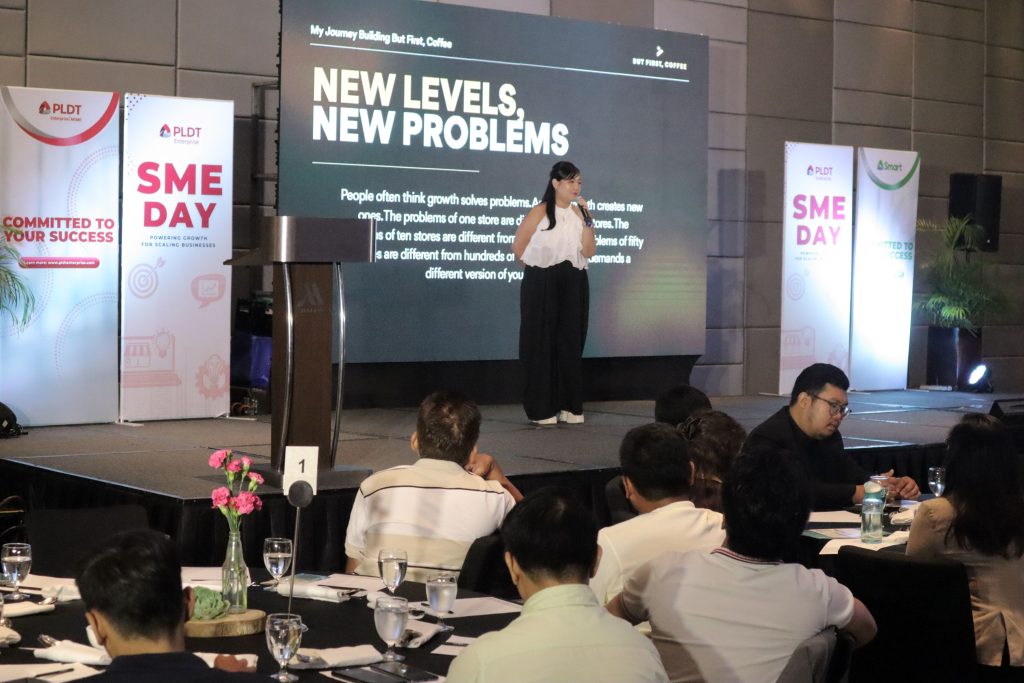
From being an online café during the pandemic, her business has fully blossomed into one with physical stores and franchises today. Magalona attributes it to kindness: “Being kind goes a long way. It’s not always about price wars. It’s about the quality, the service and the way you give back to your community.”
Boosting Filipino SMEs with SME Day
Through gatherings such as SME Day Manila, PLDT Enterprise provides small and medium enterprises a venue to learn from each other, exchange best practices, and listen to expert advice on how to harness technology to level up Filipino businesses in today’s digital-first economy.
In addition to the panel, participants also learned more about future-ready wireless solutions, resilient connectivity, cybersecurity, digital transformation, and sustainable business growth through experts from PLDT Enterprise, ePLDT, Vitro and TikTok, with key sessions highlighting 5G-driven opportunities, the critical role of fixed broadband in business resilience, and the importance of cybersecurity for modern enterprises, among other topics.
After its Pampanga and Manila editions, PLDT Enterprise is set to roll out SME Day in Davao and Iloilo. This initiative is aligned with PLDT Enterprise’s enduring commitment to empowering SMEs with the tools, technologies, and insights they need to innovate, adapt, and succeed in an increasingly digital business landscape.

FORMER Partylist Representative Atty. Nathan Oducado urged the Marcos administration to follow up the President’s State of the Nation Address with a clear path to reduce electricity costs, specifically the review of system loss charges that continue to burden Filipino consumers.
“Yesterday’s SONA rightly promised the removal of system loss charges in the electricity bill of ordinary Filipinos, but this promise must be matched by a clear pathway so that consumers will not end up paying more elsewhere,” said Oducado, speaking for the consumer watchdog and think tank CONSUMA PH.
System loss refers to electricity that is lost before reaching homes and businesses due to technical losses in transmission and distribution facilities and non-technical losses caused by illegal connections, meter tampering, and power theft, with distribution utilities currently allowed to recover system loss from consumers up to the limits set by the Energy Regulatory Commission.
“Consumers understand that some electricity is naturally lost while traveling through power lines, but they should not be made to pay for inefficiency or electricity theft that can and should be prevented,” he added.
He went on to say that any proposal to remove system loss charges should be accompanied by broader reforms because simply eliminating the charge without changing the system could lead utilities to seek increases in other regulated fees or reduce investments that ensure reliable electricity service.
“The objective is not to shift charges from one line of the bill to another but to eliminate unnecessary costs through better regulation, stronger enforcement, and a more efficient power sector,” he said. “Tatanggalin nga sa bill ang system loss, pero baka magdagdag lang naman ng panibagong buwis para i-subsidize ito. O ipapatong sa generation charge o sa ibang linya ng bill.”
Oducado called on Congress, the Department of Energy, and the Energy Regulatory Commission to make power affordability a priority following the SONA by reviewing system loss policies, strengthening anti-electricity theft measures, and ensuring that consumers pay only for electricity that is efficiently delivered to their homes.
“Any policy accounting for system loss should be clear how much electricity is lost and at what stage,” said Oducado. “This is so we know who must foot the bill, whether it’s the powerplants, the grid, or the DUs.”
Oducado stressed that while the administration highlighted economic gains and infrastructure development, millions of households continue to struggle with some of the highest electricity prices in Southeast Asia, with system loss charges remaining one of the many costs passed on to consumers under the current regulatory framework.
“What is clear is that it should not be passed on to the consumer,” said Oducado. “Not only does it raise our Bill, it also removes the incentive of the power sector to reduce losses by improving the system or going after electricity thieves.”