

The first day of school, June 8, 2026, will be forever etched in the minds of schoolchildren as a day that began with excitement for a new school year and ended as one of the most traumatic experiences of their young lives. The flag ceremony that kicked off the morning turned out to be a massive blessing, as it kept most of the learners and teachers outside where they were less vulnerable than they would have been inside the classrooms.
Social media was quickly flooded with images of the devastation, mostly showing terrified schoolchildren and collapsing buildings. These scenes reminded us once again of the fragility of our infrastructure and the unpredictable power of our planet. As reports of structural damage, displacement, and loss continue to surface from General Santos, Sarangani, and beyond, the initial shock has slowly given way to a profound, collective resolve.
In the immediate aftermath, the scenes were harrowing. We saw collapsed gymnasiums, fractured roads, and families forced into evacuation centers, their lives upended in a matter of seconds. Yet, beneath the rubble and the fear, we witnessed the enduring spirit of the Mindanaoan people—the bayanihan that defines us. Before first responders could even reach the most remote villages, neighbors were already pulling one another from the debris, sharing food, and offering temporary shelter. This capacity for compassion, even when one’s own roof is precarious, is the true bedrock of our recovery.
But how do we mitigate such profound tragedy in a region prone to seismic activity?
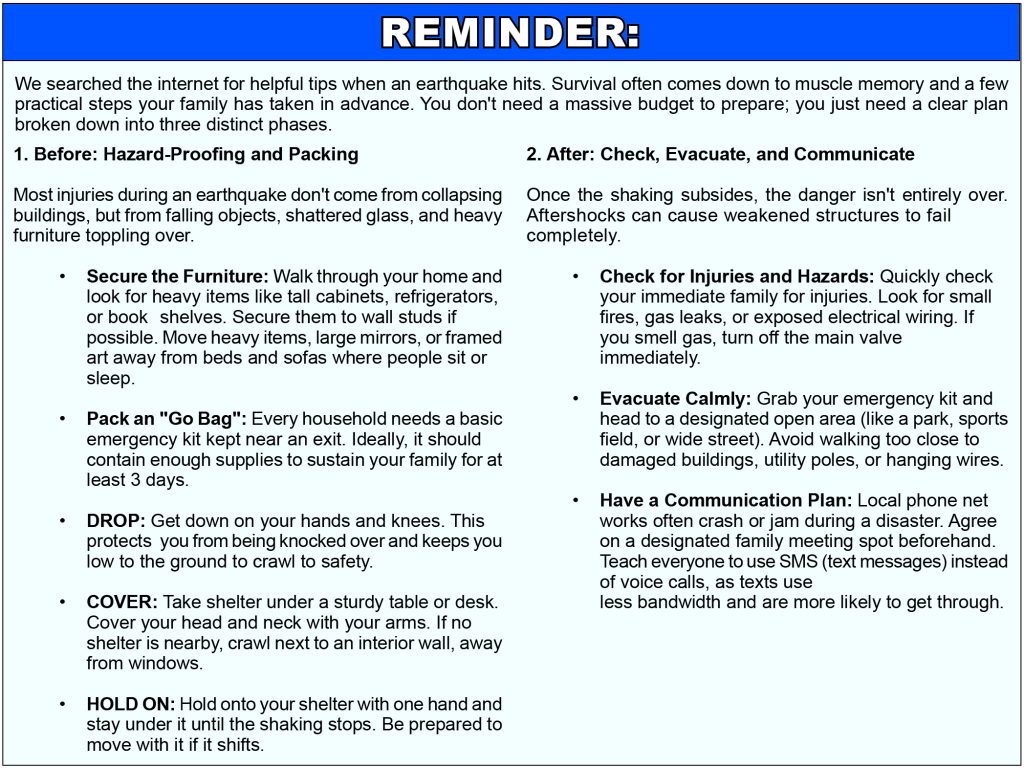
We must move beyond reactive relief and toward proactive resilience. The tragedy of June 8 serves as a stark call to action for stricter enforcement of the National Building Code. We need a rigorous, region-wide audit of our schools, hospitals, and public infrastructure to ensure they can withstand the “Big One.” PHIVOLCS has long advocated for “Drop, Cover, and Hold” drills and structural integrity assessments; these are not mere formalities, these are literal lifelines. We must treat earthquake preparedness as a fundamental aspect of our daily lives, much like how we prepare for typhoons. Coastal communities, having faced the terrifying prospect of a tsunami last week, must also be equipped with better early warning systems and a deeper, institutional knowledge of natural tsunami signs.
The days ahead will be long. The aftershocks, nearly 3,000 of them recorded since that fateful Monday, are a constant, shaking reminder that we remain vulnerable. Yet, as we clear the debris and look toward reconstruction, we carry the memory of those we have lost. We must not just build back; we must build better, stronger, and wiser.
This earthquake may have cracked our roads and broken our walls, but it has not broken our resolve. We will rise, we will rebuild, and we will do it together—because that, ultimately, is what matters most.