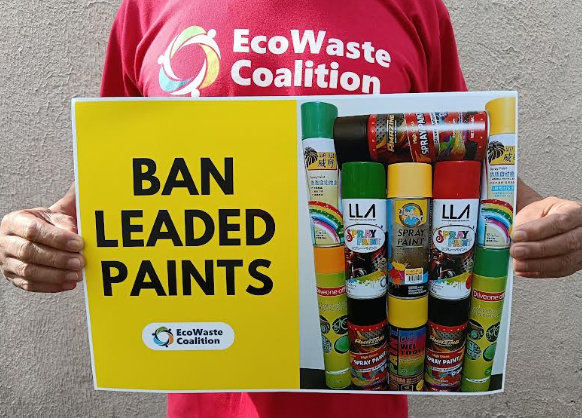

QUEZON CITY — Despite the existing Chemical Control Order (CCO) that outlaws lead in paints, harmful lead-laced paint products continue to be imported and distributed—an ongoing trend the EcoWaste Coalition has strongly deplored.
The group criticized the brazen breach of the lead paint ban as embodied in the CCO for Lead and Lead Compounds following its discovery of 11 more spray paints with lead content above the legal limit of 90 parts per million (ppm).
Issued by the Department of Environment and Natural Resources (DENR) in 2013, the CCO established a strict 90 ppm maximum limit for lead in all paints, including spray paints. The CCO further set phase-out deadlines for lead-containing decorative and industrial paints, which ended on December 31, 2016, and December 31, 2019, respectively.
As confirmed by SGS laboratory tests commissioned by the EcoWaste Coalition, the 11 paints representing six brands contained violative levels of lead, with eight products containing more than 10,000 ppm. The group purchased the paints from online sellers for P81 to P164 each.
Based on laboratory test reports, a medium yellow Herios Spray Paint manufactured in China in February 2025 had the highest lead concentration at 95,600 ppm.
The Jialing red, fresh green, and lemon yellow Amazing High Gloss Spray Paints contained 33,400 ppm, 20,200 ppm, and 714 ppm of lead, respectively.
The green and yellow Driveone Off Ultra Bright Night Light Spray Paint tested with 73,900 ppm and 69,900 ppm of lead, while the grass green and silver red LLA Spray Paints had 33,700 ppm and 5,140 ppm.
The green and yellow Wei Yue Spray Paint contained 48,100 ppm and 670 ppm of lead, and the canary yellow Wel Tools Paint had 27,900 ppm.
In January this year, the EcoWaste Coalition also released the laboratory test results of orange, beige, and green Nasmc Spray Paints, which were analyzed to contain 30,500 ppm, 10,000 ppm, and 7,460 ppm of lead, respectively.
The 14 lead-containing products mentioned above will be added to the “Public Notice on Lead-Containing Paints,” which currently includes 228 laboratory-tested spray paints with lead content. The said notice is co-published by the EcoWaste Coalition, International Pollutants Elimination Network (IPEN), and the Philippine Paint and Coatings Association, Inc. (PPCAI) to alert consumers and vendors to non-compliant paints containing lead, which are mostly imported from China and Thailand.
Lead-containing paints are a major source of lead exposure among children globally. “There is no level of exposure to lead that is known to be without harmful effects,” according to the World Health Organization (WHO), which has included lead among the ten chemicals or groups of chemicals of major public health concern.
Lead is a dangerous poison that can damage almost every part of the human body. It is especially harmful to babies and young children because their brains are still growing. When children are exposed to lead, it can cause lasting damage, including lower intelligence, trouble focusing, learning delays, and behavioral problems like aggression.
To stop leaded paints from illegally entering the Philippines, the EcoWaste Coalition is demanding tighter import restrictions. Key to this effort is adding lead chromates to the Rotterdam Convention’s list of hazardous chemicals to regulate the global trade of these toxic pigments.