
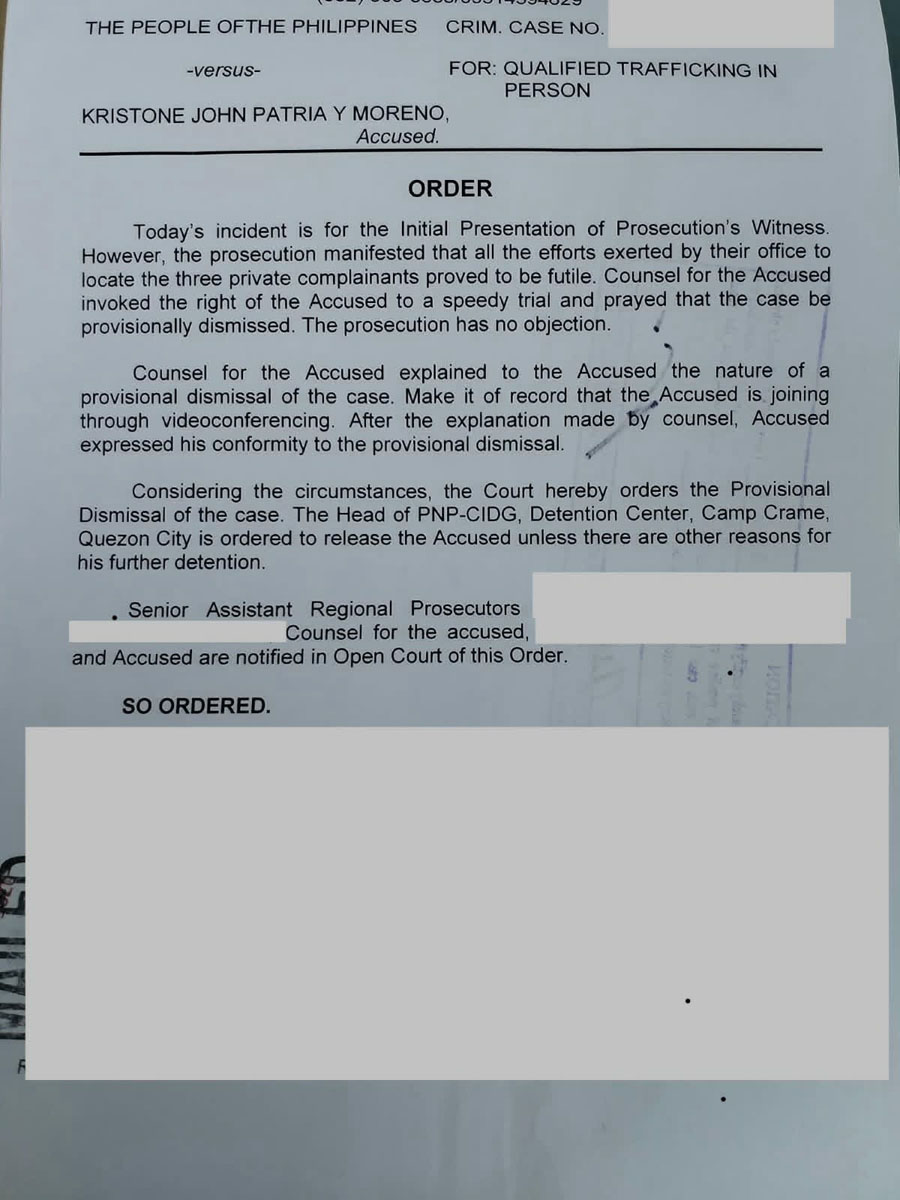
A court has ordered the provisional dismissal of the qualified trafficking in persons case against businessman Kristone John Patria y Moreno after prosecutors failed to locate three private complainants who were expected to participate in the proceedings.
The court order states that the prosecution was scheduled for the initial presentation of its witness but informed the court that all efforts to locate the three private complainants had proved futile.
Patria’s counsel invoked his client’s right to a speedy trial and asked that the case be provisionally dismissed. The prosecution raised no objection.
Patria, who appeared through videoconferencing, was informed by his counsel about the nature of a provisional dismissal and expressed his conformity.
The court subsequently ordered the provisional dismissal and directed the PNP-CIDG Detention Center at Camp Crame, Quezon City, to release Patria unless there were other legal grounds for his continued detention.
A separate portion of the court record identifies Aaron Paul A. Syboco as the private complainant in the criminal case. The document lists Syboco’s address in Baesa, Caloocan City.
This is significant because the court order refers to three private complainants who could not be located by the prosecution. The documents reviewed do not establish that Syboco is one of those three persons who could not be located.
Public reports previously identified Syboco as the complainant whose allegations triggered the CIDG investigation and subsequent entrapment operation against Patria.
The circumstances surrounding the dismissal have prompted questions about what happened to the witnesses whose testimony was expected to form part of the prosecution’s case.
A source familiar with the matter claimed that the private complainants were from Caloocan and could no longer be contacted. The source further alleged that there may have been an earlier understanding under which affidavits were executed but the complainants would no longer appear, effectively weakening the case.
The source even questioned whether the arrest and subsequent prosecution were deliberately structured in a way that would eventually allow Patria to be released.
These allegations have not been independently verified. There is also no finding in the court order that the CIDG, prosecutors or any other government agency deliberately filed a weak case or arranged for witnesses to disappear.
What is established by the court record is narrower—the prosecution told the court that it could not locate the three private complainants, the defense invoked the accused’s right to a speedy trial, the prosecution did not object, and the court ordered a provisional dismissal.
Provisional dismissal is not an acquittal The dismissal should not be interpreted as an acquittal or as a judicial finding that the trafficking allegations were fabricated.
It is specifically a provisional dismissal, and the legal consequences of such a dismissal are different from an acquittal on the merits.
The court’s order also makes clear that Patria’s release was subject to the absence of other legal grounds for his continued detention. The court record provides the answer to why the case was provisionally dismissed—but not yet to why the prosecution was unable to produce the complainants in the first place.
Patria is said to be back in business here in Davao City.