



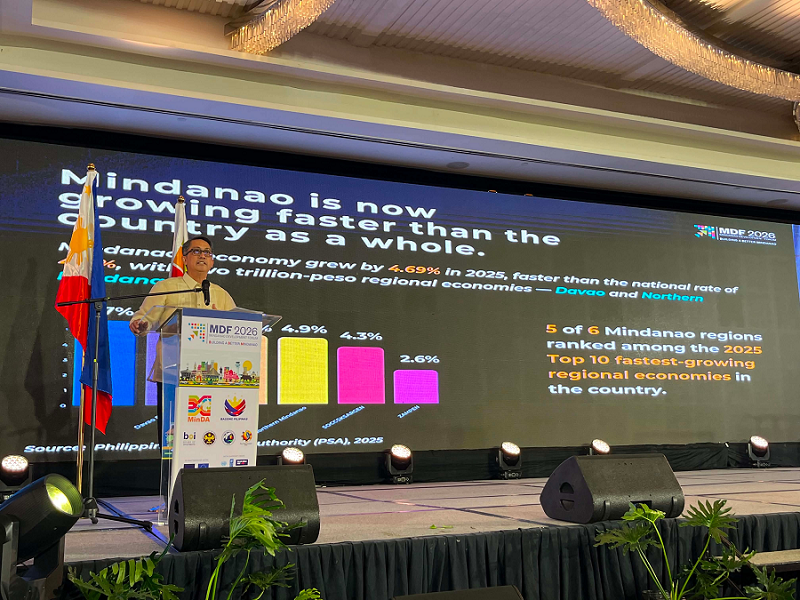
THE MINDANAO Development Forum (MDF) 2026 reported that regional economies demonstrated robust performance, outpacing the national average growth rate in 2025.
Key officials and development partners gathered for the MDF 2026 on Tuesday, Oct. 27 at Dusit Thani Davao.
Secretary Leo Tereso Magno, Mindanao Development Authority (MinDA), said the island’s economy expanded by 4.69% in 2025, surpassing the national growth rate of 4.4%.
Five of Mindanao’s six regions also secured spots among the country’s top 10 fastest-growing regional economies.
Caraga posted the highest regional growth at 5.7%, followed by strong economic performances in the Davao Region, Northern Mindanao, the Zamboanga Peninsula, and Soccsksargen, with gross regional domestic products (GRDP) continuing to cross the trillion-peso threshold.
“We aim to build an investment pipeline, to generate policy recommendations, and to forge partnership agreements that will sustain growth across our island,” Magno said.
The Bangsamoro Autonomous Region in Muslim Mindanao (BARMM) also marked significant progress, recording a 5% growth rate in 2025.
Chief Minister Abdulraof Macacua noted that family poverty incidence in the region declined from 28% in 2021 to 23.5% in 2023.
Macacua highlighted the Bangsamoro Region’s readiness to attract investments and translate the gains of the peace process into economic opportunities.
“The Bangsamoro is ready to take its next step, from peace to prosperity. We invite you to take that step with us,” Macacua said.
The Chief Minister highlighted the region’s progress, with the election of its own Parliament further strengthening governance institutions.
He stressed that sustaining investor confidence requires strong policies, reliable infrastructure, capable institutions, and close cooperation between the government and the private sector.
Macacua cited nearly ₱5 billion in investments attracted by the Bangsamoro in the past year across agriculture, fisheries, housing, logistics, and other sectors as an encouraging sign of
growing confidence in the region.
The Mas Matatag na Bangsamoro Agenda also aims to develop local industries and equip the workforce.
“Peace must mean better incomes for our farmers, decent work for our young people, growing businesses for our entrepreneurs, and dignity and security for our communities,” Macacua said.
Represented by Cabinet Secretary Benjamin Abalos Jr., President Ferdinand R. Marcos Jr. underscored Mindanao’s role in national development, highlighting strategic national policies such as Green Lanes for Strategic Investments, the Public-Private Partnership (PPP) Code, and executive orders streamlining mining applications and environmental safeguards.
Abalos cited that Mindanao accounted for more than 17.2% of the Philippine economy in 2025, but the region continues to face challenges, including uneven economic growth, weak agricultural and fisheries output, slow manufacturing growth, and persistent unemployment and underemployment.
Marcos said more than 100 of the 265 priority infrastructure projects under the Brunei Darussalam-Indonesia-Malaysia-Philippines East ASEAN Growth Area (BIMP-EAGA) initiative were slated for implementation in Mindanao.
“These efforts should mean lower transport costs, more reliable infrastructure, more local jobs, and better public services for our people,” Marcos said.
During the forum, MinDA formally launched the Mindanao Investment Portal to serve as a digital gateway for local and foreign investors, streamlining business navigation and bolstering public-private partnerships across the island’s local government units.
“Today, with the portal launched, we make it easier than ever for investors to join us in building a more competitive, inclusive, and investment-ready Mindanao,” Magno said.
National and local governments, the Bangsamoro Autonomous Region in Muslim Mindanao (BARMM), the private sector, financial institutions, development partners, and other stakeholders gather for the two-day forum.
The forum will feature high-level discussions on Mindanao’s competitiveness, investment and financing landscape, PPPs, emerging and high-growth opportunities, agriculture and agribusiness, and energy and infrastructure, alongside business matching and investment pitching.
Among those attending were European Union Ambassador to the Philippines Massimo Santoro, New Zealand Ambassador Catherine McIntosh, Asian Development Bank (ADB) Country Director Andrew Jeffries, and ADB Board member Rolly Tumpalan.
Also present were National Anti-Poverty Commission Secretary Manny Pacquiao, Anti-Red Tape Authority Director General Ernesto V. Perez, Davao del Norte Governor Edwin J. Jubahib, and Oroquieta City Mayor Lemuel Meyrick M. Acosta.

