




Manila, Philippines – TransUnion (NYSE: TRU), a global information and insights company and the Philippines’ first comprehensive private credit reference agency, today released additional findings from its 2026 Credit Perception Index (CPI), providing insights for the first time on how Filipinos across the country’s three major island groups1 perceive and engage with credit.
Introduced in 2023, the CPI examines Filipinos’ knowledge, trust, and favorability toward credit and other financial products, including the factors that influence their attitudes, behaviors and financial decisions, with the goal of supporting broader financial inclusion in the Philippines.
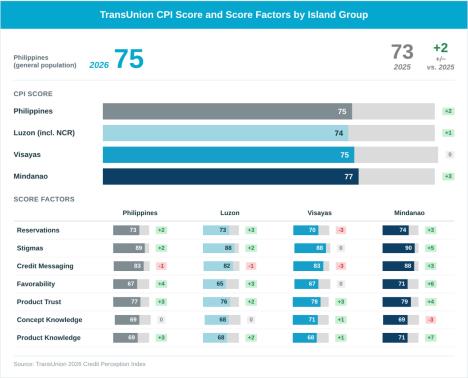
The findings show that credit perception held or improved in Luzon, Visayas and Mindanao, suggesting that broad-based progress is being observed across the country rather than concentrated in specific regions.
The Philippines’ 2026 CPI score, reflecting the general population, rose to 75 out of 100 (+2 points from 2025), the highest since the study began in 2023. Comparing the three island groups, all recorded improved or stable CPI scores in 2026. Mindanao posted the biggest gain, rising to 77 out of 100 (+3 points), while Luzon, including the National Capital Region (NCR), increased to 74 (+1 point) and Visayas remained stable at 75.
Mindanao’s improvement was driven by gains across six out of seven score factors*, including product knowledge (+7 points), favorability (+6 points), stigmas (+5 points), product trust (+4 points), as well as credit messaging and reservations (both +3 points). Similar patterns were observed in Luzon and Visayas, where most score factors improved or remained stable. In Luzon, five of seven score factors improved, while in Visayas, softer credit messaging and reservations were offset by gains in product trust and knowledge.
“It’s encouraging to see credit perception improved across the country this year. Every island group held or improved its score, which tells us that consumer confidence and knowledge in credit is building broadly — not only in and around the capital. That kind of nationwide progress is a strong and positive signal toward greater financial inclusion,” said Peter Faulhaber, President and CEO of TransUnion Philippines.
Shared Financial Priorities Across Island Groups
Perceived financial situation across island groups broadly reflected the general population, with some regional variation: a larger share in Mindanao identified as lower income (33% vs. 28% of the general population), while more in Visayas placed themselves in the lower-middle bracket (60% vs. 47% of the general population).
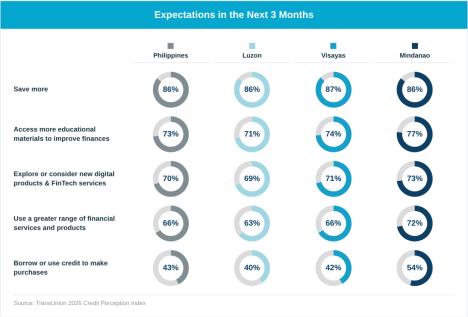
Amid a more cautious economic climate in 2026, shaped by elevated prices, Filipinos across all three island groups planned to take a proactive approach to their finances over the next three months. Saving more was the most common planned action in every island group (Luzon: 86%; Visayas: 87%; Mindanao: 86%). Accessing more educational materials to improve their finances ranked second in each (Luzon: 71%; Visayas: 74%; Mindanao: 77%), followed by exploring new digital products and FinTech services (Luzon: 69%; Visayas: 71%; Mindanao: 73%) and using a greater range of financial services and products (Luzon: 63%; Visayas: 66%; Mindanao: 72%).
Intent to use credit, however, was where the island groups diverged. More than half of Filipinos in Mindanao (54%) intended to borrow or use credit for purchases in the months ahead, 11pp above the general population (43%). The figure was 42% in Visayas and 40% in Luzon.
FinTech Use is Widespread, but Product and Learning Preferences Vary by Region
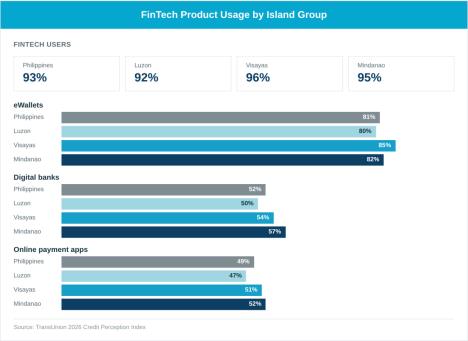
Consistent with the general population (93%), the majority of Filipinos across the three island groups were FinTech users, with Visayas seeing the highest adoption at 96%, followed by Mindanao at 95% and Luzon at 92%. eWallets, digital banks and online payment apps were the three most widely used FinTech products in every island group.
Visayas recorded strong eWallet use at 85%, four percentage points above the general population (81%), while Mindanao showed higher uptake of digital banks at 57%, five points above the general population (52%).
Where Filipinos preferred to learn about financial products followed a similar regional pattern. Social media led in every island group (Luzon 57%, Visayas 69%, Mindanao 64%), with e-learning platforms among the top three everywhere (Luzon 49%, Visayas 52%, Mindanao 50%). The third channel differed by region: banks and financial institutions ranked high in Mindanao (53%), while family and friends completed the top three in Luzon (44%) and Visayas (50%).
From Broad Progress to Inclusive Participation
Two years ago, TransUnion’s Credit Perception Index found Filipinos outside the capital lagging behind in how they viewed credit. This year, the first regional view shows credit perception holding or improving in Luzon, Visayas and Mindanao alike. Filipinos in different parts of the country engage with credit, digital tools and financial information in their own ways, and meeting them where they are is how that progress becomes lasting financial inclusion.
“There is no one-size-fits-all approach to advancing financial inclusion. Understanding local needs and behaviors through more granular insights can help stakeholders develop solutions, education initiatives and engagement strategies that resonate best with communities – which is how broad progress becomes genuine, inclusive participation,” said Faulhaber.
In the Philippines, TransUnion works alongside financial institutions, government and industry partners to expand access to financial services and support broader financial inclusion. Its solutions help lenders assess consumers with limited credit histories using alternative sources of information, while initiatives such as the Fraud Industry Council, launched in 2024, strengthen information-sharing and collective action against fraud.
TransUnion’s Credit Perception Index (CPI) is an annual study conducted exclusively in the Philippines that tracks how Filipinos perceive and engage with credit, the drivers and barriers influencing their behavior, and the implications for the broader financial ecosystem. The 2026 study surveyed 1,000 consumers from May 6-26, 2026.
For more information and insights, please view the full report of the TransUnion Credit Perception Index study.

