




RISING oil prices, a widening merchandise trade gap, and uncertain capital flows expose the Philippines to external economic pressures. The response must combine regional cooperation with stronger exports, reduced import vulnerability, and protection for ordinary households.
Bangkok’s warning: The oil shock may not fade quickly
The IMF–World Bank Annual Meetings in Bangkok have delivered an important warning for the Philippines and its ASEAN neighbors. The global economy remains resilient, but that resilience is being tested by geopolitical conflict, rising energy costs, persistent inflation, and limited fiscal room to respond.
In its World Economic Outlook, released on October 13, 2026, the International Monetary Fund (IMF) projected global growth of 3.1% in 2026 and 3.4% in 2027. Its oil-price assumptions are for an average of US$95.74 per barrel in 2026 and US$87.39 in 2027. These are annual averages, not assurances that prices will remain below US$100 throughout either year.
The downside risk is considerably more serious. A severe escalation of the Middle East conflict could push oil prices towards US$130 per barrel, prolonging the energy shock into 2027. This is an adverse scenario, not the IMF’s central forecast. The consequences would include higher import costs, weaker household purchasing power, additional inflationary pressure, and slower global growth.
At her October 14 briefing in Bangkok, IMF Managing Director Kristalina Georgieva warned that global economic resilience was reaching its limits, with energy and fiscal buffers being depleted. She urged governments to protect people rather than artificially suppress prices, strengthen public finances, and cooperate in addressing shared risks.
For the Philippines, an archipelagic economy heavily exposed to imported petroleum, the implications extend far beyond petrol stations. Higher oil prices increase transport and production costs, raise the foreign exchange needed to pay for imports and place additional pressure on household budgets.
The central question is not simply how the country can manage the next fuel-price increase. It is how the Philippines, working with ASEAN partners, can become less vulnerable to recurring external shocks without compromising growth, employment, and human development.
A widening trade gap and rising foreign-exchange requirements
The Philippine Statistics Authority’s (PSA) September 30 release of merchandise trade data for August 2026 reveals the scale of the challenge.
During January–August 2026, merchandise exports amounted to US$64.04 billion, up 14.8% year on year. Imports reached US$105.60 billion, an increase of 19.1%. The resulting merchandise trade deficit was approximately US$41.56 billion.
August offered some encouragement. Exports reached US$9.11 billion, increasing 27.8% year on year, while imports rose 16.6% to US$12.96 billion. The monthly trade deficit narrowed to US$3.85 billion. Nevertheless, the cumulative imbalance remained substantial.
Higher oil prices could widen this gap even without any increase in the quantity of petroleum imported. The country would need more dollars to purchase the same volume of fuel. Higher freight charges and production costs could also raise the price of imported food, machinery, chemicals, and industrial components.
The implications extend to the balance of payments, which includes services, income, transfers, and financial transactions, as well as merchandise trade. Remittances, tourism receipts, service exports, and foreign investment help finance the country’s external payments. If import costs rise persistently while foreign-exchange earnings fail to keep pace, pressure on the peso and external financing needs could increase.
The BSP reported a US$5.3 billion balance-of-payments deficit for January–July 2026, compared with US$5.8 billion in the corresponding period of 2025. Gross international reserves stood at US$103.3 billion at end-July, equivalent to 6.7 months of imports of goods and payments for services and primary income. These reserves provide a substantial buffer, but they do not eliminate the need to manage a persistent external imbalance.
The objective should not be to discourage all imports. Machinery, electronic components, and intermediate goods are essential to domestic production and exports. The priority is to reduce avoidable import vulnerability while ensuring that productive investment and essential supplies remain affordable.
Foreign capital: A buffer that cannot replace export earnings
Foreign investment can help finance the external deficit, but the composition and direction of capital flows matter.
BSP data show that net foreign direct investment (FDI) inflows reached US$4.071 billion in January–July 2026, compared with US$5.350 billion in the same period of 2025—a decline of approximately 23.9%.
Net equity investment, excluding reinvested earnings, was US$675 million, against US$725 million a year earlier. Net investments in debt instruments declined to US$2.428 billion from US$3.498 billion, while reinvested earnings fell to US$968 million from US$1.127 billion.
These figures indicate weaker net FDI inflows. They do not establish that all foreign investors are leaving the Philippines: net flows reflect new investments, withdrawals, repayments, and other transactions.
Portfolio flows have been more volatile. BSP data on foreign investments registered through authorized agent banks show net outflows of approximately US$4.25 billion during January–August 2026, compared with net inflows of US$4.58 billion in the corresponding period of 2025. This measure covers registered transactions and is not a complete account of all foreign portfolio activity. The distinction is important. Direct investment can finance factories, technology, productive capacity, and employment. Portfolio investment contributes to market liquidity and financing but can respond rapidly to changes in international interest rates, risk perceptions, and currency expectations.
The country therefore needs to attract more long-term, productive investment while maintaining credible macroeconomic management. Investment that expands export capacity and domestic value added is particularly valuable because it can generate recurring foreign-exchange earnings.
Foreign capital cannot indefinitely substitute for exports, remittances, and other sustainable sources of foreign exchange. A durable external position requires the economy to earn more of the currency it needs to pay for imports.
How the oil shock reaches ordinary Filipinos
The cost-of-living consequences are already visible in the inflation figures.
According to the PSA’s October 6 release, headline inflation accelerated to 7.2% in September 2026, from 6.1% in August. Food and non-alcoholic beverage inflation rose to 6.7%, while inflation in housing, water, electricity, gas and other fuels reached 8.4%. Transport inflation accelerated to 14.6%. Higher fuel costs affect much more than the price paid at the pump. Diesel makes it more expensive to transport rice, vegetables, fish, and manufactured goods. Fishing, cold storage, public transport, delivery services, and small businesses face higher operating expenses. These costs can eventually feed into retail prices.
The burden is especially difficult for lower-income households, informal workers, and public transport operators whose earnings may not rise as quickly as expenses. When food, transport, and electricity absorb more of a family’s income, less remains for education, healthcare, savings, and other essential needs.
The government should provide timely, targeted, and temporary assistance to vulnerable households and affected workers. But broad subsidies and permanent tax concessions can be costly and poorly targeted. Relief measures need to be assessed against their fiscal cost, distributional impact, and ability to reach those most affected.
The IMF’s October outlook reinforces this approach: protecting vulnerable people while preserving fiscal space is preferable to expensive, indiscriminate measures that suppress prices for everyone. Can ASEAN build a common energy-security strategy?
The Philippines should use its regional partnerships to turn energy cooperation into practical protection against future shocks.
There is already a foundation. The ASEAN Plan of Action for Energy Cooperation (APAEC) 2026–2030 sets out regional objectives for energy security, connectivity, renewable energy, and efficiency. The ASEAN Centre for Energy’s Ninth ASEAN Energy Outlook, launched on October 8, 2026, also highlights growing energy-import exposure and the importance of regional integration.
Several practical initiatives deserve priority:
First, improve regional monitoring and contingency planning. ASEAN members could share timely information on petroleum inventories, import requirements, shipping disruptions, and emergency supply availability. Better information would help governments identify shortages early and coordinate responses.
Second, explore joint procurement and emergency stock-sharing. Aggregating demand may improve bargaining power in selected circumstances. However, different crude grades, refinery requirements, storage facilities, financing arrangements, and shipping routes would need to be reconciled. Joint purchasing should be developed where commercially and logistically viable, rather than assumed to guarantee savings.
Third, accelerate electricity integration. Cross-border electricity trade and improved transmission networks can help participating countries use available energy resources more efficiently. The ASEAN Power Grid offers a framework for cooperation, although financing, technical compatibility, and national regulatory arrangements remain important constraints.
Fourth, diversify energy sources and expand domestic renewable generation. Solar, wind, geothermal power, energy storage, and efficiency improvements can gradually reduce dependence on imported fossil fuels. For the Philippines, the priorities include reliable electricity grids, adequate storage, faster project implementation, and investment conditions that encourage new capacity.
Fifth, coordinate contingency planning for maritime and supply-chain disruptions. The objective should be to preserve access to essential energy supplies and avoid uncoordinated restrictions or competitive stockpiling that could worsen shortages among neighboring countries.
ASEAN cannot insulate its members completely from global oil prices. It can, however, improve preparedness, diversify supply options, strengthen logistical cooperation, and reduce the cost of disruptions. The immediate task is to make existing regional commitments more operational.
Stronger and more diversified exports
The Philippines has an encouraging export performance to build upon. PSA data show merchandise exports rising 14.8% to US$64.04 billion during January–August 2026. Electronic products accounted for US$6.20 billion, or 68.1% of August exports, while manufactured goods represented 84.4% of the month’s total.
This is a valuable foundation, but export resilience requires a broader range of products, markets, and domestic suppliers.
Move up the electronics value chain. The Philippines can seek more investment in advanced semiconductor processes, testing, packaging, design, and engineering services. This requires reliable electricity, technical skills, research capacity, and predictable regulation.
Develop higher-value agricultural and fisheries exports. Better irrigation, cold chains, storage, processing, rural roads, and compliance with international standards can reduce post-harvest losses and increase producers’ earnings. Export growth must complement domestic food security rather than divert essential supplies away from local consumers.
Expand services exports. Business-process management, software, digital services, and other knowledge-intensive activities can generate foreign exchange and skilled employment. Better digital infrastructure and workforce development will help the Philippines sustain its competitiveness.
Diversify export markets. Stronger commercial links within ASEAN and the wider Regional Comprehensive Economic Partnership area can broaden the customer base and reduce dependence on individual markets. The aim should be to complement established trading relationships, not replace them indiscriminately.
Connect domestic enterprises to export supply chains. Filipino small and medium-sized enterprises need access to finance, technology, certification, logistics, and supplier-development programs. Enabling local firms to provide inputs and services to exporters can increase domestic value added, create better jobs, and spread the benefits of trade.
The policy objective should be sustained growth in export volumes, productivity, and domestic value added—not simply a larger export value caused by higher international prices.
Reduce avoidable import dependence, not productive imports
Import substitution should be selective and economically justified. Attempting to produce every imported product domestically could raise costs and undermine competitiveness. The priority should be goods and services whose domestic production is commercially viable, strategically useful, and capable of reducing vulnerability.
Energy is an obvious starting point. Renewable generation, modernized electricity grids, storage, efficient public transport, and more efficient industrial processes can reduce the amount of imported fuel needed to sustain economic activity.
Agriculture is another priority. Investment in irrigation, research, mechanization, storage, and rural infrastructure can improve domestic productivity and reduce avoidable food imports. Measures should strengthen competitiveness rather than impose blanket restrictions that increase consumer prices or raise the cost of essential farm inputs.
The Philippines should also assess opportunities to produce selected industrial components and intermediate goods where domestic demand, technology, and scale make production viable. Such investment should connect local enterprises to regional supply chains and export markets.
A high import bill is not necessarily evidence of economic weakness. Imports of machinery and productive inputs can strengthen future output and exports. The more important questions are whether imports expand domestic productive capacity, whether local enterprises benefit, and whether the resulting economy generates sufficient foreign exchange to finance them sustainably.
From crisis management to lasting resilience
The IMF’s October outlook offers both a warning and a policy opportunity. Its baseline assumes that oil prices will ease in 2027, but the adverse scenario demonstrates the potential cost of a prolonged conflict. The Philippines should prepare for both outcomes.
In the short term, priorities include monitoring petroleum inventories, maintaining contingency plans, providing targeted relief, and preserving fiscal and external stability. Regionally, the Philippines should push ASEAN to improve emergency coordination, diversify energy sources, and accelerate practical cooperation in electricity and supply security.
Over the medium term, the priorities are stronger and more diversified exports, higher agricultural productivity, reliable energy infrastructure, greater domestic value addition, and improved opportunities for local enterprises.
The test of resilience is not simply whether the Philippines can afford to pay more for imported oil. It is whether the country can withstand an external shock without sacrificing household welfare, productive investment, or essential development spending.
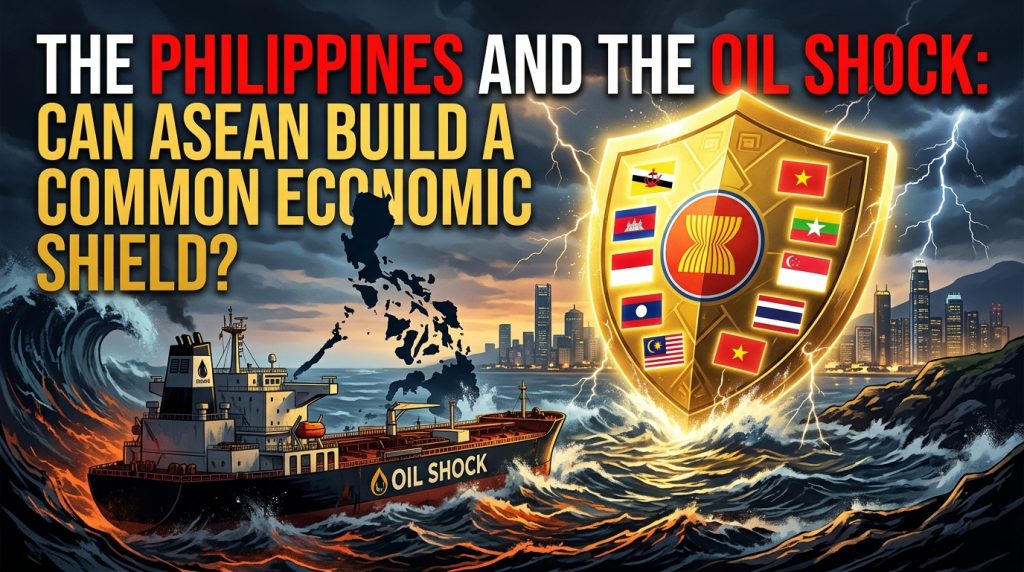
An ASEAN energy-security strategy can provide a common line of defense. The lasting protection, however, must come from a more productive Philippine economy—one that depends less on imported energy, earns more foreign exchange, creates better jobs, and ensures that the benefits of growth reach ordinary Filipinos.

