

BY ERMARD AYOC AND JOHN DABLO | DSSC Interns
FOR NEARLY five centuries, Our Lady of Guadalupe has inspired countless Catholic believers worldwide. Originating from the 1531 apparitions to Saint Juan Diego on Tepeyac Hill, this enduring devotion is marked by the miraculous image imprinted on his tilma (cactus-fiber cloak) after he gathered roses as instructed by the Virgin Mary.
In the 1990s, the International Pilgrim Virgin of Guadalupe Mission was created by Virgil Elizondo and lay collaborators to spread this message of faith, conversion, and hope across the globe. Supported strongly by Carl Anderson and the Knights of Columbus, the initiative allows millions of people who may never have the opportunity to visit the original shrine in Mexico to encounter the faithful image firsthand.
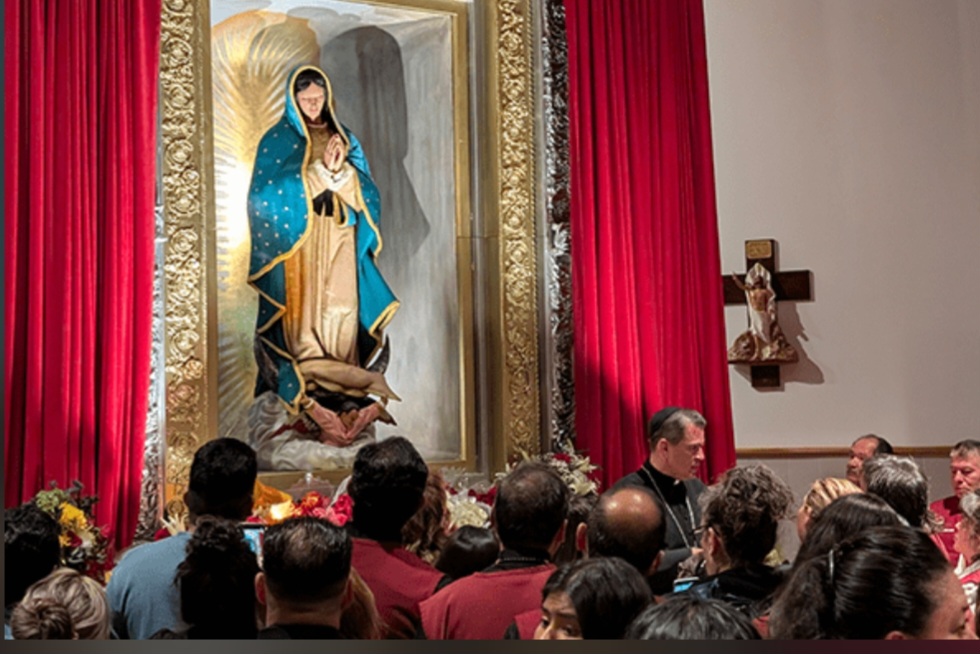
The International Pilgrim Image is a precisely crafted, life-size 3D reproduction that matches the exact size, colors, and details of the original miraculous tilma. While the original tilma remains safely enshrined in Mexico as a sacred relic, this highly accurate replica serves as a powerful focal point for spiritual activities, including Holy Masses, processions, rosaries, and Eucharistic Adoration.
The primary spiritual objective of this historic multi-stop tour is to bring the Blessed Virgin Mary’s message closer to her devotees and to prepare the faithful globally for the upcoming 500th anniversary of the apparitions in 2031.
According to Eduardo Pacana, president of the international pilgrim mission, the ultimate purpose of the visit is to enlighten the community and draw them closer to Jesus. Highlighting the spiritual core of the event, Pacana noted that the message of Guadalupe—“Am I not here, who am your mother?”—represents how, through her maternal intercession, the faithful are led closer to Christ.
The Philippines was selected as a host country for this prominent series of international visits. The tour officially commenced in Manila on June 13 and is currently winding its way through roughly 54 planned stops across the country, concluding in early December 2026.
A central highlight of the national pilgrimage is its arrival in the Davao Region, where the image will be hosted at the San Pedro Cathedral in Davao City from July 27 to July 29, 2026. Organizers expect massive local turnouts, estimating a seated capacity of around 1,800 faithful inside the cathedral, with an anticipated overflow of an additional 2,000 devotees.
To accommodate the influx of pilgrims, a comprehensive liturgical schedule has been established, featuring the laying of the tilma and anointing after every Holy Mass:
July 27 (Monday)
6:00 AM – Holy Mass
7:00 AM – Marian Procession
8:00 AM – Welcome Ceremony
9:00 AM – Welcome Holy Mass (Presided by Most Rev. Romulo G. Valles, D.D.)
12:00 NN – Holy Mass
3:00 PM – Holy Mass (Immaculate Conception Vicariate)
5:30 PM – Holy Mass
8:00 PM – Holy Mass (San Pablo Vicariate)
Public Veneration: Available from 9:00 AM to 3:00 PM, and extending through the evening until 11:00 PM.
July 28 (Tuesday)
6:00 AM – Holy Mass (Sta. Ana Vicariate)
9:00 AM – Holy Mass (Sto. Rosario Vicariate)
12:00 NN – Holy Mass (Sacred Heart Vicariate)
3:00 PM – Holy Mass (La Purisima Vicariate)
5:30 PM – Holy Mass (St. James Vicariate)
8:00 PM – Holy Mass (San Pedro Vicariate)
Public Veneration: Extending through the evening until 11:00 PM.
July 29 (Wednesday)
6:00 AM – Holy Mass
8:00 AM – Farewell Holy Mass
Following its stay in Davao City, the image will continue its journey to other vital regional stops, including Digos (Mary Mediatrix Cathedral), Tagum, Mati, and Zamboanga before concluding the nationwide tour on December 2–4, 2026.
Due to the life-size dimensions and physical structure of the 3D reproduction, the logistics of the tour are highly demanding. Assembling, disassembling, and transporting the image requires heavy manpower and significant time, taking an estimated three hours to set up or strike down at each location fully.
To ensure public safety and smooth execution, the Archdiocese of Davao, along with lay partner organizations like Acclaim, has mobilized dedicated field teams. Organizers have emphasized proactive briefings with local government units and law enforcement agencies to handle crowd control, manage traffic flow, and ensure the protection of both the sacred image and the thousands of pilgrims expected to attend.