

Along with many different fields and industries, AI is rapidly transforming classrooms worldwide. It raises an important question for schools: how can technology enhance education while keeping critical thinking, creativity, and human connection at the heart of learning?
For the University of Santo Tomas (UST), one of the country’s top universities with over four centuries of academic tradition, the answer lies in empowering teachers first.
By integrating Gemini for Education across its campus ecosystem, UST is modernizing how its faculty teaches and how its 46,000-strong student body learns across 22 degree-granting academic units.
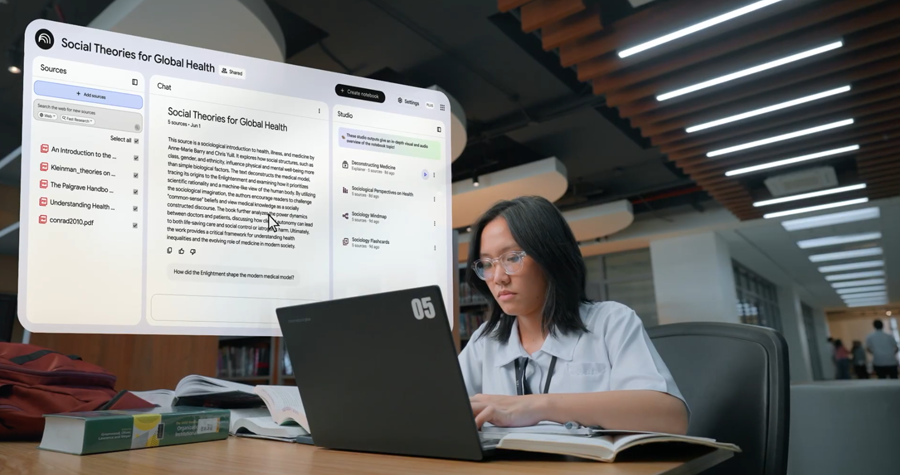
UST’s digital transformation with Google started with the adoption of Google Workspace for Education, but the leap forward came with the campus-wide rollout of generative AI tools like Gemini and Gemini Notebook.
Rather than viewing AI as a replacement for traditional teaching, UST approached it as an enhancement. Led by its Educational Technology Center (EdTech), the university trained over 2,000 faculty members to use AI purposefully in their specific disciplines.
To ensure smooth adoption, 45 e-learning specialists embedded across various colleges help tailor AI tools to local classroom needs, supported by more than 300 Google Certified Educators.
“At the Educational Technology Center, our mandate is to integrate technology tools for teaching, learning, research, and community service,” explained Asst. Prof. April Joy M. Gascon, Acting Director of the UST EdTech Center. “Each of our e-learning specialists brings their own stories and contexts on how technology best serves their specific discipline.”
To guide this transition safely, UST established clear guidelines for responsible AI use, ensuring technology supports—rather than compromises—academic integrity and ethical values.
Inside UST classrooms, AI is not a one-size-fits-all tool. Instead, educators use Gemini to make complex subjects clearer, visually engaging, and interactive.
For example, in nursing, the faculty generate realistic patient-care scenarios to help students practice emergency decision-making before entering real hospital settings. Meanwhile, in architecture, students and professors use AI visualization to turn architectural concepts into realistic renders reflecting vernacular Philippine design.
In engineering courses, teachers create dynamic visual representations of complex mathematical formulas to help visual learners grasp spatial coordinates easily. And in Theology classes, students use Gemini Notebook to synthesize dense historical and philosophical texts, saving hours of reading prep so classroom time can focus on rich, faculty-led discussions on ethics and human values.
“Ever since we started using Google AI, classroom dynamics have changed for the better because students can now demonstrate their learning in transformative ways,” said Shane Alexander Y. Laong, Team Leader for E-Learning Specialists at UST.
“When Gemini Notebook was integrated, it definitely lessened the workload for both teachers and students, allowing them to turn mountains of literature into flashcards, quizzes, and review materials that make learning more engaging.”
From lecturers to learning designers: more time for what matters
One of the greatest benefits of AI in education is time saved on repetitive administrative prep. By using Gemini to draft lesson plans, design rubrics, and generate visual guides, UST educators are stepping out from behind the podium and into mentor roles.
Instead of spending hours recreating slide decks each semester, faculty spend quality time conducting face-to-face mentorship, providing personalized feedback, and building meaningful connections with their students.
“I strongly encourage my fellow educators to set aside their fears of AI. Understand what it does, understand its impact on instruction, and redesign teaching to make it more purposeful and relevant for students,” said Prof. Cheryl R. Peralta, DrPH, UST Vice Rector for Academic Affairs.
“We aim to produce Thomasian graduates who are future-ready, competent, committed, and compassionate—empowered to use critical thinking, problem-solving, and AI ethically and responsibly.”
Watch this YouTube video for more information: https://www.youtube.com/watch?v=8y_wcf8XrmQ&t=1s