



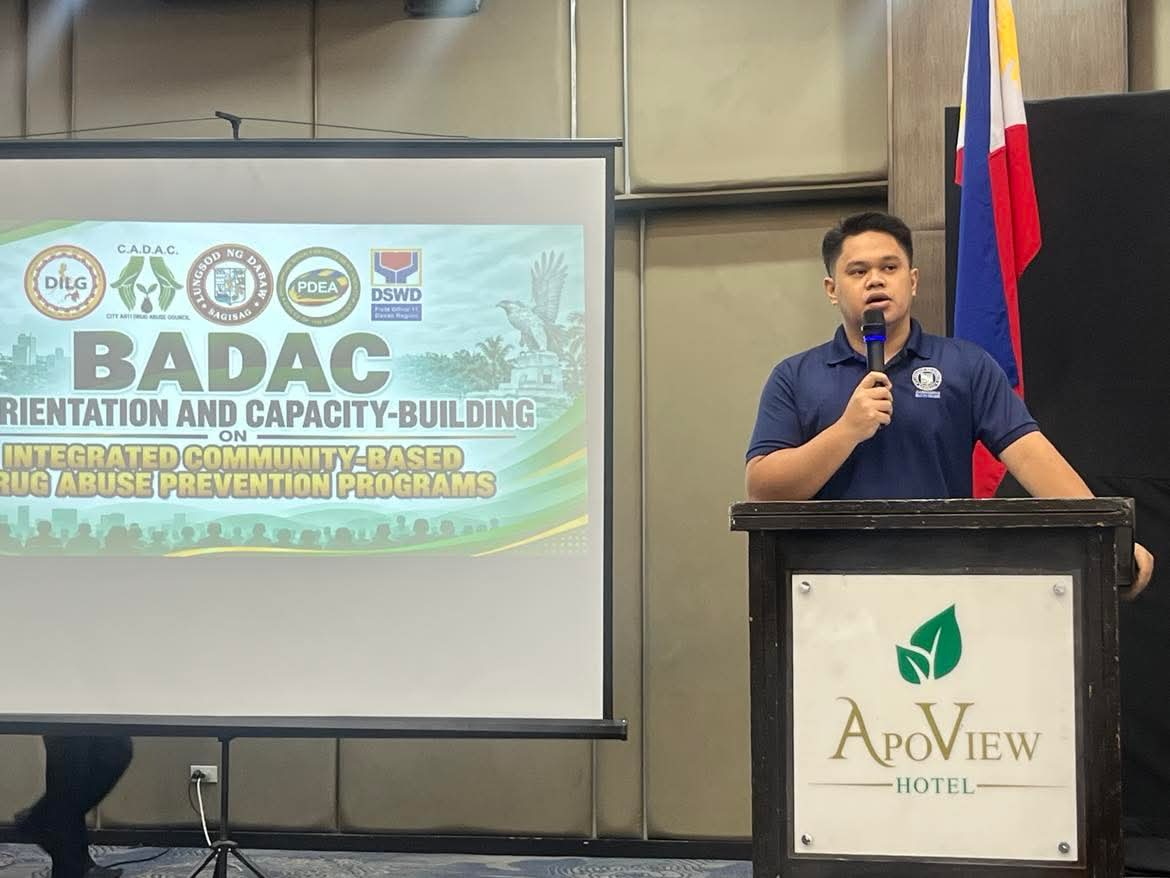
THE CITY Government of Davao has reinforced its anti-drug campaign by stressing grassroots implementation through a reorientation and capacity-building initiative on Wednesday, October 21.
Barangay functionaries from Bunawan, Tugbok, and Baguio districts of Davao City convened at Apo View Hotel for the Barangay Anti-Drug Abuse Council reorientation and capacity-building.
Mayor Sebastian Duterte, in a message delivered by Jaffar Marohomsalic, head of the City Anti-Drug Abuse Council (CADAC) said anti-drug campaigns remain “an important priority of the city government.”
“We continue to strengthen our collective efforts to foster drug-free communities by strengthening the implementation of anti-drug programs and advocacies through prevention and control of drug abuse, rehabilitation services, preventive education initiatives, and barangay empowerment,” Duterte said.
Participants underwent sessions covering critical operational frameworks, including BADAC assessment indicators, the Yakap Bayan program, legal advocacies against illegal drugs, and faith-based community rehabilitation models.
Jeff Anthony Vazquez, CADAC TARA NA community-based drug rehabilitation program representative, said synchronized efforts are vital to ensuring that the city’s holistic drug-clearing strategies directly reach constituents at the barangay level.
TARA NA, or Tabangan Atong Reformists Aron Naay Asenso (Help Reformists Towards Progress), is a community-based rehabilitation and aftercare program helping drug reformists recover, gain livelihood skills, and reintegrate into society.
At present, there are a total of 7,400 clients enrolled in TARA NA.
TARA NA is a holistic program intended for persons who use drugs (PWUD), which consists of GINHAWA, KKDK, and YAKAP Bayan.
GINHAWA stands for General Intervention on Health and Wellbeing Awareness, while KKDK stands for Katatagan, Kalusugan at Damayan ng Komunidad, which supports low- and moderate-risk substance users.
Vazquez said phase 1, consists of GINHAWA, which is eight modules for two months, and KKDK, which is four months. Meanwhile, the YAKAP Bayan will be 18 months for aftercare.
“Even though humana sila sa interventions, dili pa mahuman atong serbisyo, padayon ang monitoring and pagtabang sa ilaha,” Vazquez said.
He noted that recovery is a lifelong process, as addiction is a chronic, relapsing brain disease once the individual is not committed to and assisted with recovery.
Abdel-Hafidz L. Mansari, Department of Social Welfare and Development (DSWD) XI Yakap Bayan focal person, emphasized that the agency is ramping up efforts to institutionalize the Yakap Bayan Program for the social reintegration of recovering persons who use drugs (RPWODs).
Spearheaded by the Department of Social Welfare and Development (DSWD) as the lead implementing agency through local City Social Welfare and Development Offices (CSWDO), the program provides structured intervention modules spanning a maximum period of 18 months.
“The framework addresses a critical gap in post-treatment care by ensuring that individuals who have completed primary drug rehabilitation are not left behind,” Mansari said.
The program utilizes a multi-disciplinary approach centered on four core modules: personal self-management and self-reflection, family support systems, community integration, and livelihood development.
To ensure wide-scale compliance, technical assistance is rolled out to various LGUs across the region, including areas such as Baganga, Compostela, San Isidro, and Mabini.
He emphasized that barangay-level units serve as the crucial first touchpoint for returning clients to foster an environment free of discrimination and stigma.
