




THE PHILIPPINES has an opportunity to turn its maritime wealth into a stronger engine of development. As the country holds the ASEAN chairmanship in 2026, the challenge is not simply to generate more economic activity from the sea. It is to ensure that this activity creates better jobs, strengthens food security, raises incomes in coastal communities, and protects the marine ecosystems on which future prosperity depends.
The opportunity is substantial. The Philippine Statistics Authority reported on July 23, 2026, that the country’s ocean economy generated ₱1.08 trillion in economic value in 2025, equivalent to 3.8% of gross domestic product (GDP) at current prices. It supported 2.46 million jobs, or 5% of total national employment. The ocean economy grew by 5.3% in 2024.
These figures establish the sector’s economic importance. The larger question is whether the Philippines can generate greater value from its maritime resources while ensuring that the benefits reach ordinary Filipinos.
The sea is an economic asset, not merely a natural resource
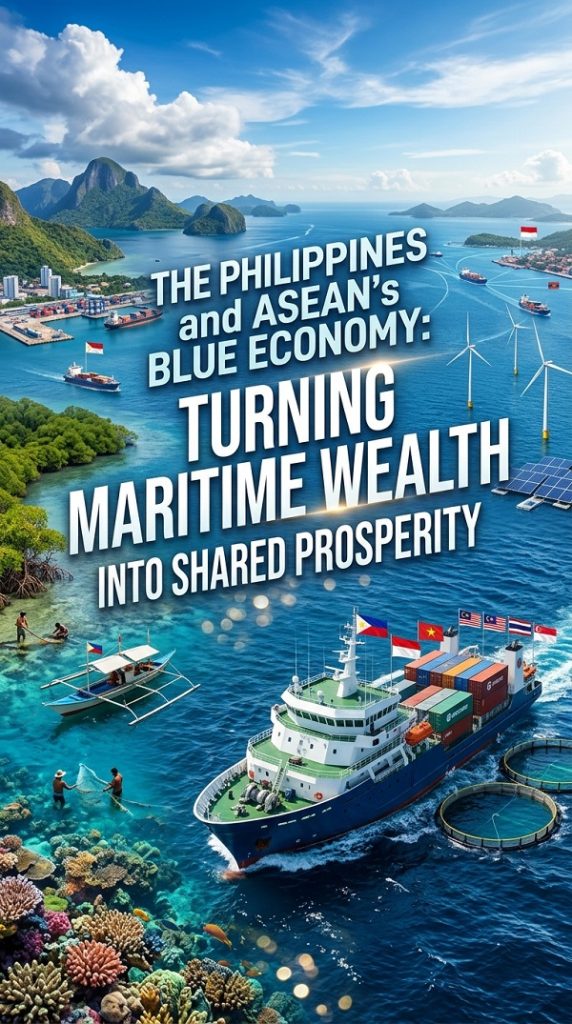
The blue economy encompasses much more than fishing. It includes sustainable fisheries and aquaculture, seafood processing, maritime transport, ports, shipbuilding and repair, coastal tourism, marine research, and offshore renewable energy. Its defining principle is that economic development must go hand in hand with responsible ocean management.
For an archipelagic nation, these activities can support food supplies, employment, domestic connectivity, exports, and regional trade. But abundant marine resources do not automatically translate into higher incomes. The challenge is to improve productivity, reduce waste, develop domestic processing capabilities, and enable small enterprises and coastal communities to capture a larger share of the value generated.
From fishing livelihoods to stronger food security
According to the Philippine Statistics Authority, ocean fishing accounted for 24.1% of the ocean economy’s value in 2025 and 37.8% of employment in ocean-based activities. This makes the productivity and welfare of fishing communities central to the blue economy’s development potential.
Affordable credit, modern landing facilities, ice-making equipment, cold storage, processing technology, and better transportation can reduce post-harvest losses and improve the prices received by producers. More efficient distribution can also help make nutritious seafood more affordable to consumers.
Sustainable aquaculture can complement wild fisheries, provided it is developed with appropriate safeguards for water quality, coastal habitats, and fish health. Science-based fishing limits and protection of breeding grounds are equally important. Higher catches today cannot come at the expense of future fish stocks and the livelihoods they support.
Food security must be considered from both sides: dependable incomes for producers and access to nutritious, affordable food for households. A more productive blue economy can help advance both objectives, but only if environmental sustainability and the distribution of economic benefits receive equal attention.
ASEAN’s blue economy: From regional vision to investment
The regional opportunity is gaining momentum. Manila hosted the Fourth ASEAN Blue Economy Forum on August 24–25, 2026, to help translate the ASEAN Blue Economy Implementation Plan 2026–2030 into action.
A further development followed on September 19, 2026, when the Asian Development Bank (ADB) announced its ASEAN Blue Economy Initiative, under which it aims to mobilize up to $6 billion through 2030. Announced at the 58th ASEAN Economic Ministers’ Meeting in Metro Manila, the initiative forms part of ADB’s wider commitment to mobilize $30 billion for ASEAN priorities by 2030.
The initiative focuses on three priorities: strengthening policy, institutions, and data; expanding investment in fisheries, aquaculture, coastal resilience, and port-linked value chains; and reducing marine pollution through circular-economy solutions and innovative financing that attracts private capital. It also recognizes that effective ocean protection requires better water and solid-waste management on land.
The regional stakes are considerable. According to ADB, Southeast Asia produces about one-fifth of the world’s fisheries and aquaculture output. Its ports, coastal logistics, and tourism also sustain trade, employment, and local incomes. Yet marine ecosystems are under pressure from pollution, excessive fishing, and climate-related damage.
For the Philippines, ASEAN cooperation offers opportunities to improve fisheries research, exchange marine data, develop sustainable seafood value chains, strengthen maritime skills, and expand access to regional markets. Shared standards and coordinated action can also help address illegal fishing and marine pollution that cross national boundaries.
However, regional commitments must produce tangible results. Their value should be judged by improvements in productivity, incomes, decent employment, food security, and marine health—not simply by the number of agreements signed or meetings held.
What ADB’s research tells us about financing the blue economy
ADB’s analytical work offers an important lesson: natural resources alone cannot create a productive blue economy. Businesses need financing, technical capabilities, market access, and institutions capable of managing resources sustainably.
On February 17, 2026, ADB’s Southeast Asia Development Solutions platform published Improving Ocean Health Can Drive Inclusive and Low-Carbon Growth in the Philippines. The article connects marine ecosystem protection with economic resilience, sustainable livelihoods, and inclusive development. It also explains the role of policy reform and investment in strengthening the country’s ocean-based economy.
An earlier ADB report, Financing the Blue Economy: Investments in Sustainable Blue Small–Medium Enterprises and Projects in Asia and the Pacific, published in June 2022, examines financing constraints facing small and medium-sized enterprises. It identifies limited access to capital as a significant obstacle to expanding sustainable ocean-based businesses and explores ways to connect local enterprises with public, private, and development finance.
The implications are particularly relevant to the Philippines. Large infrastructure investments and national policy reforms matter, but the blue economy also depends on smaller enterprises involved in fishing, aquaculture, seafood processing, tourism, recycling, and marine services.
These businesses need affordable and appropriately structured finance, technical assistance, improved technology, and support in meeting environmental and commercial standards. Without such support, the sector’s aggregate value may grow while smaller producers remain excluded from higher-value activities.
A concrete Philippine example: ADB’s $500 million program
The Philippines has already undertaken a major financing initiative in this area. On December 11, 2025, ADB announced approval of a $500 million policy-based loan for the Marine Ecosystems for Blue Economy Development Program (Subprogram 1).
France’s Agence Française de Développement and Germany’s KfW Development Bank provided additional cofinancing commitments of approximately $234.92 million each, bringing the total financing plan to about $969.84 million.
The program supports three interconnected areas: integrated and inclusive management of coastal and marine ecosystems; improved plastic and solid-waste management and circularity; and stronger planning, budgeting, and investment in natural capital. It is aligned with the Philippine Development Plan 2023–2028 and the country’s climate and adaptation objectives.
ADB’s project documentation identifies 120,000 fishers, operators, traders, and market vendors as intended beneficiaries of improved fisheries governance, infrastructure, and monitoring systems. It also identifies at least 10,000 waste-sector workers as intended beneficiaries of related actions.
The Philippine Department of Finance subsequently reported the signing of a €200 million financing agreement with KfW on March 17, 2026, under the same program. This should be understood as part of the existing financing framework, not as a separate blue economy project.
ADB’s project record shows that the first subprogram was fully disbursed by August 2026 and lists the operation as closed. This is a financing milestone, not evidence that all intended environmental and livelihood outcomes have been achieved. The project record does not list an independent evaluation.
Nevertheless, its design offers three important lessons.
First, environmental protection and economic development must be planned together. Healthy coastal ecosystems support fisheries, tourism, natural protection against storms, and community livelihoods. Treating conservation as separate from economic policy overlooks these economic connections.
Second, development finance can combine resources around shared objectives. ADB’s loan and the cofinancing commitments demonstrate how multilateral and bilateral development institutions can support a common policy agenda. But the quality of implementation, institutional coordination, and public accountability will determine the eventual development benefits.
Third, the transition must include workers and smaller businesses. Fisheries governance, waste management, local infrastructure, and sustainable livelihoods need to be addressed together. Policy reforms will have limited inclusive impact if coastal communities lack the skills, finance, and practical support needed to benefit.
The next task is to measure results: changes in household incomes, fisheries productivity, waste management, ecosystem health, and the resilience of coastal communities. Financing should be judged by the development outcomes it helps deliver, not merely by the amount disbursed.
Protecting the natural capital on which growth depends
The blue economy cannot succeed if its ecological foundations deteriorate. Overfishing, plastic pollution, untreated wastewater, habitat destruction, and climate-related damage threaten biodiversity and economic livelihoods alike.
Mangroves, coral reefs, and other coastal ecosystems provide essential habitats and natural protection against storms and erosion. Their degradation can reduce fisheries productivity, damage tourism, and increase the exposure of coastal communities to disasters.
The Philippines therefore needs better waste collection and wastewater treatment, stronger enforcement of environmental regulations, protection and restoration of critical habitats, and investment in climate-resilient ports and coastal infrastructure. Because much marine pollution originates on land, local government capacity and community participation are indispensable.
ASEAN cooperation can support shared research, practical standards, knowledge exchange, and financing for solutions that benefit several countries. But regional action must complement effective implementation at home.
Turning maritime wealth into inclusive growth
The ultimate test of the blue economy is not simply the value of marine resources or the growth of ocean-related GDP. It is whether the benefits reach ordinary Filipinos.
The Philippines needs a coordinated strategy that combines better infrastructure for fishing communities, affordable finance for small enterprises, sustainable fisheries management, stronger maritime education, investment in processing and logistics, and transparent monitoring of environmental outcomes.
As ASEAN chair, the country has an opportunity to help move the regional blue economy agenda from broad commitments to practical cooperation and investable projects. This means connecting finance with clear policy objectives, measurable results, capable institutions, and meaningful participation by coastal communities, women, and young people.
Success should be measured through decent employment, household incomes, seafood affordability, domestic value addition, private investment, and the condition of marine ecosystems—not GDP alone.
The Philippines does not need to choose between economic growth and ocean protection. It needs to make the two mutually reinforcing.
The real promise of the blue economy is not simply to extract more wealth from the sea. It is to build a maritime economy that creates better livelihoods, makes nutritious food more accessible, generates higher-value jobs, and preserves the natural capital on which future generations will depend. If ASEAN cooperation and development finance can turn that promise into measurable gains for Filipino households and coastal communities, the blue economy can become a powerful instrument of inclusive and sustainable development.
