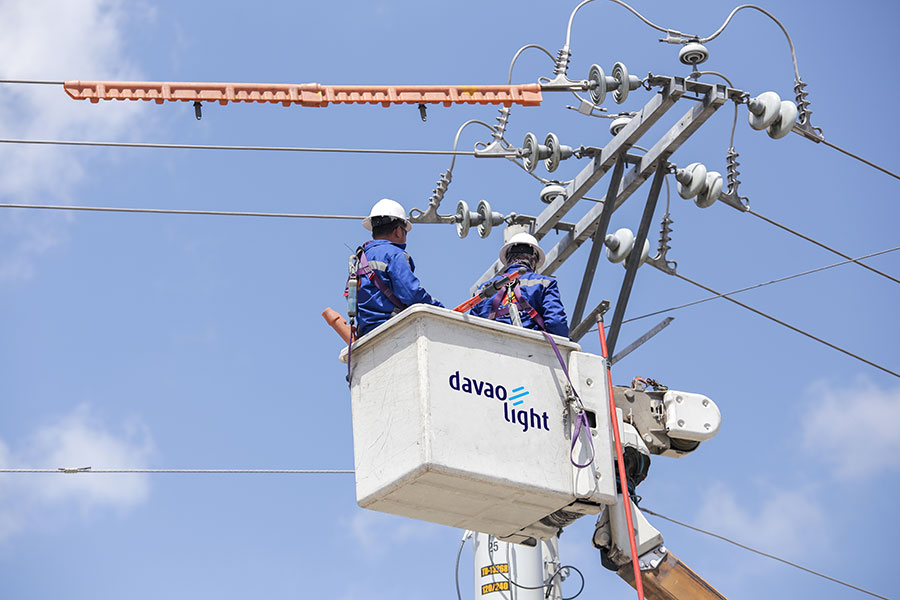

DAVAO Light and Power Co., Inc. (Davao Light) will conduct switching power interruptions on Monday, Dec. 8, 2025, in the Municipality of Sto. Tomas, Davao del Norte. These are necessary to facilitate the line-clearing activity along the Marsman footbridge and the line-upgrading works of the Kapalong line.
The first power interruption will be for 8 hours from 7 a.m. to 3 p.m., affecting customers from Marsman going to New Katipunan, including the entire Sto. Tomas Poblacion area.
The second interruption will be for 10 hours from 7 a.m. to 5 p.m., affecting customers from New Katipunan going to Luna Kapalong.
Meanwhile, the normalization or return of loads to their normal setup will be conducted for 45 minutes anytime between 4 p.m. to 5 p.m. Specifically affected are those from Sto. Tomas Fire Station to New Katipunan.
Davao Light apologizes for the inconvenience caused by these scheduled power interruptions. But it will exert all efforts to restore electric service as scheduled or earlier. However, there may be instances where restoration may extend beyond the schedule due to unavoidable circumstances.
Safety is paramount to the company, and Davao Light reminds the public to always take extra precautions when passing by activity areas where line repairs and maintenance are being done. Please heed and follow warning signs, especially in areas where personnel operate heavy equipment.
Please contact our 24/7 Customer Contact Service at (082) 229 3572 or 0919 056 3572 for any power interruption that will fall outside the given schedule.
davao light
In the Dark: Samal’s small businesses struggle under the weight of power woes
ISLAND GARDEN CITY OF SAMAL, Davao del Norte — On this island famous for its white sands and laid-back charm, the hum of daily life is often interrupted by silence—the kind that comes when the power cuts off without warning. For visitors, these power interruptions might seem a slight inconvenience but for small business owners, they have become a regular battle for survival.

What to do with melted ice cream?
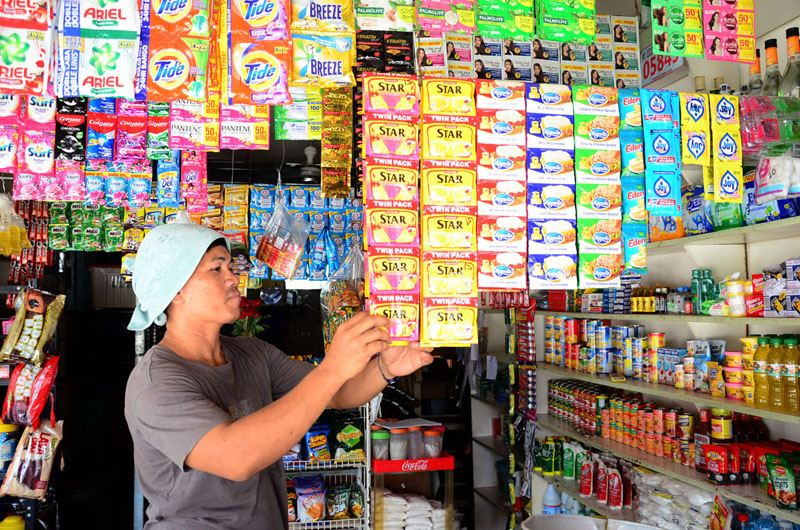
Banggat Randie, 40, a helper at a sari-sari store in Barangay Villarica in Babak District, just a few minutes from the ferry wharf, said that every power interruption is a gamble, particularly for their ice cream products.
“Mag melt ang ice cream kung dugay mubalik ang kuryente pero wala ta mahimo (The ice cream will melt if power won’t return quickly, but we can’t do anything),” he said, with a shrug. He said that it’s not just ice cream but also frozen food that tends to spoil when the electricity cuts off without warning.
However, it’s not just the uncertainty. He also shared the high per kilowatt hour rates they have to pay to the utility provider. For instance, in October 2025, the sari-sari store was billed P14,000 for its energy cost, while his own household bill reached P1,500. For a family of four, that meant sacrifices — no television, fewer comforts, and constant worry about how to stretch their earnings.
“We don’t even use our TV anymore to save money. My wife and I only earn so much,” he explained.
He recounted that around three years ago, his children had to study by candlelight or move from house to house during rotational brownouts. “Thankfully, their grades did not suffer,” he said, though the memory lingers—the warm nights, the flickering candles, and the frantic calls of whose house was lucky enough to have power.
While outages happen only once or twice a week and only for about 15 minutes, Randie said that luxury is contained in Barangay Villarica, which is considered the business center of the island. For remote barangays, brownouts still extend to hours and residents have no choice but live with it.
At this point, Randie admits he is ready for change. He said that he took out a P50,000 loan because the cost of applying for an electrical connection was too steep. However, he happily shared that he already settled that debt.
“If Davao Light will take over, I think most of us will transfer. I will even apply for another loan if necessary because the rates are cheaper, and I think even the installation fee is more affordable,” he said.

The hotel where guests slept in heat
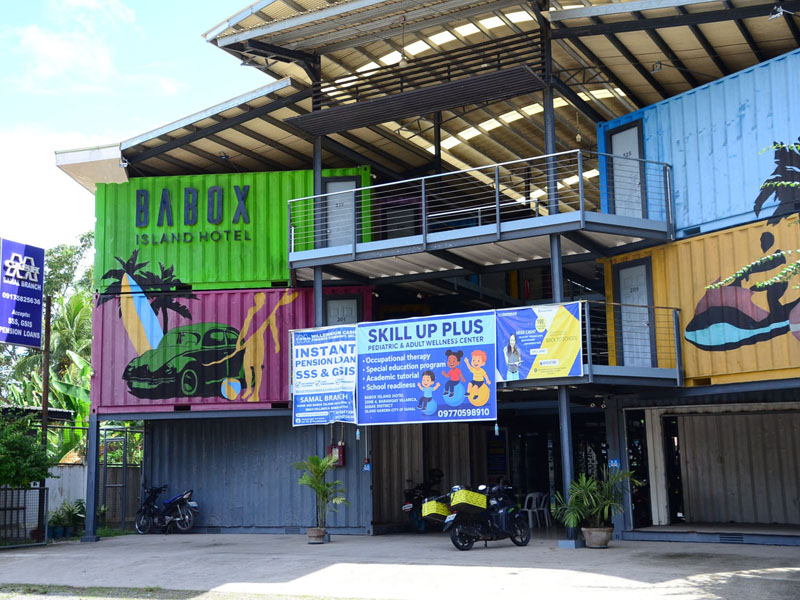
At Babox Island Hotel, cashier Shiela Gantalao remembers nights when guests fanned themselves in the dark, waiting for the generator to sputter back to life. Their machine could only power 10 air conditioners out of 32 rooms, leaving families restless and frustrated.
“During the peak of the brownouts, we had four or five zero occupancies in a month,” she recalled.
The hotel was teetering on the edge since expenses piled up as they had to purchase 10 gallons of diesel per month to keep the generator running, and the rooms remained unoccupied. In addition, broken appliances added to the losses. To her recollection, they had more than five air-conditioners that broke due to the fluctuating electricity.
Even now, the hotel is weighed by the aftermath of those two-three-hour power outages. They still receive inquiries from guests asking if Samal still experiences prolonged brownouts.
“They always ask us if we still have brownouts, and, of course, we couldn’t lie to them,” she said. The answer often discouraged bookings, leaving rooms empty and staff anxious. At the time of the interview, they only had one occupied room. Yet in October 2025, the hotel racked up P20,000 in electricity bills.

Even her own family felt the strain. She recalls nights when her four-year-old child had to sleep under the sweltering heat, cooled only by a handheld fan. “Usually, maabtan ka kadlawon so mabuntagan ka pinaypay sa imong anak (You’ll be up until dawn fanning your child to sleep),” she said.
For her, the hope lies in stability. “We are happy to hear about Davao Light coming in because we only heard good things about how they are providing service to Davao City,” she said.
The car wash that stopped mid-queue
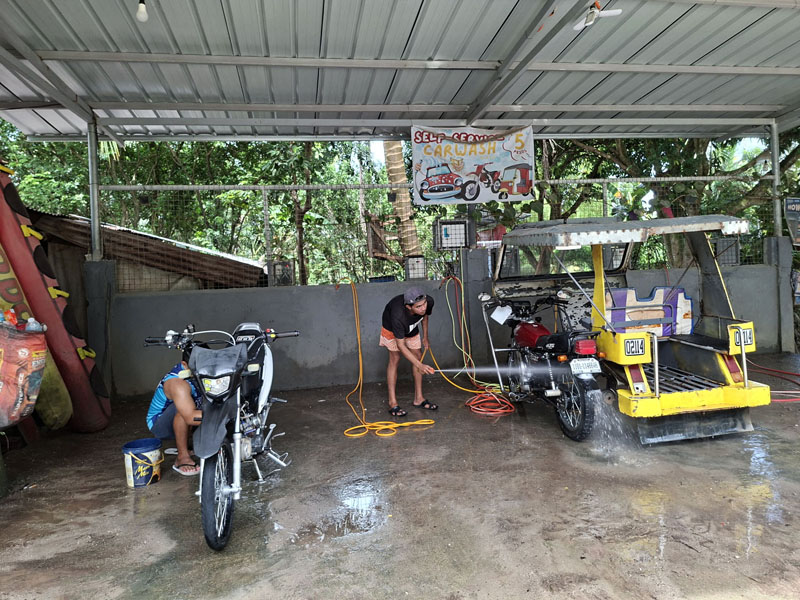
The sound of rushing water is the heartbeat of a self-service car wash in Barangay Miranda, about 15 kilometers from the ferry wharf. Customers pay ₱5 for six minutes of water, but when the power cuts, machines stop, queues grow longer, and income vanishes. “Wala mi income kung mag brownout since our water relies on electricity to run,” said 17-year-old James Aredidon, a student who also works as a watcher of the car wash shop.
He estimates that each nozzle serves about 10 customers per hour. Multiply that by nozzles, and the losses quickly add up during a three-hour brownout. Yet the numbers don’t capture the frustration of motorists waiting in line, coins in hand, staring at machines that won’t run.

The owner also had some hard decisions to make due to the high cost of energy rates. For instance, bills once averaged ₱5,000 to ₱7,000 monthly, until the owner cut operating hours to reduce costs. Now, the car wash opens only from 5 AM to 7 PM, a far cry from its previous 24-hour service.
“I think that the electricity situation is better now compared to before when I remembered three-hour outages. But we hope the service improves, especially since we don’t receive any notices prior to the brownout,” James said.
Waiting for change
Across Samal, these stories echo the same frustrations: spoiled goods, broken appliances, lost customers, and lost income. But beyond the financial losses lies the human cost. Families endured sleepless nights in sweltering heat. Children struggle to study under dim light, and workers lose hours of productivity, waiting for power to return. The island’s beauty hides a harsher reality. For those who live and work in Samal Island, electricity is not just a utility; it is the backbone of survival. Without it, businesses falter, households suffer, and dreams are put on hold.
AS FAR as we can recall, the reason why our congressmen in Davao City’s three districts are pushing for the street lighting project is to save on cost in electric bills from the local power distributor.
Yes, while the city does not spend a single centavo on the acquisition and installation of the sodium street lights (labor and maintenance included), these are among the biggest contributors to the city’s monthly power bill.
With the present number of streetlights installed by Davao Light, plus the thousands of solar-powered bulbs lining the city’s roads at roughly 20 to 30 meters distance in between, Davao is indeed one of, if not the most, massively lighted cities these days.
But what happened to the original intention in shifting to solar street lights, which is to reduce the electricity bill of the local government?
We are asking this question because we have observed during our many trips to downtown Davao at night, the sodium lamps installed by the power firm are still very much around and still lighting.
Clearly, the city’s power bill remains at the level before the solar-powered lamps were put up in all of Davao City.
Meaning, other than adding to the city’s beauty during nighttime, the local government is still saddled with the gargantuan financial requirement for paying the monthly electricity bill.
Of course, with the huge income that the city government is getting from its people and juridical entities, the amount needed to settle its monthly power payable may only be a pittance.
***********************************
Yesterday, toward noon, we again used the route Catalunan Grande-Tacunan-Biao Matina in going home to our rural residence from the city proper.
Every time we do, we cannot help but take a look at a concrete bridge spanning the small creek dividing Catalunan Grande and Tacunan. As we have written many times in the past columns of ours, the bridge itself has long been completed, except that the approach at the Tacunan end of the span has not been put up.
On the other hand, the approach at the Catalunan end of the roughly 15-meter-long bridge was completed almost at the same time as the connector itself. The only problem is that, for still unknown reasons, the approach has not yet been connected to the main road.
But there was one thing we saw on the bridge yesterday. Its metal railings are already destroyed and detached from the concrete component. We would not be surprised if, anytime soon, the metal railings will suddenly go missing. These items are very attractive to scrap metal buyers.
Perhaps that particular bridge project deserves to be given the attention of the investigators of the Independent Commission for Infrastructures (ICI). It may not be a total ghost project, but certainly an unfinished one that could have already been reported as completed some years back and already fully paid. Maybe it is also imperative that the investigators from the ICI and the Davaoeno public know the contractor of that particular infrastructure.
That bridge may not cost much, but it’s certainly worth several million of taxpayers’ money.
Will anyone from the local office of the DPWH in the city, or the City Engineer’s Office come forward and explain the bridge project’s present status?
And, cannot anyone among our councilors, especially the chair of the Council’s Infrastructure Committee, pay a visit to the said project and find out if its present condition is not worth a Council investigation?
***********************
For local governments that have experienced getting hit by various natural disasters like floods, constructing a somewhat permanent evacuation facility is worth every citizen’s appreciation.
But it is only in our City that we saw an evacuation structure that doubles up as a public market. We have no doubt that the facility, a four-level imposing building, can accommodate a good number of families, hundreds of market stalls, and hundreds, even thousands, of market goers on any day.
But what will the agglomeration of evacuees and market vendors, and market goers make of the situation when the magnitude of the calamity requires the evacuation of a huge number of families?
Will it not possibly create another form of disaster that could endanger the health of both the evacuees and the market vendors and goers because of congestion?
We cannot really help but ask the questions because this is the only project of this nature that we have seen and heard about.
And of all places, only in Davao City.
AT THE outset, we beg for the indulgence of our readers for this column’s failure to come out in yesterday’s online edition of this paper.
While we were halfway to finishing our write-up, the screen of our monitor went dark. When we took a look at our study room and the sala, there was not a single electric bulb lighting. The sound of the ice crusher in our little cold snack center went silent. Then we were told by our son that a power outage had just started.
We were hoping that the power interruption would be only for a shorter period than we normally experienced in the past. The outage started at 1:36 p.m. In the back of our mind, we still entertained the thought that if electricity would be back by, say 2 or 2:30 p.m., we still could catch up with the deadline of submission set by our editorial office for columns.
Then 2 o’clock p.m. came, 2:30, 3:00 o’clock, 4 p.m. The power still did not come back. We were already apprehensive that we were about to miss another issue for our column. And yes, 6 o’clock came, then 7 p.m.
Adding to our misfortune is that, in our place, while we have mobile phones, there is also no signal. We have a landline courtesy of PLDT. But we could not make a call since the landline plan we have is Internet-dependent. Meaning, when the Internet is off, we cannot make any contact. Adding to this is the fact that the Internet is also power-dependent. That was why when the power went off the other day for nearly six long hours, a large chunk of our available means of communication was cut off in the house.
Worst, our landline has not been functioning for weeks already, and PLDT seems unmindful of our request despite our up-to-date bill payments.
The electric outage incident – no thanks to a broken power line, according to Davao Light – actually gave us triple whammies.
First, we were unable to complete writing our column and failed to send the same to this paper. Second, we saw the death of three of our Koi freshwater fish that we have nurtured for over ten years already, and estimated to weigh over one kilo each. And third, the little cold snack center we have beside our house missed meeting an order of 70 glasses of “halo-halo” by a nearby barangay that was celebrating the culmination program of the Nutrition Month. Well, that was one experience we hope will not happen again.
By the way, whatever happened to that much-ballyhooed system that the power firm claims to have set up in its main substation that will reflect the location of a fault in any of its distribution lines and the areas covered? Gone with the wind? Or, set aside for a more sophisticated power distribution improvement?
**********************************
Several rabidly pro-Duterte Senators, all Duterte congressmen, and several other lawmakers, and of course Vice President Sara Duterte did not attend the 4th State of the Nation Address (SONA) of President Ferdinand R. Marcos, Jr.
Well, we strongly believe that they did the right thing. After all, why would they bother attending and hearing what the President will report? They do not believe in all that he said. The non-attending lawmakers have their own idea of their own state of the nation.
Of course, we know that they lost one good opportunity to find a basis in disproving the President and making their “true state of the nation” even more credible.
Or, would they rather continue lambasting the administration of President Marcos Jr., with their own bias and politics-dictated observations of the things happening in the country?
**********************************
It is our take that the President should better take out from his close circle of appointed advisers men who are giving him more problems or causing the push down of his administration.
One such guy is Presidential Adviser Larry Gadon. He is the one who doesn’t seem to know how to hold his tongue in chastising those who are on the other side of the political fence, or rulings even by the courts that seem to favor the nemesis of the Marcos administration.
The latest of Gadon’s vile language is his calling the Supreme Court “Tuta ni Duterte.” It was his comment on the ruling of the Highest Court of the land, virtually stopping the impeachment trial of VP Sara for the House’s violation of the one-year bar in filing of impeachment cases.
If indeed the SC is “tuta ni Duterte,” is Gadon, and the administration for that matter, admitting that the former President still wields a huge influence that can sway the Justices? Then, it is the reason why the administration’s attack dogs are doing everything to diminish the Duterte mystique if its supported candidates in the 2028 polls are to survive.
**********************************
This imbroglio generated by the Supreme Court ruling on the VP’s petition to stop her impeachment trial has added one important stock knowledge in our mind. And ironically, this came from a lawyer who questions the High Court’s resolution – one Atty. Jesus Falcis, when he was interviewed by broadcast journalist Christian Esguerra.
The 2-word term he used to describe the ruling? It is a “Judicial legislation.”
IF THIS post on social media is true, that the International Criminal Court (ICC) in The Hague, Netherlands, only allows former President Rodrigo R. Duterte’s former wife, Elizabeth Zimmerman, to stay and take care of his personal, then this situation is slowly giving truth to the saying that “Gaano man kahaba ang prosesyon sa simbahan pa rin ang balik nito.”
“No matter how long the procession is, it always leads back to the Church.”
A FILIPINO PROVERB
In English, “No matter how long the procession is, it always leads back to the Church.” Somehow, the post validated stories on social media about the former President telling his women to start looking for other men with credit cards.
Yes, FPRRD’s “other women” who went to The Hague reportedly to visit the detained former Chief Executive were refused their request to personally see their man. In other words, if they were denied a personal visit, then they have no way of taking care of the personal needs of FPRRD.
It was also posted on the same platform that the children of FPRRD, with his former wife as well as his grandchildren with them, are extremely happy with the said development.
It’s hardly surprising. After the break-up of their parents and the pain that goes with the estrangement, they could now look forward to becoming a family again. Hopefully back in one house and in Davao City, Philippines.
Of course, it comes with a huge price to pay. That is, the incarceration of the former President in a land so far away that it will take a fortune for members of his family to visit too often.
***********************************
This paper’s online edition yesterday had for its banner headline a run executed by some 5,500 runners. The run was dubbed “Run for FPRRD.” No, the participants in the activity were not running away from the former President. Neither did they run to meet him at the Bangoy International Airport, not yet.
They run to show their support for the former President and their solid intention to deliver a strong message to the ICC about how the former President is loved by his fellow Davaoeños. Thus, if only to manifest their strong desire to have the ICC allow the former President’s interim release, they have to run even on the first working day of the week.
Will the run by a mass of 5,500 people persuade the ICC judges to grant the petition of the former President for an interim release through his lawyer? We can only hope. However, such a manifestation is a steep climb. We Filipinos must admit that the judges in that international court are all non-Filipinos. Therefore, they have traits totally different from ours.
It is even possible that they have their own way of interpreting the laws that govern the litigation of crimes referred to the ICC judges for resolution.
We can only wish that they be given the wisdom to interpret the laws they are supposed to refer to as a guide in resolving cases brought into their laps for resolution.
********************************
The Department of Education-Davao City Division, in coordination with the city government, is contemplating constructing more buildings in various campuses to address the lack of classrooms. We are just wondering if the city school authorities have realized that the campuses of public schools, especially those in the city’s downtown areas and its peripheries, are already congested with buildings to the maximum.
Yes, we had been to several schools in the city proper during our time as head of the Corporate Social Responsibility (CSR) Department of Davao Light. We noted that buildings were erected because the increase in the number of students was also spiraling. The result? Well, many campuses in the city proper and in the peripheries are getting so crowded that hardly a vacant space is left for the students to have some extra ground to get fresh air or loiter to relax.
Now, the students in public schools, both elementary and high school, converge in these campuses. Though they may already be accommodated by the additional classrooms constructed and the shifting scheme, the school campuses concerned are already too crowded. The huge number of students inside the school campus becomes like sardines packed in every available space.
Why will not the DepEd and the local government explore the possibility of establishing additional school campuses where new edifices can be built? This will definitely address the classroom lack. It will also solve the congestion of students in existing campuses.
Of course, the availability of vacant city government or national lands may be a problem. But as the common saying goes, problems have solutions. And like miracles, solutions are always there. It is only the will to explore it that is needed in order to have it.