

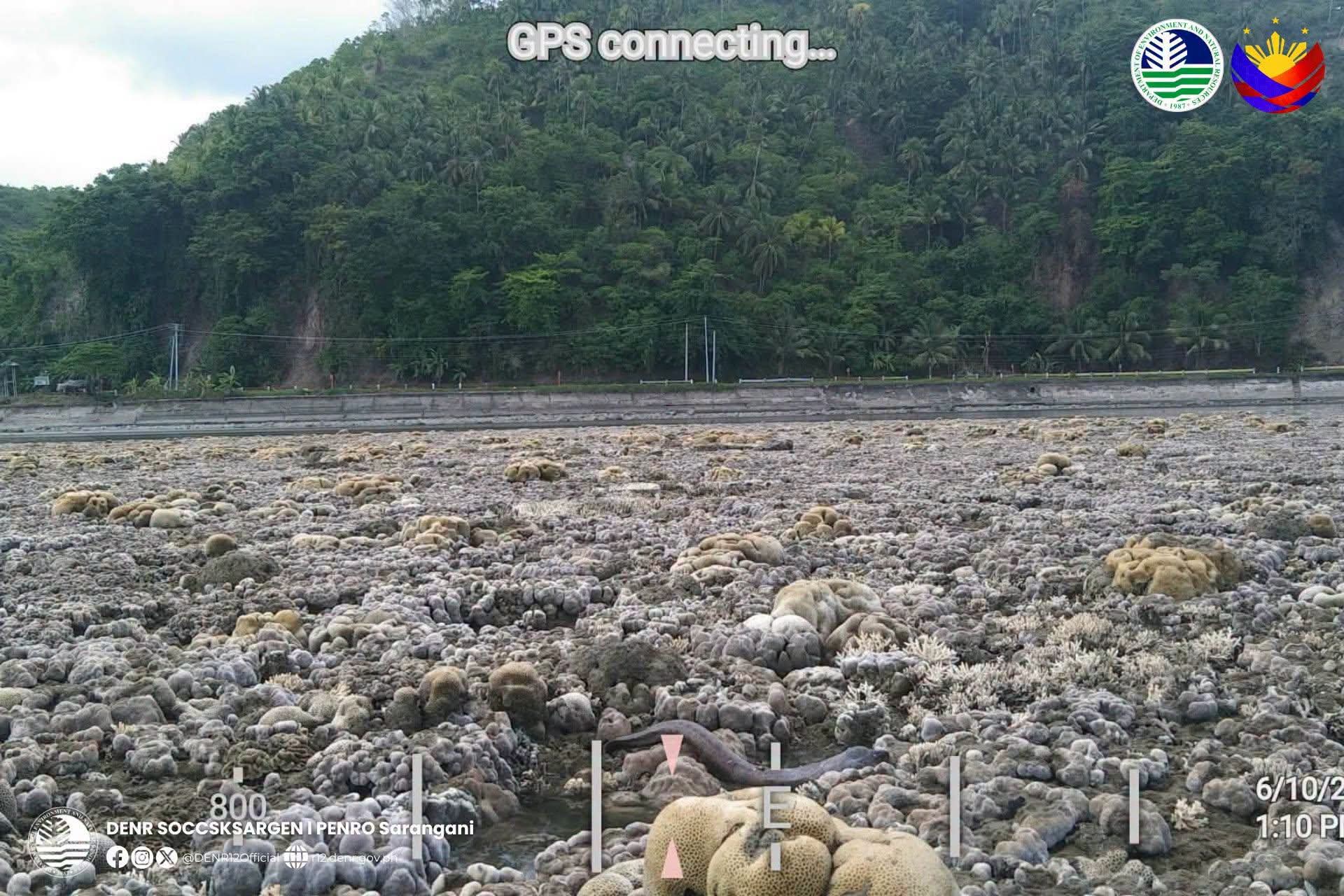
PHIVOLCS issued a warning to local government units to completely prohibit any residential, commercial, or tourism developments on the massive coastal uplifts exposed by the June 8 earthquake.
Edward Lousie Orquillas of PHIVOLCS Mindanao Cluster Monitoring for Earthquake and Tsunami said that despite the sudden emergence of new land, the ground is highly dangerous and structurally non-viable.
“Our findings show that the coastal uplift consists of corals. It is not applicable even for housing because it can easily be hit or damaged by future earthquake events or storm surges,” Orquillas said during the National Disaster Resilience Month Caravan here last July 3.
“Because the corals are so soft, any structure placed there will become unbalanced,” he stressed.
The seismic shift resulted in shorelines receding by as much as 200 meters in parts of Jose Abad Santos in Davao Occidental and Sarangani province, permanently exposing extensive stretches of coral reefs and seagrasses.
Field investigations revealed that the uplifted land is primarily composed of loose, soft coral formations that cannot support heavy structural foundations, due to the land being forced up abruptly.
“It is not applicable to put up a structure or transform it into a resort, because it is not naturally safe,” he said.
He noted that the land generation was due to a powerful earthquake and not accumulation through natural formation throughout the years.
Local governments of the affected areas are directed to immediately classify these newly exposed areas as strict environmental enclosures or protected scientific zones.
Orquillas emphasize that while the areas are invaluable for marine research and studying seismic history, they must remain entirely off-limits to land or structural use.