



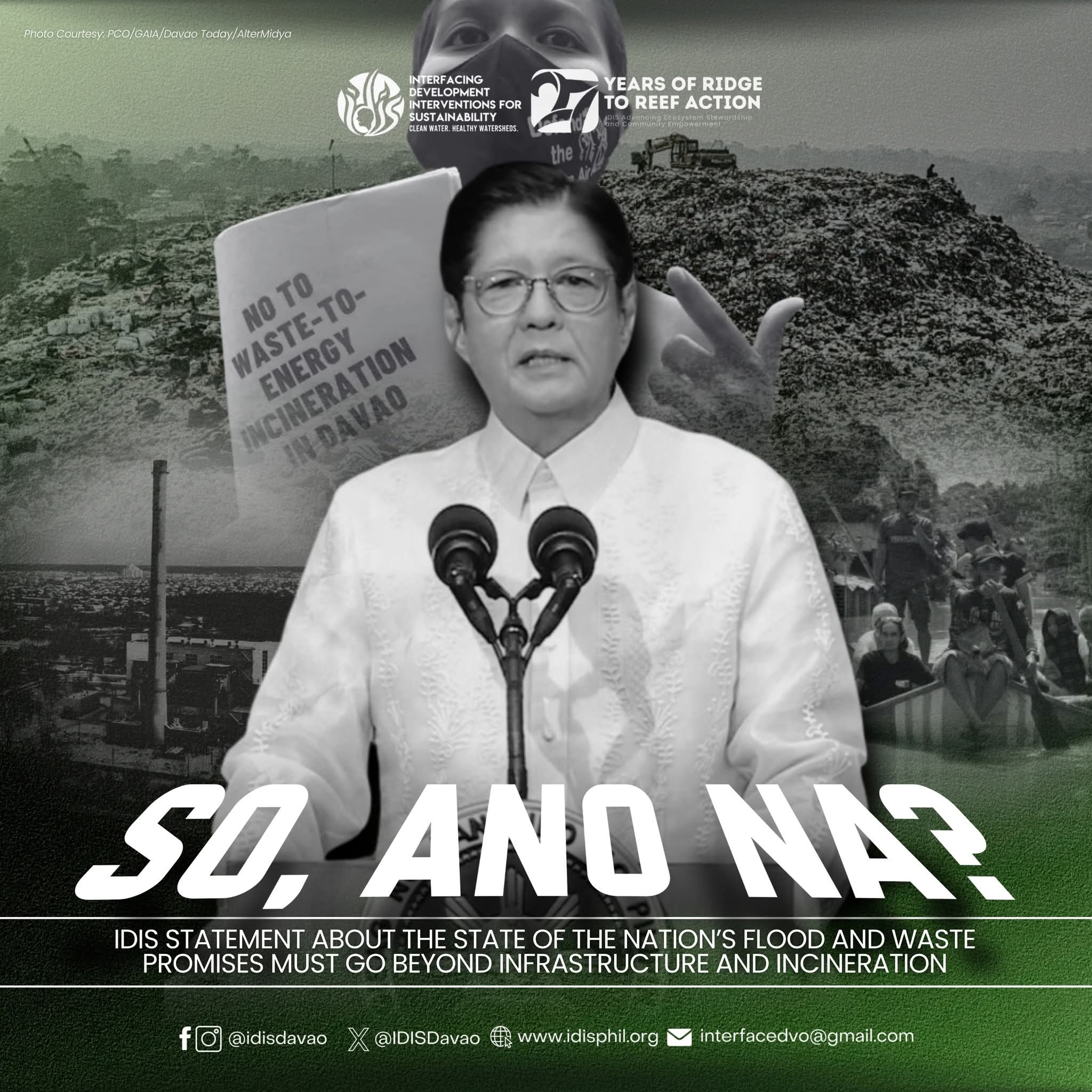
ENVIRONMENTAL group Interfacing Development Interventions for Sustainability (IDIS) said the national government’s acknowledgment of corruption in flood-control projects and worsening flood and waste problems in the 2026 State of the Nation Address (SONA) must be followed by concrete reforms that address root causes, not just symptoms.
“Resilience cannot be built through concrete alone, and the waste crisis cannot be solved by burning waste,” the group said, calling on the government to pursue a whole-of-government, ecosystem-based approach connecting good governance with environmental protection,” IDIS said in a press statement issued July 27.
The group emphasized the administration’s response to flooding should not be limited to building more flood-control infrastructure or clearing waterways clogged with waste, but should address the root cause.
IDIS stressed that flooding stems from degraded watersheds, the loss of natural waterways and drainage systems, inappropriate land-use decisions, and poor urban planning.
“Flood control must be grounded in science, transparency, and ecological protection. The government must ensure infrastructure projects must be necessary, properly designed, appropriately priced, and responsive to actual hydrological and environmental conditions,” IDIS executive director Atty. Mark Peñalver said.
He added that natural systems such as forests, watersheds, rivers, and wetlands must be recognized as critical infrastructure protecting communities from flooding and other climate-related hazards.
While the group welcomed calls to revisit the country’s waste management framework, it said any reform of the Ecological Solid Waste Management Act must strengthen the principles of waste prevention, reduction, reuse, segregation, recycling, composting, and producer responsibility.
President Ferdinand R. Marcos Jr. on Monday in his fifth SONA, called for an overhaul of the country’s 25-year-old solid waste management law.Marcos urged Congress to update the law to support modern waste management technologies considering waste disposal remains a major concern that requires policy changes.
He mentioned one systemic intervention is to update the 25-year-old Ecological Solid Waste Management Act, aligning it with modern waste management practices, such as waste-to-energy and waste treatment technology.”
IDIS reiterated its opposition to waste-to-energy incineration as a solution to the country’s waste crisis, saying such projects do not address the root causes of waste generation and instead risk sustaining demand for large volumes of waste.
Waste incineration, the group stressed, is undermining reduction, segregation, recycling, composting, and circular economy initiatives. It also cited concerns over air emissions, toxic ash, resource waste, and long-term environmental and public health impacts.
“The country needs policies that prevent waste generation, ensure segregation at source, strengthen materials recovery facilities, support recycling and composting, and hold producers accountable for the full life cycle of the products and packaging they place in the market,” IDIS said.
It added that any reform must not allow incineration to become “a shortcut for addressing weak waste governance.”
On disaster resilience, IDIS said stronger early-warning systems, preparedness and resilient infrastructure are important but stressed that action must begin before disasters occur.
“Genuine resilience must begin before disasters occur. Protecting watersheds, forests, rivers, wetlands, and coastal ecosystems,” it said.
Meanwhile, the group also raised concerns over large-scale development projects it said could create new pressures on the country’s land, water, energy, and ecological systems, citing the proposed Pax Silica industrial hub as an example.
While the project has been presented as an opportunity

