




THE INDIAN prime minister’s visit offers the Philippines an opportunity to build a far more ambitious partnership with India—one that extends from maritime security to trade, investment, manufacturing, technology, and human development, while giving new momentum to India-ASEAN cooperation.
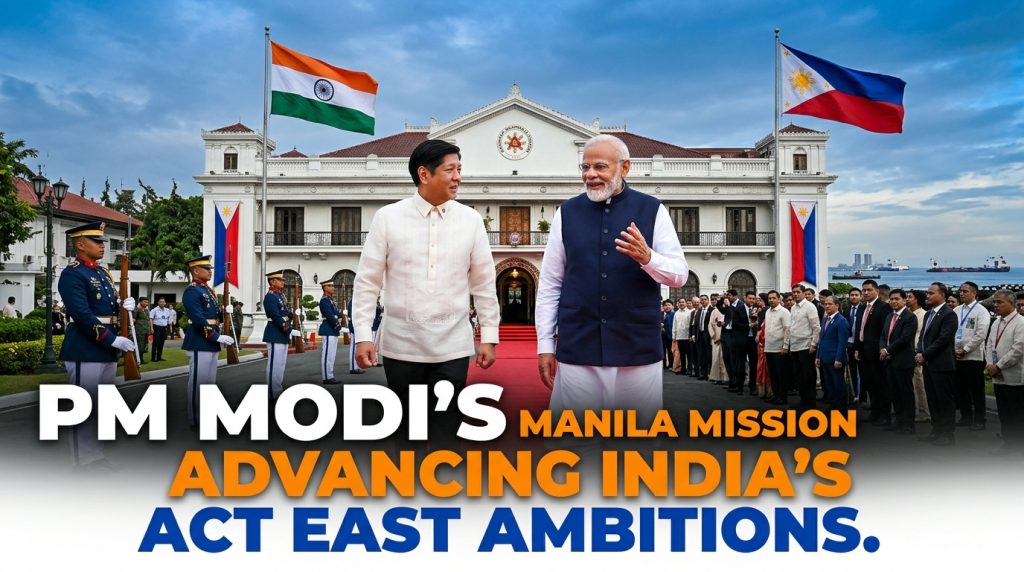
Prime Minister Narendra Modi’s forthcoming visit to Manila for the 49th ASEAN Summit and Related Summits comes at a particularly important juncture in India’s engagement with Southeast Asia and the evolving relationship between India and the Philippines. The visit is significant not merely because it brings together two leaders whose countries have growing strategic interests in the Indo-Pacific, but because it offers an opportunity to translate diplomatic goodwill into tangible economic, technological, and developmental outcomes.
For the Philippines, the challenge is to diversify economic partnerships, strengthen domestic productive capabilities, attract quality investment, and create more employment opportunities. For India, the visit provides an opportunity to advance its Act East Policy and deepen its economic and strategic engagement with an important Southeast Asian partner.
But there is a larger question: can the two countries develop a partnership that goes beyond defense procurement and conventional trade to encompass manufacturing, technology, energy, food security, infrastructure, and human development? And can their closer relationship give fresh impetus to India-ASEAN cooperation?
The foundations are already in place. During President Ferdinand Marcos Jr.’s state visit to India in August 2025, the two countries established a strategic partnership and adopted a five-year plan of action for 2025–2029. The framework covers defense, maritime security, trade, investment, science and technology, space, healthcare, agriculture, digital cooperation, connectivity, climate change, and people-to-people exchanges.
The two leaders met again in New Delhi on September 13, 2026, during the 18th BRICS Summit. They agreed to deepen cooperation in defense and security, trade and investment, science and technology, artificial intelligence, financial technology, education, tourism, railway infrastructure, and space cooperation. President Marcos subsequently expressed his expectation that the forthcoming Manila engagement would help translate these understandings into concrete programs and results.
The task now is to move from an ambitious diplomatic framework to a practical program of economic cooperation.
From Strategic Partnership to Economic Partnership
Defense and maritime security have provided an important foundation for India-Philippines relations. India’s delivery of the first batch of the BrahMos missile system in April 2024 marked a significant milestone, making the Philippines the first foreign country to acquire the system.
The relationship is now developing a wider institutional dimension. On October 28, 2026, Indian Defence Minister Rajnath Singh met Philippine Defense Secretary Gilberto Teodoro Jr. in Cebu on the sidelines of the 13th ASEAN Defence Ministers’ Meeting-Plus. Both reaffirmed their commitment to strengthening defense cooperation, particularly maritime security, defense modernization, and military engagement.
A particularly important outcome was the Philippines’ commitment to facilitate the deployment of a liaison officer to India’s Information Fusion Centre–Indian Ocean Region. This could strengthen maritime information-sharing and improve coordination in monitoring developments across the Indian Ocean. The Philippines also expressed interest in expanding its Defense Attaché’s Office in India.
These developments give practical substance to the strategic partnership.
For an archipelagic country such as the Philippines, maritime security is inseparable from economic security. The protection of shipping routes, ports, fisheries, offshore energy infrastructure, and undersea communication cables directly affects trade, investment, and national development.
Cooperation should therefore extend to maritime domain awareness, coast guard coordination, naval training, hydrographic surveys, search and rescue, shipbuilding, cybersecurity, and the protection of critical maritime infrastructure.
However, the relationship should not be viewed exclusively through a defense lens. Maritime cooperation can also support a much larger economic partnership involving shipping, port development, marine research, fisheries, tourism, and the blue economy.
The two countries should also work towards greater cooperation in co-development and co-production of defense equipment, creating opportunities for technology transfer, industrial collaboration, and local manufacturing.
Trade and Investment: The Unfinished Economic Agenda
The economic relationship has considerable room to grow. Bilateral trade remains modest relative to the size and complementary strengths of the two economies. The proposed India-Philippines Preferential Trade Agreement (PTA) therefore deserves priority.
The two governments should accelerate the preparatory work and negotiations, identify priority products, and address regulatory and market-access barriers. Indian businesses should have greater access to the Philippine market, while Philippine exporters should be able to explore India’s large and expanding consumer and industrial markets.
India’s exports to the Philippines include engineering goods, pharmaceuticals, chemicals, petroleum products, agricultural products, and electronic goods. Philippine exports include semiconductors, electrical machinery, minerals, and other industrial materials.
But increasing the volume of trade alone is not sufficient. The objective should be to diversify its composition, encourage two-way investment, and create production linkages that generate value in both economies.
There are encouraging signs that this transition is beginning.
During President Marcos’s September 2026 visit to India, discussions with Indian business leaders covered investment opportunities in airport infrastructure, digital technology, telecommunications, renewable energy, agro-technology, healthcare, business-process outsourcing, and advanced electronics manufacturing.
Among the developments discussed was GMR Group’s partnership with Cavitex Holdings for the proposed development of Sangley Point International Airport. iSON Group reaffirmed its earlier commitment to invest up to US$300 million over ten years in expanding its telecommunications tower network while also exploring opportunities in renewable energy, agro-technology, digital healthcare, and business-process services.
Discussions involving HCLTech, Cognizant, Hinduja Group, and VVDN Technologies also explored opportunities in IT services, AI-driven operations, customer experience management, electronics design, and manufacturing.
These engagements are important because they demonstrate that the relationship is moving beyond general expressions of investment interest towards identifiable commercial opportunities.
The priority should now be implementation. Both governments should facilitate investment approvals, regulatory coordination, infrastructure access, and partnerships with local enterprises. The objective must be to convert investment intentions into actual projects, productive capacity, and employment.
Manufacturing and Semiconductors: Building Complementary Capabilities
Perhaps the most promising opportunity lies in manufacturing and regional supply chains.
India has been expanding its manufacturing capabilities in electronics, automobiles, pharmaceuticals, engineering, and industrial equipment. The Philippines has an established semiconductor and electronics industry and an important role in regional assembly, testing, and packaging operations.
These strengths are complementary.
Indian and Philippine companies could explore joint ventures in semiconductor assembly and testing, electronic components, circuit boards, industrial automation, automotive parts, electrical equipment, and advanced engineering.
The global semiconductor industry is undergoing considerable change as demand for chips increases with the expansion of artificial intelligence, electric vehicles, data centers, and advanced electronics. Countries are seeking to diversify production and reduce excessive dependence on concentrated supply chains.
India and the Philippines could develop complementary roles in this evolving industrial ecosystem.
However, investment should go beyond assembling imported components. The priority should be technology transfer, local supplier development, research, technical training, and greater domestic value addition.
The Philippines should seek investment that strengthens its own industrial capabilities, creates skilled employment, and enables local enterprises to participate in regional production networks. Indian businesses, in turn, can benefit from the Philippines’ established electronics ecosystem and access to wider Southeast Asian markets.
Digital Infrastructure, AI, and Financial Connectivity
Digital cooperation could become one of the most transformative dimensions of the partnership.
India’s experience in digital public infrastructure, particularly digital identity and payments, offers valuable lessons for the Philippines. India’s Unified Payments Interface (UPI) has demonstrated how scalable digital systems can reduce transaction costs, improve financial inclusion, and facilitate commerce.
An important development during President Marcos’s September visit was the discussion between NPCI International and the Land Bank of the Philippines on modernizing the country’s real-time payment infrastructure and exploring interoperability between India’s UPI and the Philippines’ QR Ph.
If successfully implemented, this could facilitate faster and more convenient cross-border payments for businesses, tourists, and individuals.
The broader regional opportunity is also significant. India, the Philippines, Malaysia, Singapore, and Thailand are participating in the Bank for International Settlements’ Project Nexus, which seeks to connect domestic instant payment systems and improve cross-border payment connectivity.
Artificial intelligence offers another major opportunity. The Philippines has an established IT and business-process outsourcing industry, while India has a substantial technology, software, and startup ecosystem.
Joint initiatives could encompass AI applications, cloud computing, cybersecurity, digital health, education technology, data analytics, and financial services.
The two governments should encourage universities, technology companies, research institutions, and startups to develop joint research and commercial projects. Cooperation in digital skills and workforce reskilling is equally important.
The objective should be inclusive digital transformation: technology that improves productivity, expands opportunities, and makes essential services more accessible, rather than allowing its benefits to remain concentrated among large corporations and technologically advanced sections of society.
Energy Security, Critical Minerals, and Peaceful Nuclear Cooperation
Energy security is another area where the two countries have complementary interests.
The Philippines needs reliable and affordable energy to support industrialization, attract investment, and improve economic competitiveness. India has developed considerable capabilities in solar and wind power, renewable-energy manufacturing, battery storage, and grid infrastructure.
There is scope for Indian participation in Philippine renewable-energy projects, energy storage, grid modernization, energy efficiency, and green hydrogen.
Critical minerals offer another opportunity. The Philippines possesses important mineral resources, including nickel and copper, which are essential for batteries, electric vehicles, electronics, and clean-energy technologies. India, meanwhile, has growing requirements for these materials as its manufacturing and energy-transition ambitions expand.
The partnership should focus not merely on securing supplies of raw materials but on developing mineral processing, technology, research, and responsible industrial value chains. Environmental protection, transparent governance, and local economic benefits must remain integral to such cooperation.
An additional area that deserves attention is the peaceful use of nuclear energy. This is already included in the August 2025 Strategic Partnership Declaration.
The Philippines has been examining nuclear power as part of its longer-term energy diversification strategy. India has decades of experience in civilian nuclear research and power generation. The two countries could explore cooperation in nuclear science, technical training, regulatory capacity, safety standards, and research.
Any future project would, of course, require rigorous assessment of economic viability, nuclear safety, environmental considerations, and regulatory requirements. Nevertheless, technical cooperation and knowledge-sharing could help the Philippines make more informed decisions about its future energy mix.
Agriculture and Food Security: Cooperation That Reaches Rural Communities
One important area that should receive greater attention is agriculture.
Both India and the Philippines have large agricultural sectors and substantial rural populations. Both face challenges involving productivity, climate variability, water management, post-harvest losses, food affordability, and the modernization of agricultural supply chains.
The Strategic Partnership Declaration specifically identifies rice production, agricultural research, sustainable fishing and aquaculture as areas for cooperation.
India’s experience in agricultural research, seed development, digital agricultural services, irrigation, mechanization, and food processing could be useful to the Philippines.
The Philippine experience in tropical agriculture, fisheries, and aquaculture could also contribute to joint research. Cooperation should encompass climate-resilient crop varieties, water-efficient irrigation, agricultural technology, cold-chain infrastructure, food processing, storage, and post-harvest management.
The two countries could also encourage agricultural universities, research institutions, and private businesses to undertake joint projects.
Food security is not simply a question of producing sufficient quantities of food. It also depends on affordability, reliable distribution, farmers’ incomes, and resilience against climate and market disruptions.
A stronger agricultural partnership could therefore improve productivity, strengthen rural livelihoods and make food systems more resilient.
Healthcare and Pharmaceuticals: Making Development More Inclusive
India’s pharmaceutical industry can make a significant contribution to affordable healthcare in the Philippines. India is an important supplier of generic medicines and pharmaceutical products, and the two countries have considerable scope to expand cooperation in vaccines, medical equipment, diagnostics, pharmaceutical research, and local manufacturing.
There is also potential for collaboration in telemedicine, medical education, healthcare workforce training, and digital health systems, particularly for communities outside major urban centers.
Traditional medicine and Ayurveda provide another avenue for institutional cooperation.
Healthcare should not be treated merely as a commercial opportunity. Affordable medicines, better diagnostic facilities, and accessible medical services contribute directly to human development and economic productivity.
The two countries should explore partnerships that combine India’s pharmaceutical and medical technology capabilities with Philippine healthcare institutions, universities, and local enterprises.
Grassroots Development: Making the Partnership Visible to Ordinary Filipinos
A strategic partnership becomes more meaningful when its benefits reach beyond governments and large corporations.
India’s Quick Impact Projects (QIP) program offers an important example of development cooperation at the community level. Under the bilateral grant-assistance framework, six initial projects were undertaken in agriculture, disaster-risk reduction, healthcare, and livelihood development.
By August 2026, four of these projects had been completed, including a livelihood training center in Bobon, Northern Samar; a primary care facility in Bacolod, Lanao del Norte; a barangay health station in Cervantes, Ilocos Sur; and a working and training hall in Numancia, Aklan.
The latter facility is expected to benefit approximately 5,500 farmers and fisherfolk by providing space for skills development, training, and community activities.
India has indicated that a further ten Quick Impact Projects are under consideration for the next cycle.
This is a valuable model of cooperation because relatively small investments can produce visible benefits in underserved communities. The two governments should expand such projects, with local government and community participation, and ensure that they respond to locally identified needs.
India’s Indian Technical and Economic Cooperation (ITEC) program offers another important avenue. More than 1,300 Filipino professionals have availed themselves of ITEC training, covering areas such as renewable energy, public health, environmental management, agriculture, and public administration.
This cooperation should be expanded to include AI, semiconductor technology, cybersecurity, healthcare management, disaster resilience, and vocational training.
Ultimately, the partnership must contribute not only to large investment projects but also to the development of people, skills, and local institutions.
Space, Infrastructure, and Connectivity
The partnership also has considerable potential in science, space technology, and infrastructure.
The two governments signed a Statement of Intent on peaceful uses of outer space in August 2025. Cooperation could encompass satellite applications, remote sensing, weather forecasting, agricultural mapping, disaster monitoring, and technical training.
For the Philippines, which is exposed to typhoons, floods, earthquakes, and volcanic activity, satellite-based monitoring and early-warning systems can provide substantial developmental benefits.
India’s experience in applying space technology to agriculture, disaster management, and public services could be particularly valuable.
Infrastructure is another important area. India’s experience in railway modernization, engineering, construction, and digital infrastructure could complement Philippine development priorities.
Cooperation could extend to railways, airports, ports, logistics, urban transport, and digital infrastructure. Indian companies should be encouraged to explore commercially viable opportunities in these sectors, preferably in partnership with Philippine enterprises.
Direct air connectivity between the two countries, along with the visa facilitation measures welcomed in the 2025 Strategic Partnership Declaration, can further strengthen tourism, business travel, educational exchanges, and cultural engagement.
Better maritime shipping and port-to-port connectivity could also reduce logistics costs and strengthen commercial links.
The objective should be to develop infrastructure that connects production centers with markets, reduces transaction costs, and improves economic productivity.
Disaster Resilience and Climate Cooperation: A Natural Partnership
Few areas offer a more compelling basis for cooperation than disaster resilience.
The Philippines is among the countries most exposed to typhoons, floods, earthquakes, and other natural hazards. India also faces substantial climate and disaster risks and has developed considerable experience in disaster management, early-warning systems, resilient infrastructure, and emergency response.
President Marcos’s decision to have the Philippines join the Coalition for Disaster Resilient Infrastructure (CDRI), an India-led initiative, provides an important institutional opportunity.
The two countries could work together on climate-resilient roads, bridges, ports, schools, hospitals, and power infrastructure. They could strengthen early-warning systems, emergency communications, disaster-response capacity, and post-disaster reconstruction.
There is also scope for cooperation through the Fund for Responding to Loss and Damage, whose Board is headquartered in the Philippines. The Strategic Partnership Declaration identifies this as an area for possible collaboration.
India and the Philippines could support greater international attention to the financing needs of vulnerable developing countries, particularly in relation to climate-related losses, adaptation, and resilient infrastructure.
Such cooperation would have relevance beyond the two countries and could contribute to the wider development agenda of the Global South.
The Larger Opportunity: Giving India-ASEAN Cooperation New Momentum
The significance of the Manila visit extends well beyond bilateral relations.
The Philippines is ASEAN Chair for 2026 and India’s Country Coordinator for ASEAN-India Dialogue Relations for 2024–2027. It is therefore particularly well positioned to facilitate a stronger relationship between India and the regional organization.
India-ASEAN merchandise trade reached US$128.38 billion in India’s fiscal year 2025–26, according to India’s Ministry of Commerce and Industry. Separately, preliminary ASEAN statistics presented at the September 22, 2026, ASEAN-India Economic Ministers’ Consultation put two-way trade at US$114.1 billion in calendar year 2025 and Indian FDI inflows at US$7.1 billion. The figures use different reporting periods and statistical bases, but both demonstrate the importance of the relationship.
There remains considerable scope to expand trade, investment, and regional production integration.
Modernizing the ASEAN-India Trade Agreement
The review of the ASEAN-India Trade in Goods Agreement (AITIGA) is one of the most important issues on the economic agenda.
The agreement, which came into force in 2010, helped expand trade, but businesses have continued to face difficulties involving market access, rules of origin, customs procedures, and non-tariff barriers.
The 15th meeting of the AITIGA Joint Committee, held in Jakarta from October 6–9, 2026, called for outstanding negotiations to be expedited through time-bound deliverables. The next meeting is scheduled for January 2027 in India.
A modernized agreement should make trade simpler, more predictable, and more beneficial to businesses. It should facilitate genuine trade, reduce unnecessary barriers, and strengthen regional production networks.
The Philippines can use its coordinating role to encourage constructive engagement and maintain momentum towards an early and mutually beneficial conclusion.
Maritime Cooperation: From Exercises to Regional Economic Security
The year 2026 has been designated the ASEAN-India Year of Maritime Cooperation.
An important practical development was the second ASEAN-India Maritime Exercise, AIME-2026, which commenced at Subic Bay in the Philippines on September 28. Indian naval ships INS Sahyadri and INS Kulish participated alongside maritime forces from ASEAN countries.
This exercise demonstrated the possibilities of operational coordination and professional exchanges.
The next step should be to extend cooperation beyond military exercises to maritime domain awareness, shipping, port development, maritime logistics, hydrography, search and rescue, sustainable fisheries, and marine environmental protection.
An additional development from the October 2026 ASEAN Defence Ministers’ meetings is the Philippines’ proposed co-hosting with India of the Maritime Security Resilience Amidst Emerging Technologies Conference in 2027.
This provides another opportunity to examine the implications of emerging technologies for maritime security, including information systems, surveillance, cyber threats, and critical maritime infrastructure.
For India, with its extensive coastline and growing economic interests in Southeast Asia, maritime connectivity is an essential component of its Act East Policy. For the Philippines and ASEAN, it can help protect trade routes and strengthen the economic use of maritime resources.
Digital Economy and Financial Integration
Digital integration should be another priority.
The Philippines’ ASEAN Chairship is emphasizing AI, semiconductors, innovation, and the digital economy. These priorities align closely with India’s technological capabilities and development ambitions.
India and ASEAN should deepen cooperation in digital payments, AI, cybersecurity, data infrastructure, digital skills, and technology entrepreneurship.
Cross-border payment connectivity can reduce transaction costs and facilitate commerce, tourism, and remittances. Cooperation in trusted digital systems and financial inclusion could also benefit small businesses and underserved communities.
The ASEAN Digital Economy Framework Agreement provides a wider regional context for advancing digital integration. India should explore practical cooperation with ASEAN as this framework develops, particularly in digital trade facilitation, cybersecurity, and interoperable payment systems.
Energy Security, Industrial Clusters, and Food Systems
Regional cooperation should also encompass energy and industrial development.
The September 2026 ASEAN-India Economic Ministers’ Consultation provided an opportunity to discuss regional economic integration, trade, and investment. The Economic Research Institute for ASEAN and East Asia has also emphasized the importance of connecting energy security with industrial development and regional production networks.
India and ASEAN should explore ways to link renewable energy, energy storage, critical minerals, industrial clusters, manufacturing, and logistics.
Food security deserves similar attention. Agricultural technology, climate-resilient farming, fisheries, food processing, storage, and regional food supply chains can strengthen economic resilience and improve access to affordable food.
These areas offer an opportunity to make regional cooperation more relevant to the everyday concerns of households, farmers, and businesses.
Infrastructure and People-to-People Connectivity
India and ASEAN should pursue greater cooperation in ports, shipping, air connectivity, logistics, railways, digital infrastructure, education, and research.
India’s geographical position, including its eastern coastline and the Andaman and Nicobar Islands, provides an important basis for engagement with Southeast Asia.
Improved maritime, air, and digital connectivity can reduce transaction costs, facilitate investment, and strengthen regional commercial integration.
Cooperation in higher education, research, vocational training, tourism, and cultural exchanges will help build the human foundations of a stronger regional relationship.
The objective should be to create a network of practical partnerships connecting businesses, universities, workers, and communities across India and ASEAN.
The Philippines as a Bridge Between India and ASEAN
The Philippines should view its ASEAN Chairship and coordinating role as an opportunity to shape a more ambitious regional relationship.
It can encourage Indian investment in Philippine industries, facilitate partnerships between Indian companies and ASEAN businesses, promote technology and research collaboration, and help advance regional trade and connectivity initiatives.
It can also use its position to ensure that India-ASEAN cooperation addresses the practical needs of developing economies: affordable energy, food security, employment, digital inclusion, resilient infrastructure, and access to technology.
India, in turn, should recognize that ASEAN Centrality is essential to a stable and inclusive regional architecture. Its engagement should respect ASEAN’s institutions, priorities and collective interests.
A stronger India-Philippines relationship can demonstrate how bilateral partnerships can reinforce wider regional cooperation.
What Should the Manila Visit Deliver?
The opportunity is substantial, but it will not be realized through diplomatic declarations alone. The two governments should use the visit to establish a focused implementation agenda.
Five priorities deserve particular attention:
First, accelerate economic negotiations. Establish a clear timetable for progress on the proposed bilateral PTA and support the early conclusion of the AITIGA review.
Second, promote productive investment. Identify priority projects in semiconductors, electronics, pharmaceuticals, renewable energy, critical minerals, infrastructure, and digital technology, with an emphasis on local value addition, technology transfer, and employment.
Third, institutionalize maritime cooperation. Strengthen maritime priorities, on-sharing, coast guard coordination, hydrography, shipbuilding, maritime research, and disaster response.
Fourth, create a technology, energy, and skills partnership. Develop joint initiatives in AI, fintech, digital public infrastructure, peaceful nuclear energy, space applications, healthcare, agricultural technology, and vocational training.
Fifth, deepen grassroots and institutional engagement. Expand quick impact projects, ITEC training, university partnerships, and business-to-business cooperation, while establishing regular mechanisms to monitor implementation.
These priorities should be accompanied by measurable targets, responsible agencies, and periodic progress reviews. The Five-Year Plan of Action already provides an institutional framework; the task is to make it work more effectively.
From Strategic Trust to Shared Prosperity
The international economic environment is changing rapidly. Geopolitical tensions, supply chain vulnerabilities, technological competition, energy uncertainty, and climate risks are compelling countries to rethink their economic relationships.
For the Philippines, India offers an opportunity to diversify trade and investment partnerships, strengthen manufacturing, improve access to technology, and develop more resilient supply chains. For India, the Philippines offers a strategically located partner, an expanding market, and an important connection to Southeast Asia’s economic and institutional networks.
The relationship should not be presented as an alternative to existing partnerships or as an instrument against any third country. Its strength should lie in creating additional choices, strengthening economic resilience, and contributing to an open, inclusive, and rules-based Indo-Pacific.
There is also a larger developmental message. Both countries have substantial populations whose aspirations depend on better jobs, affordable healthcare, improved infrastructure, stronger education systems, and more productive economies. International partnerships become meaningful when they help meet these domestic priorities.
Prime Minister Modi’s Manila visit should therefore be judged not by the number of agreements announced or the warmth of diplomatic statements, but by what follows: new factories, stronger business partnerships, better technology, more skilled workers, expanded trade, improved connectivity, and greater economic opportunities.
The Philippines has a timely opportunity to use its ASEAN leadership and strategic partnership with India to advance a wider regional agenda. India, for its part, can demonstrate that the Act East Policy is not merely a diplomatic or geopolitical orientation but a practical instrument of economic integration and shared development.
The real promise of the Manila engagement lies in moving beyond strategic trust to shared prosperity. If India and the Philippines can make that transition, their partnership could become an important model of how two developing Asian economies can combine their strengths, create opportunities for their people, and contribute to a more connected, resilient, and prosperous ASEAN region.

