
THE PHILIPPINE stock market has underperformed several regional peers. Is the weakness temporary—or does it reveal a deeper challenge for the country’s capital markets?
The Philippine stock market is sending a message that deserves closer attention.
The PSEi closed at 5,736.69 on October 7, 2026. That was about 5.2% below its end-2025 level of 6,052.92 and about 12.1% below its end-2024 level of 6,528.79. The decline in 2026 has occurred amid the war in West Asia, higher oil prices, global risk aversion, and uncertainty over US monetary policy. But these factors cannot explain the entire story. The Philippine market was already losing ground before the latest geopolitical shock.
The more interesting question, therefore, is not simply why Philippine stocks have fallen. It is why investors have been more willing to put their money into several other ASEAN markets.
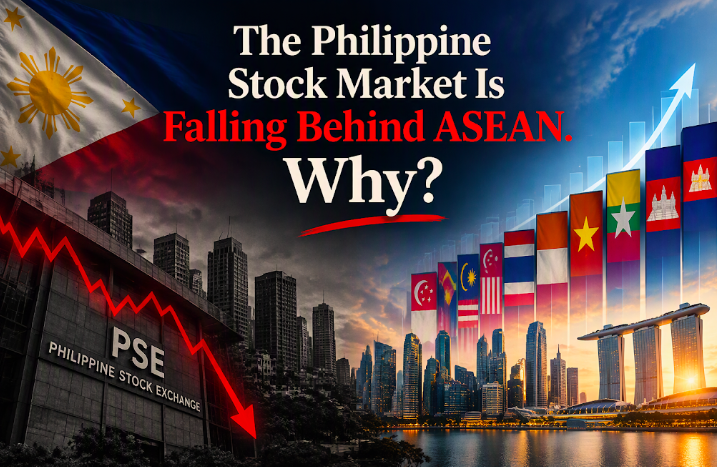
The regional comparison is striking. According to ASEAN Exchanges data, by the end of August 2026, the Philippine PSEi was down 1.6% for the year. In contrast, Singapore’s STI had gained 23.9%, Thailand’s SET 26.6%, Malaysia’s KLCI 2.7%, and Vietnam’s VNI 2.7%. Indonesia’s JCI, however, was down 24.5%, reminding us that this is not a simple story of all ASEAN markets outperforming the Philippines.
That comparison makes the question more useful: what distinguishes the Philippine market from the ASEAN markets that have attracted stronger investor interest?
The weakness predates West Asia
The first point is important. It would be too easy to blame the present weakness entirely on the Middle East conflict, oil prices, and the Federal Reserve.
The Philippine Stock Exchange reported that the PSEi fell 7.29% in 2025 after rising only 1.2% in 2024. Foreign investors recorded net selling of ₱51.78 billion in 2025, compared with ₱23.18 billion in 2024.
The market therefore entered 2026 with a considerable problem already in place.
There was, in fact, a brief improvement early this year. The PSEi rose to 6,611.24 by February 27, before subsequently losing ground. This suggests that global conditions alone cannot explain the market’s performance. Investor sentiment toward Philippine equities has been changing over time, responding to a combination of domestic and international factors.
The PSE itself, in reviewing 2025, pointed to concerns over the peso, disappointing economic growth, and confidence-related issues as factors behind persistent foreign selling.
The implication is important: the West Asian conflict may have intensified an existing problem rather than created it.
Is foreign capital really fleeing?

This question needs more careful treatment.
At first glance, the foreign-selling figures from the PSE suggest a clear withdrawal. But the broader balance-of-payments data from the Bangko Sentral ng Pilipinas tell a more complicated story.
BSP data show that the Philippines recorded net portfolio investment of $615 million in January-June 2026, compared with a net outflow of $337 million during the same period of 2025. Equity and investment-fund shares recorded a net inflow of $683 million during the first half of 2026, compared with a $24 million outflow a year earlier.
Yet the quarterly pattern changed sharply. Net portfolio investment was positive by $1.082 billion in the first quarter but turned negative by $468 million in the second quarter.
This suggests that “foreign investors are fleeing the Philippines” is too simple a description.
The more accurate interpretation is that foreign portfolio capital has become highly selective and volatile. Investors can remain interested in the Philippine economy while reducing exposure to Philippine equities, shifting between asset classes or reallocating capital among emerging Asian markets.
That distinction matters.
Foreign direct investment tells a different story again. BSP data show nonresident investment liabilities under direct investment at $3.38 billion during January-June 2026, down from $4.12 billion a year earlier. The decline deserves attention, but it is not a collapse of foreign investment.
The Philippines, therefore, has not become invisible to international capital. The question is why its equity market is not attracting a proportionate share of that capital.
ASEAN is providing the comparison
This is where the Philippine story becomes more revealing.
Singapore’s strong stock-market performance reflects its role as a financial centre and safe regional destination, as well as the strength of its financial and technology-related companies.
Malaysia has benefited from its position in the semiconductor and electronics supply chain and from growing investment in data centres and digital infrastructure.
Thailand’s market has been supported by expectations surrounding tourism, technology and investment, although its performance is not immune to domestic economic and political uncertainties.
Vietnam has continued to attract attention because of its manufacturing and export-oriented development model.
Indonesia’s sharp decline shows that ASEAN is not a uniform success story. Indonesia has its own problems, including commodity exposure, currency pressures, and changes in investor sentiment.
The lesson is not that the Philippines should copy one of its neighbours.
The lesson is that international investors are comparing opportunities across the region.
Capital does not ask only whether an economy is growing. It asks where earnings can grow faster, where companies have room to expand, where markets are liquid, where currencies are reasonably stable, and where investors believe the rules of the game will remain predictable.
The economy beneath the stock market matters
A stock exchange ultimately reflects expectations about corporate earnings and the economy that generates those earnings.
The Philippines’ economic growth slowed sharply to 2.3% year-on-year in the second quarter of 2026. The International Monetary Fund’s September 25 Article IV assessment projected growth of only 3.4% for the full year, although it expects a recovery to 5.1% in 2027.
The IMF identified weaker private investment, a sharp fall in public construction investment, natural disasters and the prolonged property-sector slowdown among the factors weighing on the economy.
That matters to equity investors.
If economic growth slows, corporate earnings expectations weaken. If investment slows, future productive capacity becomes less certain. If property activity remains subdued, banks, developers and related industries can feel the effects. If oil prices rise, the country’s import bill increases and household purchasing power can come under pressure.
The stock market therefore reflects much more than daily sentiment. It is also a forward-looking assessment of the economy.
But there is another problem: market depth
The Philippines has a reasonably sophisticated capital market, but it remains relatively small compared with some regional peers.
The PSE had 282 listed companies at the end of 2025. Its average daily value turnover rose to ₱7.33 billion in 2025 from ₱6.10 billion in 2024, which is encouraging. Yet market depth remains an issue.
A market needs a continuous supply of new companies, new sectors, and new investment opportunities to remain attractive to global investors.
There are encouraging signs. International Container Terminal Services became the first Philippine company to reach a ₱2 trillion market capitalization in July 2026. The PSE also approved Maynilad Water Services for inclusion in the PSEi in August, while new rules for REITs, market making and listings are being developed.
The San Miguel Corporation follow-on offering raised ₱30 billion in August, and Arthaland’s October follow-on offering raised another ₱2.15 billion and was 1.43 times oversubscribed.
These developments show that capital raising remains possible.
But the broader challenge is to create a larger and more diversified pipeline of investable companies.
The market needs more than a better index
This leads to a larger development question.
A stock market should not be judged only by whether the PSEi rises or falls in a particular year. A deeper capital market can mobilize savings, provide equity financing to businesses, reduce excessive dependence on bank borrowing and help finance investment.
For the Philippines, this matters particularly as the country tries to expand manufacturing, infrastructure, digital services, logistics, healthcare, renewable energy and other productive sectors.
The objective should therefore not be to engineer a higher stock-market index.
It should be to create the economic and institutional conditions under which more Philippine companies can grow, list, raise capital and become attractive to both domestic and international investors.
What needs to change?
The first requirement is a stronger growth and earnings story.
Investors need confidence that Philippine growth can return to a durable trajectory closer to the country’s potential. Macroeconomic stability remains necessary, but stability alone is not enough. Investors also need evidence of rising productivity and expanding corporate earnings.
Second, the Philippines needs a deeper and more liquid equity market. More IPOs, larger public floats, stronger institutional participation, and a broader range of listed companies would give international investors more choices.
Third, the country needs to strengthen investor confidence and corporate governance. Transparency, predictable regulation, effective enforcement, and protection of minority shareholders are not abstract principles for capital markets. They affect the risk premium investors attach to Philippine assets.
Fourth, the Philippines needs to develop more investable growth sectors. Its strengths in business-process and digital services, electronics, logistics, and infrastructure provide a base, but the challenge is to generate more high-productivity companies capable of becoming major listed enterprises.
This is where the ASEAN comparison is particularly useful. Malaysia’s semiconductor ecosystem, Singapore’s financial and technology strengths, Thailand’s tourism and emerging technology sectors, and Vietnam’s manufacturing platform have all created identifiable investment themes.
The Philippines needs its own equally compelling investment narrative.
Finally, the country needs to continue improving capital-market infrastructure and accessibility. The PSE has already pursued measures to increase liquidity and listings, while recent reforms have reduced transaction costs and encouraged new market products. These efforts need to continue.
Capital markets are part of development infrastructure
The Philippine stock market’s current weakness should not be viewed merely as a problem for investors.
It is also a development issue.
A country that wants to attract investment needs a capital market capable of connecting domestic and international savings with productive businesses. A deeper market can help companies finance expansion, innovation and employment without relying exclusively on bank credit or government resources.
The Philippines therefore faces a dual challenge.
It must restore confidence in the underlying economy while simultaneously making its capital market deeper, more liquid, more diversified and more attractive to international investors.
The West Asian conflict, oil prices and US interest rates will eventually change. Global capital will continue to move from one market to another.
The more enduring question is whether, when investors compare opportunities across Asia, the Philippines can offer a sufficiently strong combination of growth, productivity, corporate earnings, market depth, governance and investor confidence.
That is ultimately what will determine whether Philippine equities merely recover from the current weakness—or whether the country’s capital market can become a stronger instrument for Philippine development.