



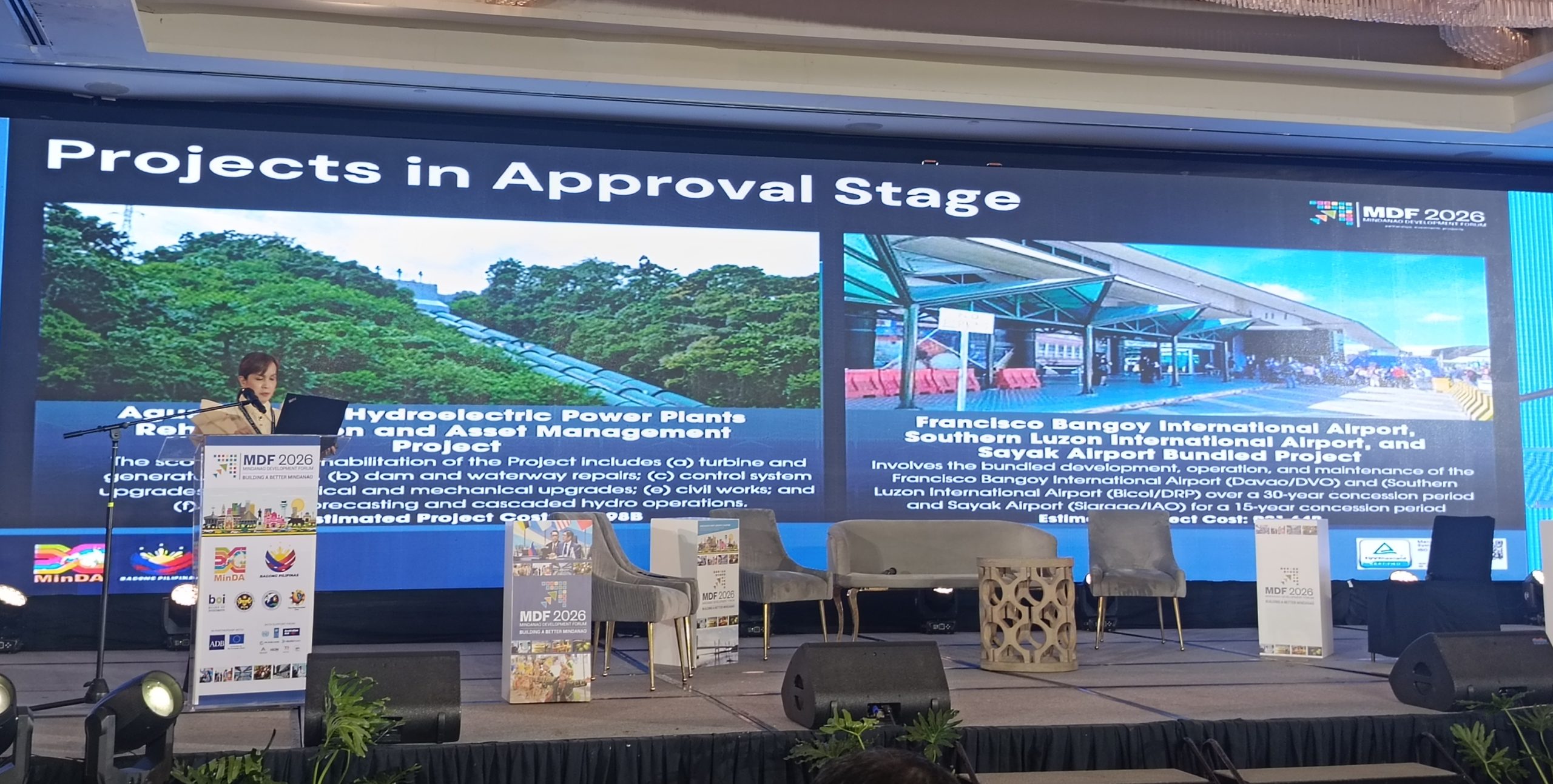
THE P69.72-BILLION proposal to rehabilitate and operate the Agus-Pulangi Hydroelectric Power Complex is now before the Economic Development Council, the government’s approving body.
During a breakout session on Oct. 27, day 1 of the Mindanao Development Forum in Davao City,
Usec Rizza Blanco-Latorre, Public-Private Partnership (PPP) Center executive director, reported that the project is currently in the approval stage.
Agus-Pulangi Complex is one of the country’s most critical renewable energy assets. The project is being pursued through a joint venture with the Power Sector Assets and Liabilities Management Corporation (PSALM) as the implementing agency.
Latorre reported that the scope of the rehabilitation of the project includes turbine and generator overhaul, dam and waterway repairs, control system upgrade, electrical and mechanical upgrade, civil works, weather forecasting, and cascaded hydro operations.
“This has passed ICC technical board, ICC Cabinet committee level and is to be presented to the Economic Development Council next month,” Latorre said.
According to a document obtained by TIMES from PPP Center, the indicative timeline for project review and approval is by December 2026. The proposal is an unsolicited one from a consortium of San Miguel Global Power Holdings Corp. and Sta. Clara International Corporation, the original proponent.
The project covers the rehabilitation, operation, and maintenance of seven plants: Agus I, II, IV, V, VI and VII, and Pulangi IV, and aims to restore the complex’s total dependable capacity to at least 1,001 megawatts (MW).
Rehabilitation will proceed unit by unit, with each unit undergoing an average of nine months of work, to maintain capacity adequacy.
The private proponent will also carry out reservoir improvement, sedimentation management, and hydrology and water resource management programs.
Operations and maintenance will begin once the complex is turned over to the private proponent, while rehabilitation is ongoing.
Latorre clarified in an interview with TIMES after the breakout session that if the ED Council approves the project, it will go through the Comparative Challenge process under the PPP Code and its implementing rules.
The approving body will set the challenge period, which can run from 90 calendar days to one year. If a superior bid is received, the original proponent has 30 calendar days to match it after being informed.
According to PPP, once the challenge ends, PSALM’s PPP Bids and Awards Committee submits its recommendation for award within seven days after final evaluation; the PSALM’s head decides on the recommendation within seven days.
The notice of award (NOA) is issued within three days of that decision, and the winning proponent has 20 days to comply with the award’s conditions, which PSALM will confirm compliance within five days.
The PPP contract is signed within five days after the proponent is notified that the NOA conditions are met.
Asked regarding potential privatization and escalating user fees, Latorre clarified to TIMES that the initiative is structured strictly as a PPP rather than a sale or privatization of public property.
Under the concession agreement, the private proponent will rehabilitate, operate, and maintain the facility, but ownership of the asset will remain with the government and revert fully at the end of the concession period.
“In this case, hindi siya idi-dispose ‘yung ownership. The proponent will rehabilitate and operate and maintain the asset, but at the end of the concession period, the ownership will have to be returned to the government,” she said.
However, officials noted that service fees are expected to increase following the overhaul, as substantial private capital investments will be poured in to modernize and upgrade its infrastructure and services.
Any proposed adjustments to electricity rates will be subject to the applicable regulatory requirements and approval of the Energy Regulatory Commission, including the required stakeholder participation and public hearings.

