



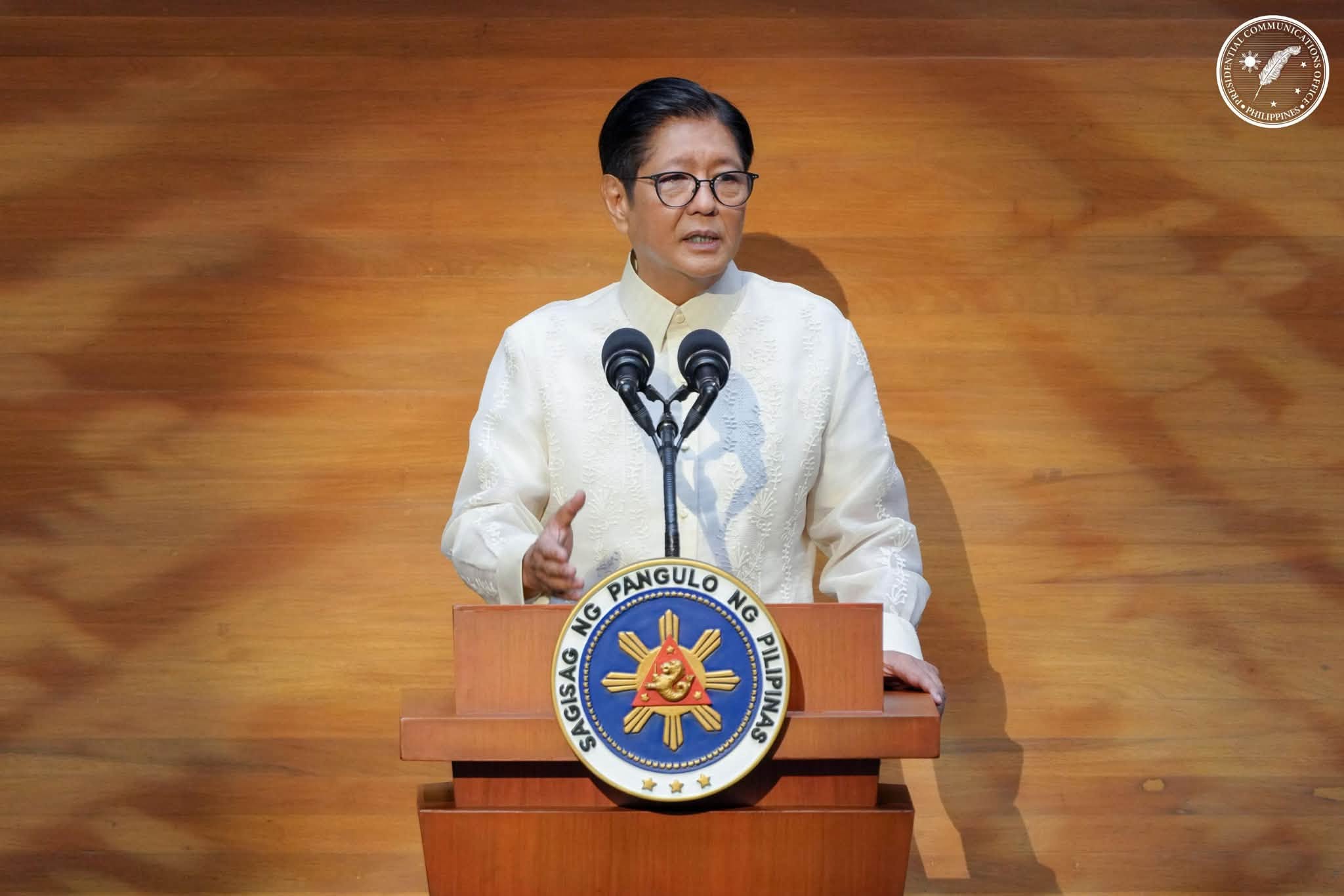
MANILA, Philippines — A year after vowing to hold government officials tied to the flood control scandal accountable, President Ferdinand Marcos Jr. has convinced only 10% of Filipinos that his administration has done enough, according to the inaugural release of The National Momentum Survey.
The non-commissioned survey, conducted by newly founded public opinion research firm Momentum Research, found that most Filipinos consider the administration’s efforts to address the flood control corruption scandal either “insufficient” (43%) or “lacking” (41%), with only 4% unsure and 1% declining to answer.
Regionally, nearly half of Filipino respondents in Metro Manila (48%), the Rest of Luzon (49%), and Visayas (46%) said the Marcos Jr. administration had made some effort to hold those behind the flood control anomalies accountable over the past year, but described that effort as “insufficient” (See Table 1).
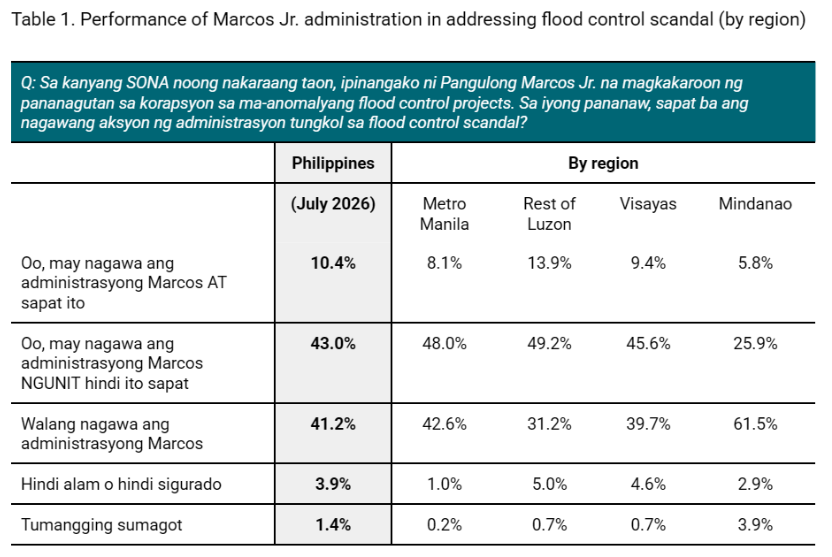
Mindanao respondents were the most dissatisfied, with 61% saying the administration had done nothing at all to genuinely address the corruption scandal. This was followed by Metro Manila (43%), Visayas (40%), and the Rest of Luzon (31%).
Satisfaction with the administration’s response remained low across all regions: 14% in the Rest of Luzon, 9% in Visayas, 8% in Metro Manila, and just 6% in Mindanao — the lowest nationwide.
Momentum Research founder and CEO Cleve Arguelles, a political scientist, said the survey findings point to a public that, while giving the administration some credit for taking action, largely believes it has fallen short of what the flood control scandal demands.
“The latest survey data suggests that while many Filipinos recognize the Marcos administration has taken steps to respond to the flood control scandal, a larger public sentiment is that more could have been done,” Arguelles said in a statement.
“Accountability, particularly over the alleged anomalies in flood control projects, has emerged as one of the issues Filipinos most want the President to address,” he added.
Even along political lines, satisfaction with the administration’s flood control response was thin.
Self-identified Pro-Marcos respondents were the only faction where a plurality expressed some satisfaction. Although even among them, more said the effort had fallen short (46%) than those who said it was enough (42%). Just 9% of Pro-Marcos respondents believe the administration had done nothing (See Table 2).
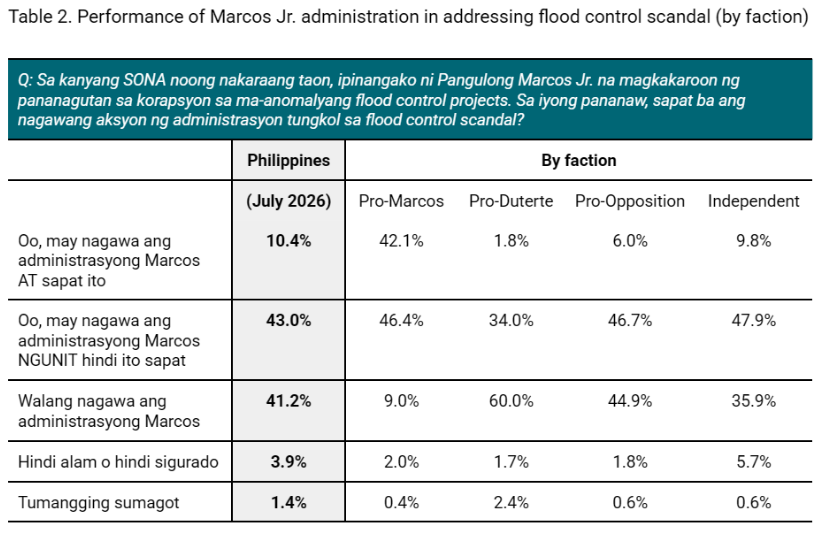
In contrast, Pro-Duterte respondents were the most critical of the administration, with only 2% saying its efforts to curb corruption in flood control projects were adequate. A majority of them (60%) said the Marcos government made no meaningful effort, while the remaining 34% said some effort had been made but was not enough.
Among respondents aligned with the political opposition — such as former Vice President Leni Robredo, Sen. Risa Hontiveros, and Sen. Bam Aquino, and their allies — 47% said the administration’s efforts were inadequate to solve the flood control scandal, while 45% of them said it had done nothing at all. Only 6% considered the response sufficient.
Meanwhile, independents, or those who did not align with any political faction, followed a similar pattern to the opposition. Nearly half (48%) said the effort had fallen short, while 36% said the administration failed to respond to the problem. Only 10% said the Marcos Jr. government had done enough.
“The most striking finding is that dissatisfaction extends even to Pro-Marcos respondents. When even your own supporters think more should be done, the public is sending a clear signal that accountability remains unfinished,” Arguelles said.
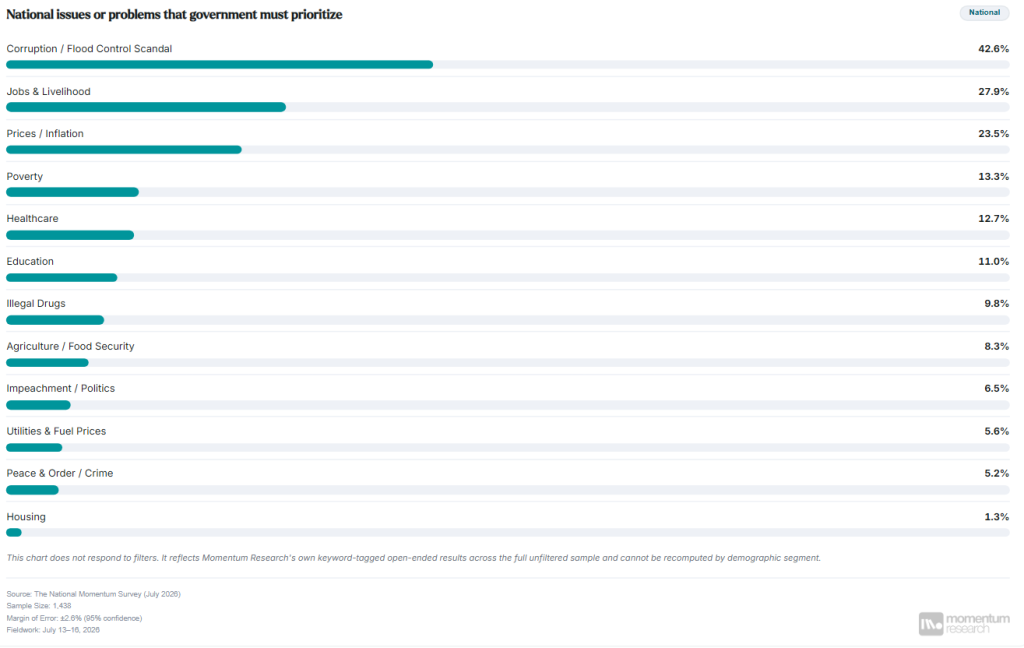
These findings are consistent with Momentum Research’s broader data on public sentiment. When respondents were asked what the government should prioritize, 43% of Filipinos pointed to corruption or the flood control scandal (See Figure 1). This was the top response, higher than jobs and livelihood (28%), and prices and inflation (23%).
A separate question asked what Marcos should address in his fifth State of the Nation Address (SONA), and 33% named accountability for the flood control scandal — the third-highest response, behind lowering prices of goods (60%) and job creation (38%) (See Figure 2).
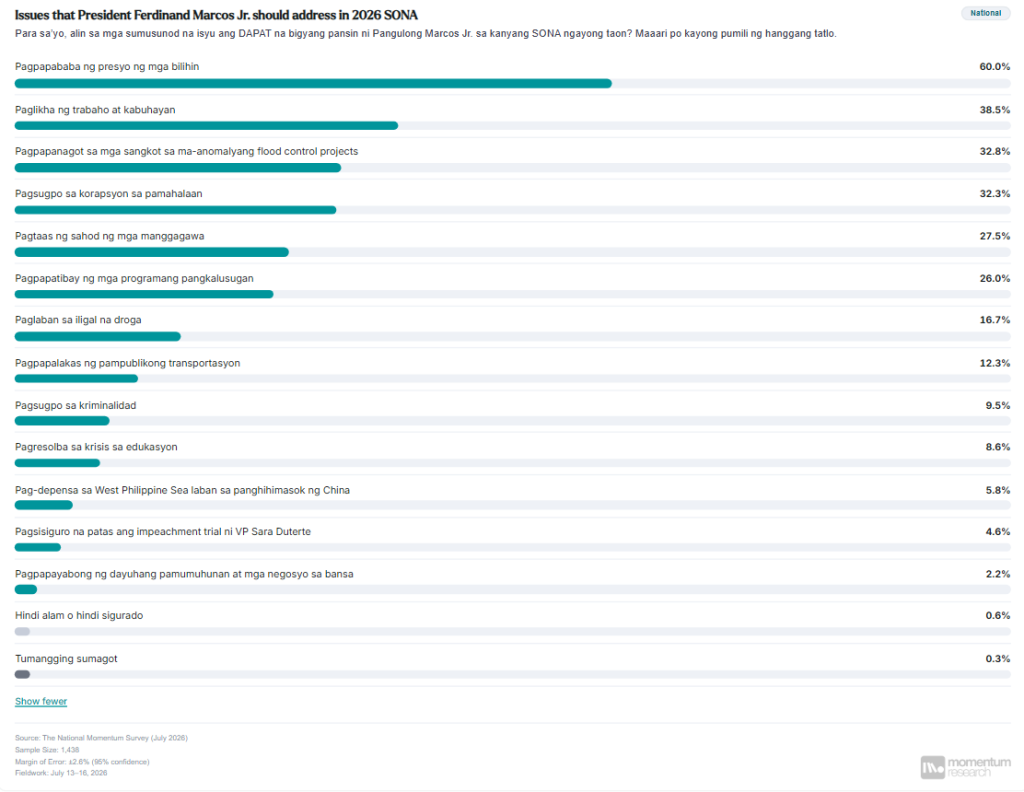
Respondents were allowed to pick three issues at most for both questions.
The nationwide survey was conducted from July 13 to 16, just two weeks before the president is expected to deliver his fifth SONA. It was done through face-to-face interviews with a nationally representative sample of 1,438 Filipino adults. It has a ±2.6% national margin of error and a 95% confidence level.
Subnational margins of error are ±7% for the National Capital Region, ±4% for the Rest of Luzon (North, South, and Central Luzon), ±6% for Visayas, and ±5% for Mindanao — all at a 95% confidence level.
The National Momentum Survey is Momentum Research’s flagship initiative, capturing what Filipinos think, feel, and stand for on the country’s most pressing sociopolitical issues. The inaugural July 2026 issue also covers public opinion on government performance, Vice President Sara Duterte’s impeachment trial, and the 2028 National Elections.
To explore the complete survey findings, visit Momentum Research’s website at www.momentumresearch.ph and access our live dashboard.

