



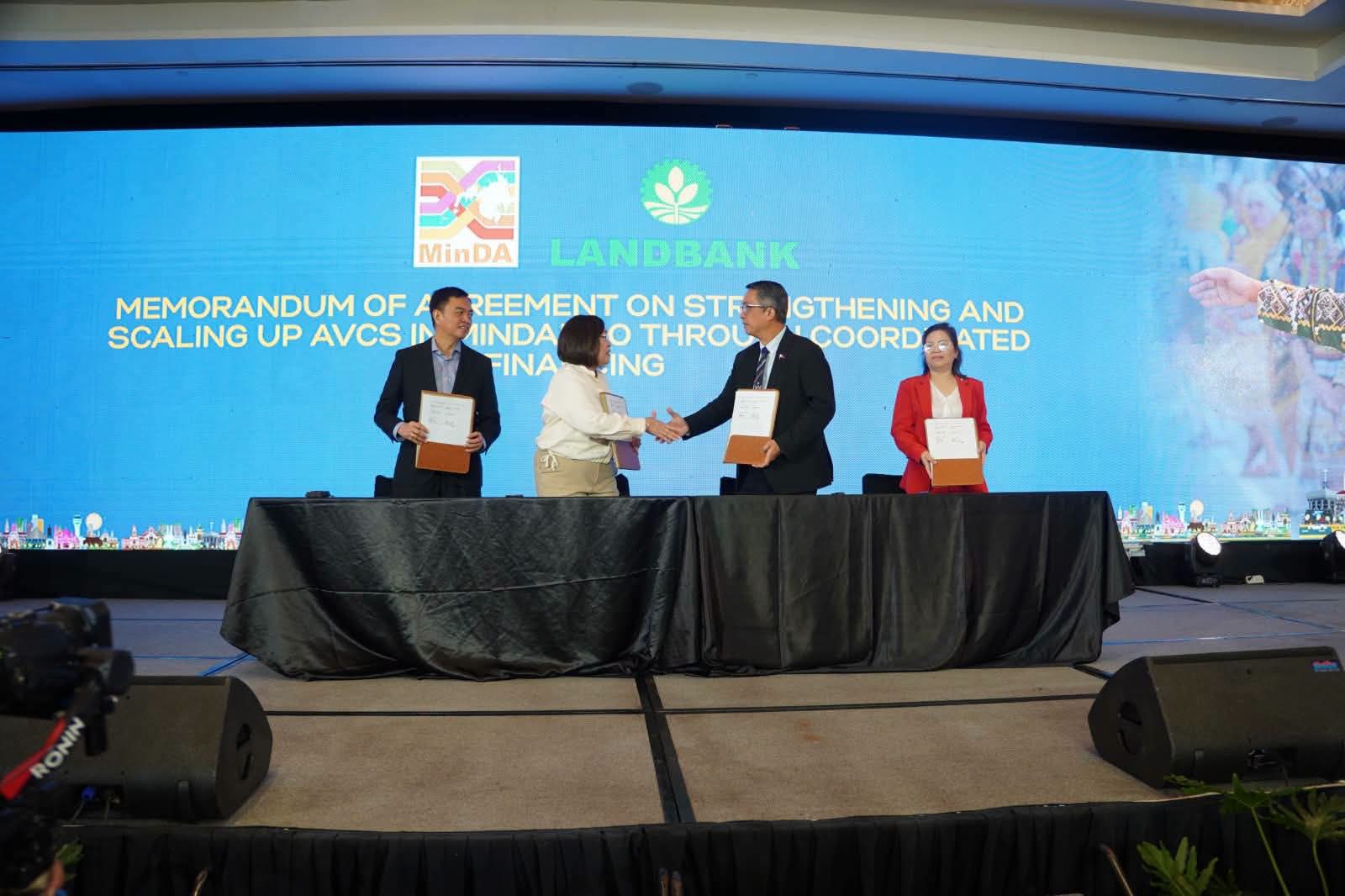
THE LAND Bank of the Philippines (LANDBANK) and the Mindanao Development Authority (MinDA) committed to partnering in advancing farmers’ and agribusinesses’ access to financing and markets.
Both entities signed a memorandum of agreement (MOA) on the second day of the Mindanao Development Forum (MDF) 2026 on Oct. 28.
The MOA was a result of the Mindanao Agriculture Value Chain Stakeholders and Investors Forum held Oct. 26, 2026, in Davao City.
The agreement covers firms and farmer cooperatives supported by MinDA’s Transformational Enterprise Support for the Agribusiness Value-Chains of Mindanao (TEAM) Project.
Charlotte I. Conde, LANDBANK National Development Lending Sector executive vice president, said the bank supports Mindanao’s economic growth through accessible development financing and will give MinDA-endorsed applicants priority treatment.
“We will provide a green lane to all applicants. I have instructed the head of our Mindanao operations to give priority to applications endorsed by MinDA,” Conde said.
She added that LANDBANK complies with turnaround time requirements and will strictly observe them.
Under the MOA, LANDBANK will channel financing through its AGRISENSO Plus and LIFTING MSMEs programs and other suitable lending facilities. Possible arrangements include contract growing and accounts receivable financing.
MinDA, for its part, will identify and pre-screen prospective borrowers, link them to technical and enterprise development services, and work with LANDBANK in monitoring the results of the financing.
LANDBANK first vice president Eden Japitana and MinDA executive director Usec. Janet M. Lopoz witnessed the signing.
The partnership follows Executive Order No. 101, s. 2025, which strengthened implementation of the Sagip Saka Act, which supports farmers’ enterprises.
MinDA chairperson Sec. Leo Tereso A. Magno said production must be linked to financing, technology, processing, and dependable markets if Mindanao’s agricultural potential is to raise farmers’ incomes.
“Our farmers need dependable markets, accessible financing, modern technologies, adequate post-harvest facilities, and stronger links with processors, exporters, and institutional buyers,” Magno said.
He said the TEAM Project works with government agencies, financial institutions, and industry partners to align financing and infrastructure support with priority agricultural value chains.
The agreement also includes training in financial literacy, entrepreneurship, digitalization, and business management, along with mentorship, data sharing, and participation in trade fairs, among others.

