

THE DEPARTMENT of Science and Technology–Food and Nutrition Research Institute (DOST-FNRI) called for sustainable solutions as food insecurity persists in Davao Region.
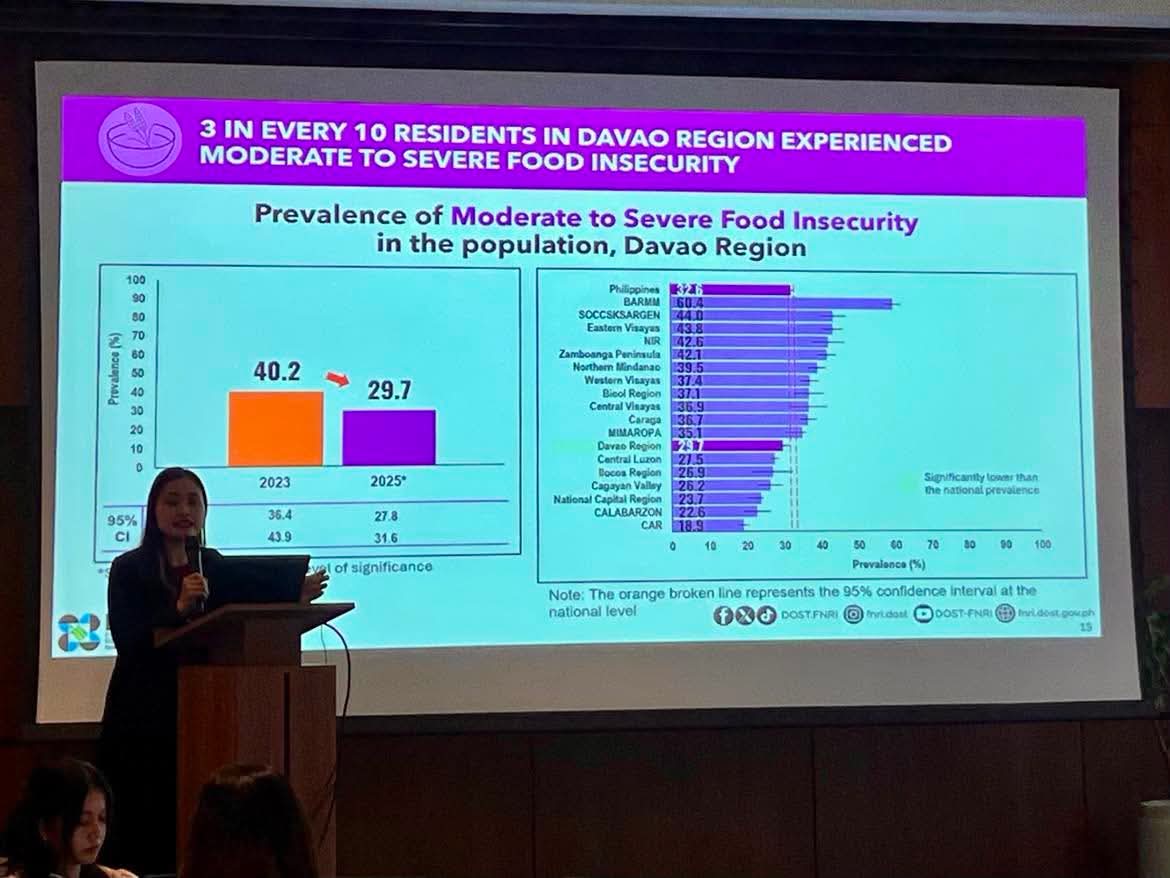
Food insecurity in Davao Region is down to 29.7% in 2025, but 3 in 10 residents still belong to that category, according to DOST FNRI 2025 Updating Survey Dissemination of the Nutritional Status of Filipino Children and Other Population Groups presented on Wednesday at Seda Abreeza.
Dr. Mildred Guirindola, DOST-FNRI chief science research specialist, said while the decrease is significantly down from 40.2% in 2023, it’s no reason to be complacent.
“Ang ganda ng pag-improve ng food security, pero nakikita pa rin natin na 3 out of 10 ay nakakaranas ng food insecurity whether ito ay pag-aalala at nakakaranas ng gutom,” Guirindola said.
Cheder Sumangue, DOST- FNRI science research specialist, who presented the results said the Food Security survey assessed at the individual level as well as household coping mechanisms and strategies.
“Food security data guides targeting of programs and social protection,” Sumangue said.
DOST-FNRI defines food security using the six dimensions of availability, access, utilization, stability, agency and sustainability, but the 2025 Updating Survey in Davao region only based on the individual’s access to adequate resources for acquiring appropriate foods for a nutritious diet.
The survey reached 2,394 households with an average size of four members. Of the 7,587 individuals surveyed, 51.5% were female, and 48.5% were male.
Sumangue reported that 29.7% of Davao Region residents experienced moderate to severe food insecurity in 2025, down from 40.2% in the 2023 National Nutrition Survey (NNS).
The 2025 figure is lower than the national prevalence of 32.6%.
Moderate to severe food insecurity was significantly higher among individuals in poor households at 43.7%, against 24.2% among the non-poor.
Sumangue noted that wealth status was computed using an asset-based index of the household rather than household income.
Rural residents had a higher prevalence of moderate to severe food insecurity at 34.5%, compared with 27.8% among urban residents, and households with more than five members registered 32.2%, while smaller households recorded 28.5%.
Meanwhile, severe food insecurity in the region likewise decreased, from 3.7% in 2023 to 2.2% in 2025, below the national figure of 2.9%.
Severe food insecurity logged 4.2% among the poor and 1.5% among the non-poor; 2.3% in rural areas and 2.2 % in urban areas.
It was also experienced by 2.8% in households with more than five members against 1.9% in smaller ones.
The survey also documented how food insecure households cope, where among 1,688 such households, gathering food from their own backyard garden or own produce was the most common food coping strategy, reported by 71.0%.
For non-food coping strategies, looking for a sideline or extra work (64.6%) and borrowing money from relatives (64.3%) were the most common.
Guirindola called the Department of Agriculture along with local government units to expand the reach of the programs that directly connect local producers in vulnerable barangays.
“Ma-connect talaga natin na yung mga produce ay masustansya, nagiging affordable, accessible sa mga tahanan, na yung mga produce ng ating farmers are nakakarating talaga sa ating households,” she stressed.
She said this reduces reliance on intermediaries, and provides consumers with safe and nutritious food at affordable prices, and enables farmers to receive fairer prices and better returns for their produce.
Guirindola also noted that DA & LGUs should scale up the implementation of National Urban and Peri-Urban Agriculture Program (NUPAP) in all highly urbanized cities in the region.
“Nakita natin na coping mechanism ng mga households ang pagtatanim sa kanilang bakuran, sana ito yung ma intensify natin,” she stressed.
This includes provision and distribution of vegetable seeds prioritizing low-income families while providing all assistance to commercial and community-based vegetable growers to enhance local food accessibility.
DOST-FNRI also called to fully implement programs like the Free Meals Program under the Sagip Saka Act that national and local government agencies ( DSWD, DepEd, DOH) should ensure that at least 50% of their food requirements are procured directly from local cooperatives, without competitive bidding, to strengthen local food systems and support local producers.