



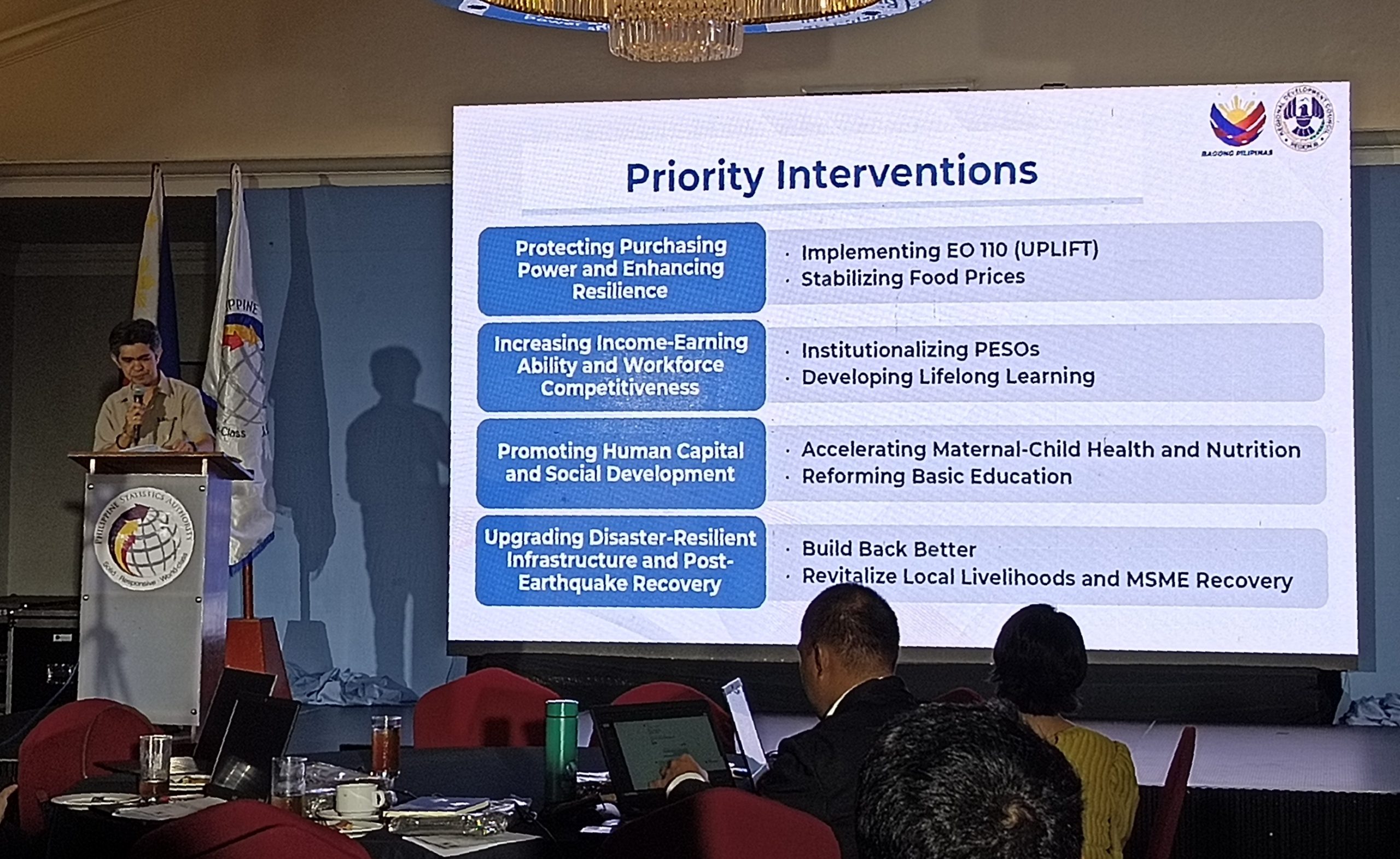
A REGIONAL development official pushed measures to improve agriculture targets, close job-skills gaps, improve health and education to keep poverty incidence from rising again after it fell to 5.5% in 2025 from 11.3% in 2023.
Rosendo Aya-ay, Department of Economy Planning and Development XI chief economic development specialist, said the measures form part of the midterm update of the Davao Regional Development Plan 2023-2028.
During the 2025 full year preliminary results official poverty statistics dissemination forum here on Tuesday, Nov. 10, the Philippine Statistics Authority XI reported that poverty incidence among the families dropped from 11.3% in 2023 to 5.5% in 2025.
However, Aya-ay warned that inflation, slow national growth, and disaster damage threaten those gains, especially for near-poor households.
To protect incomes, the region will implement Executive Order 110, or the UP-LIFT program
to manage the energy crisis and global oil volatility. In line with this, he said local authorities will monitor the movement of fuel, food, and medicines.
“Kadiwa ng Pangulo outlets will continue to sell affordable goods to vulnerable sectors,” Aya-ay said.
The Regional Development Council (RDC) XI also passed Resolution No. 92, which directed provincial local governments to revise their targets for agriculture, forestry, and fisheries.
He said the region is also modernizing agriculture and buffer-stocking infrastructure.
“With updated targets, LGUs will work together to achieve a stronger, more resilient agricultural base that protects farmers and stabilizes consumer prices,” he said.
Inflation in Davao Region has stayed above 8% in recent months, and food is the largest household expense, which hit near-poor families the hardest.
Despite an employment rate of 97.1% in 2025, the official said the region must address a persistent jobs-skills mismatch.
Part of the plan is the push for Public Employment Service Offices in all 54 local government units to be upgraded into full-service hubs offering job matching, career guidance, and labor market information.
“We need to increase the income earning ability and workforce competitiveness,”
The region will also expand flexible, industry-aligned training that lets workers stack micro-credentials, in coordination with the Philippine Qualifications Framework and the Philippine Credit Transfer System.
Priority fields eyed are ICT, agribusiness, logistics and tourism.
For health and education, the RDC will roll out the Philippine Multisectoral Nutrition Project and the Tutok Kainan program.
He cited that child stunting fell to 5.08% in 2025, but full immunization dropped to 57.15% and maternal mortality rose to 121.81.
Local governments are urged to trace zero-dose children and expand primary care facilities.
In education, elementary reading and math proficiency improved to 54.18% in 2025.
The region will prioritize reading literacy programs, teacher professional development and the DepEd computerization program, and will cut teachers’ administrative tasks, following recommendations of the Second Congressional Commission on Education (EDCOM 2).
Meanwhile, he stressed recovery from the magnitude 7.8 earthquake that struck Southern Mindanao on June 8, 2026, will follow a build-back-better approach.
The quake caused an estimated ₱4.54 billion in damage and losses, and recovery is estimated to cost ₱10.1 billion.
Plans include permanently relocating displaced families to safe sites and rebuilding schools and health facilities to withstand quakes up to magnitude 8.0.
Roads, bridges and seaports, including those in San Isidro and Governor Generoso, will be restored, along with farm-to-market roads and fishing boats.
For urbanization, he said that as more people migrate to Davao City, poverty programs will be aligned with the JICA-supported Metro Davao urban development master plan.
Projects such as the Davao Bypass and enhanced shipping aim to link rural producers to markets and lower logistics costs for small farmers, the official said.
“As we face shifting macroeconomic challenges in 2026, we call on our local chief executives, our regional line agencies, the academe, the private sector partners, to work together and align resources, execute high-impact catch-up strategies, and eliminate the remaining disparities across provinces,” Aya-ay said.

