



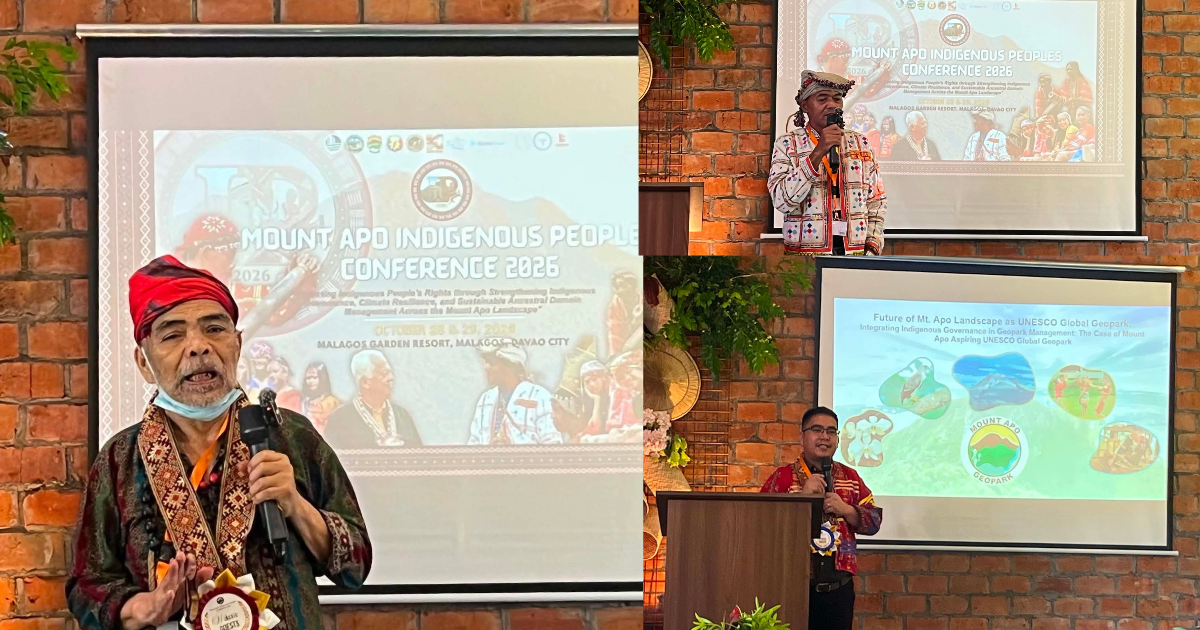
INDIGENOUS community leaders and tribal elders from the Davao Region called for stronger governmental mechanisms to protect ancestral domains and recognition of sacred sites.
The Mt. Apo Indigenous Peoples Conference on Oct. 28, at the Malagos Garden Resort in Malagos, highlighted ongoing development pressures and territorial conflicts surrounding Mt. Apo.
The conference brought together indigenous leaders from Bagobo Klata, Bagobo Tagabawa, and Obu-Manuvu communities, government agencies, local government units, and conservation partners.
Speaking during the forum, IP leaders underscored that Mt. Apo should not only be seen as the country’s highest peak, but as a vital ancestral domain deeply embedded in indigenous history and spirituality.
Apo Ernesto Sicao of the Sicao Village Community urged national and local institutions, alongside environmental agencies, to align development policies with indigenous frameworks to safeguard sacred sites, watersheds, and biodiversity.
Sicao said his group has spent 10 years working on a village plan covering a 1,818-hectare ancestral claim, citing an old village site, an old burial ground, and historical accounts that show the area was already a barangay in 1959.
Sicao said various activities have complicated the community’s claim, and asked the NCIP to clarify whether such activities could disrupt the tribe’s rights.
“Hinaut tan-awn sa NCIP ang 1,800 nga old village ug old burial ground. Kung di na mahatagan ug kasulbaran, mahimong gubot ra gihapon,” he said.
He also questioned why the community is being called “illegal,” saying its members have long lived on and preserved the land.
He urged the government to recognize the claim and to protect the area from encroachment, citing a lack of enforcement.
Datu Lipatuan Joel Unad Sr. of the Obu Manuvu pointed out that a significant portion of traditional lands within Mt. Apo faces commercial and environmental disruptions, complicating traditional governance and resource stewardship.
He appealed to national and local government agencies to recognize Mt. Apo as a landmark and part of the identity of the Obo Manuvu.
Unad said the declaration of Mt. Apo as a national park, and the entry of energy projects, including geothermal, came without the meaningful participation of the tribe.
He said government policies on the mountain conflict with the rights of indigenous peoples.
“Malawak at malaki ang problema ng tribu about Mt. Apo. I hope matulungan ninyo ang mga tribu within Mt. Apo,” he said.
He called for the partner organization, Lifebank Foundation, along with NGOs and other institutions, to help the tribe restore Mt. Apo to its “normal” state under the ownership of the IP and establish its sacred landmarks.
He warned that without help, the tribe’s heritage could be lost.
Clint Michael Cleofe, Mt. Apo Natural Park protected area superintendent, presented during the forum that traditional ecological knowledge has an impact on geoconservation.
A socio-cultural mapping of the mountain documented the beliefs of the Bagobo Tagabawa tribe, for whom Mt. Apo’s seven peaks are tied to seven spirit deities.
Out of the 64,000 hectares covering the MANP, 96% is inside the ancestral domain, and 40,000 hectares are covered by a Unified Tagabawa ancestral domain.
The deities include Baye’t Pande (Davao City Peak), the goddess of wisdom who is believed to hold the tribe’s knowledge.
Apo Matulos (Digos Peak) is head of the Bagobo Tagabawa pantheon, revered as a divine guardian, provider, and spiritual father, while Apo Manama (Sta. Cruz Peak) is the god of love.
Apo Tagagume (Bansalan Peak) is the god of water, associated with the area’s springs, algae, and mosses, while Apo Mandarangan (Kidapawan Peak) is the god of bravery and enforcer of nature’s laws.
Meanwhile, the unknown peak is believed to be home of Apo Anito, the god of healing, believed to guide the tribe in gathering medicinal plants.
The presentation said that before the mapping, visitors were largely unaware of the sacred peaks, leaving trash behind and behaving unruly.
But after the mapping, conservation measures integrated cultural sensitivities and proper decorum at the summit to preserve its sacredness.
Cleofe said the active involvement of the indigenous communities is one of the edges of MANP for its bid to become the second in the country to be declared a Global Geopark.
It can be noted that international validators Dr. Guy Martini of France and Chenggong Zhang of China arrived in Davao City on Aug. 16 to conduct a five-day on-site validation mission.
The evaluators conducted a field visit to verify the self-evaluation document and application covering conservation, education, and sustainable community-led development submitted jointly by the Department of Environment and Natural Resources (DENR) regional offices XI and XII.
A final decision from UNESCO on Mt. Apo’s nomination is expected by 2027 following the completion of the full evaluation cycle.
Organized by LBF-Sicao Project, supported by LifeBank Foundation, the two-day conference aims to harmonize land management policies across government bodies and establish a united Mt. Apo Declaration.
The Mt. Apo Declaration will encompass the commitments from the stakeholders.
The conference is also expected to produce a draft of a five-year action plan, in which participants will formulate a 5-year action plan spanning policy governance, land management, disaster risk resilience, biodiversity conservation, and ecotourism frameworks.

