

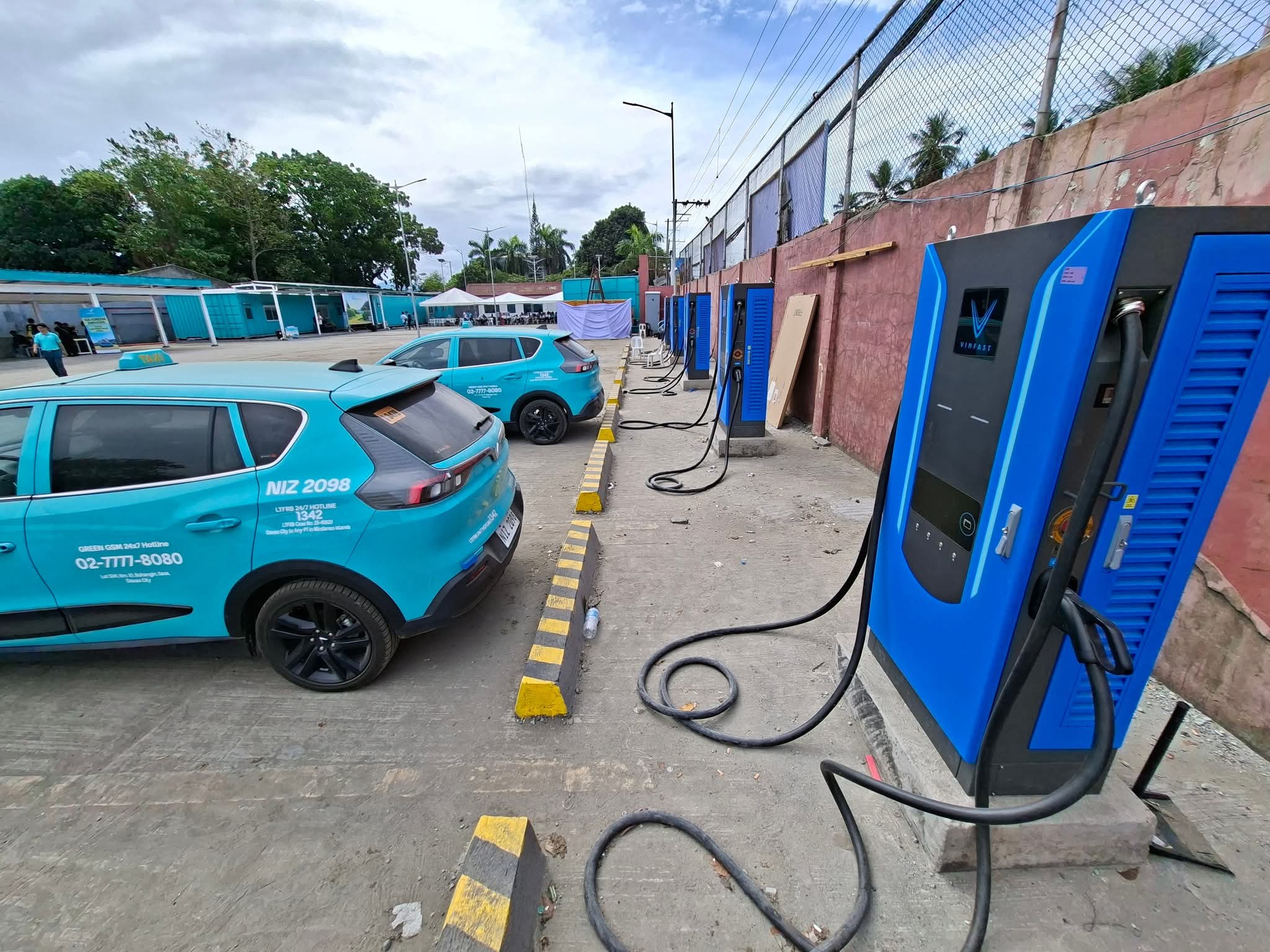
THE DEPARTMENT of Energy (DOE) Mindanao Field Office said electric vehicle charging stations (EVCS) across Davao Region should expand to meet the demand of an increasing number of users.
Eric George Uy, DOE Mindanao Energy Utilization Management Division OIC-chief, said there are only 16 registered charging stations across the region.
Of the number, Davao City accounts for 14 of the registered charging stations, while Tagum City and Digos City each have one. Uy said plans are underway to expand the network through new government guidelines targeted for release in the coming months.
“With regard to further the acceleration adoption of electric vehicles. So, currently, the department has issued and has been developing several additional guidelines for the expansion of the charging infrastructure,” Uy said during Habi at Kape on Wednesday.
He added the agency is finalizing two key policy measures to accelerate the rollout of charging infrastructure.
The first is a set of guidelines mandating the installation of EV charging stations in identified public and private buildings.
“The draft department circular is being updated following the changes to the proposed provisions,” Uy said.
He added that a public consultation is targeted for the first week of October 2026.
The second measure is a streamlined permitting process for EVCS installation and operation, to be issued through a Joint Memorandum Circular involving the DOE, the Department of the Interior and Local Government (DILG), the Department of Public Works and Highways (DPWH), and the Anti-Red Tape Authority (ARTA).
Uy said the DOE is currently awaiting comments and concurrence from the DPWH on the draft circular.
He reminded that applications related to EVCS recognition, including for operators and service providers, are processed online through the agency’s platform, evindustry.ph, which also shows the locations of registered charging stations nationwide.
On EV adoption, the DOE cited a sharp increase in registered electric vehicles nationwide, based on data from the Department of Transportation.
From a baseline of 24,000 registered EVs in 2024, the number rose to more than 60,000 by 2025. DOE is projecting around 100,000 registered EVs by the end of 2026.
Uy highlighted the cost advantage of electric vehicles contributing to the shift.
Citing DOE estimates, running a conventional internal combustion engine (ICE) vehicle costs around ₱5 per kilometer, compared to ₱3.50 for hybrid or plug-in hybrid vehicles, and ₱1.71 per kilometer for battery electric vehicles.
The DOE said distribution utilities are now required to factor electricity demand forecasts from the EV industry into their respective distribution development plans, under a department circular covering all distribution utilities nationwide.
Asked about the ideal number of charging stations per city or municipality, the DOE representative said this would depend on local conditions and current EV demand in each area.
The DOE said electric mobility forms part of the country’s broader energy security strategy, aimed at reducing dependence on imported petroleum products, offering a modern transport alternative, and supporting cleaner, more energy-efficient technologies.
But he added that this transition must be paired with adequate and accessible charging infrastructure, alongside continued investment in power generation, particularly renewable energy transmission capacity, and energy efficiency measures across sectors.