
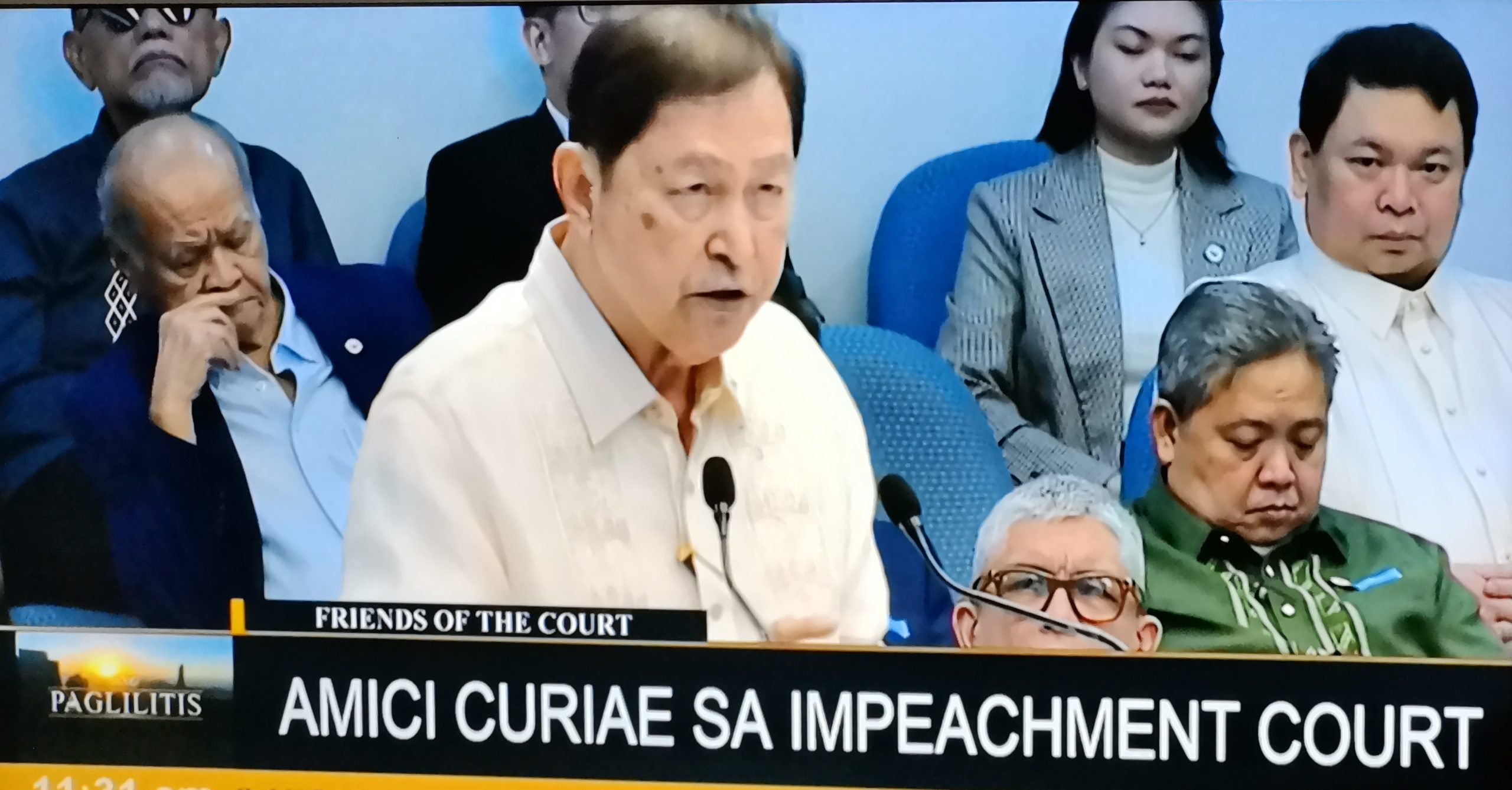
FOUR RETIRED Supreme Court magistrates—former Chief Justices Reynato Puno, Hilario Davide Jr., Artemio Panganiban, and retired Associate Justice Adolfo Azcuna—appeared before the Senate impeachment court on Wednesday, September 16, 2026, to serve as amici curiae (“friends of the court”) and provide critical legal guidance on the voting threshold required to convict Vice President Sara Duterte.
The high-profile session centered on interpreting the constitutional requirement that conviction in an impeachment trial demands the concurrence of two-thirds of all members of the Senate, rather than merely two-thirds of a quorum present at trial.
The “All Means All” Standard
Invoking a strict constructionist view, retired Associate Justice Adolfo Azcuna maintained that the denominator must include all sitting members of the Senate, emphasizing that an impeachment trial is a political-judicial hybrid exercise carrying irreversible consequences.
“Impeachment is a political-judicial exercise; it is not an ordinary vote… As long as they are members of the Senate, they constitute the denominator in computing the threshold of two-thirds because all means all,” Azcuna said.
Azcuna warned against lowering the threshold to a variable quorum, which could reduce the requirement to a simple majority of participating members. Such a move, he cautioned, could “punish deliberation” and encourage rushed decision-making among senator-judges. He further added that the voting threshold must remain fixed and determinable from the beginning of the proceedings, noting that the unique two-thirds requirement guards against a “thin, unrepresentative conviction.”
Diverging Perspectives Among Legal Luminaries
The former magistrates presented nuanced legal arguments regarding the computation of the two-thirds requirement and the participation of senator-judges:
Hilario Davide Jr. argued that the basis of computing the two-thirds should be the number of senators who are qualified to vote, rather than a blanket application to all 24 members regardless of status.
Artemio Panganiban noted that mathematically, two-thirds of the Senate’s 24 members is 16, but emphasized the practical distinction between abstract rules and the realities of legislative proceedings.
Reynato Puno pointed out the deliberate phrasing of Article XI, Section 3 (6) of the Constitution, noting that the framers intentionally used a fractional standard— two-thirds of all members— instead of simply mandating a flat numerical requirement of 16 votes.
Internal Senate Rules on Attendance and Voting
Addressing procedural gray areas, Azcuna also weighed in on whether senator-judges who missed certain hearings could still cast their votes. He opined that this remains an internal matter for the Senate to decide based on its own wisdom.
Because the tribunal is a court of record where proceedings are transcribed and heavily reliant on documentary evidence, Azcuna suggested that a senator-judge who missed select hearings could still render an honest, impartial judgment based on the official record, provided they uphold their sworn constitutional oath.
The testimony of the esteemed former justices provides vital legal framing as the Senate impeachment court deliberates on the definitive rules governing the historic trial.