
- New Manulife Asia Care Survey 2026 reveals Filipinos are prioritizing self-reliance, financial freedom, and quality care as they prepare for longer lives.
- Filipinos are redefining legacy around independence, but caregiving pressures, rising care costs, and planning gaps may challenge long-term resilience.
- Survey finds Filipinos want to age independently and avoid burdening loved ones, highlighting the need for stronger health, care, and financial planning.
MANILA—As Filipinos prepare for longer lives, many are placing greater importance on maintaining their independence as they age, according to the latest findings from the Manulife Asia Care Survey 2026: Independence as the New Legacy. The study found that Filipinos increasingly view self-reliance, financial freedom, and the ability to avoid becoming a burden on loved ones as the legacy they can leave their families.
The survey, which gathered insights from more than 9,000 respondents across Asia, including 1,000 in the Philippines, explores attitudes toward longevity, health, caregiving, retirement preparedness, and financial well-being.
Independence as the New Legacy
The results build on a broader trend that Manulife has observed in recent years. As conversations around longevity have evolved, Filipinos have increasingly shifted their focus from simply living longer to living healthier, more fulfilling lives. The latest survey suggests this aspiration is becoming more defined: remaining physically, financially, and emotionally independent for as long as possible.
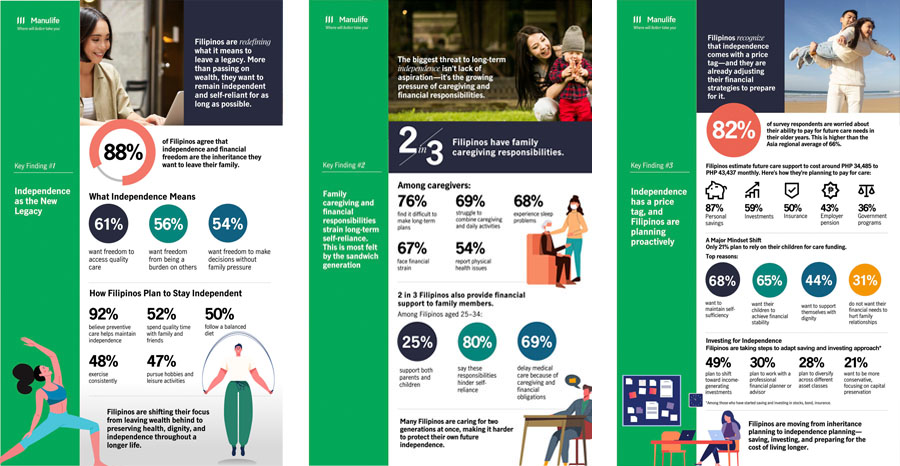
- Among survey respondents, 88% agreed that their independence and financial freedom are the inheritance they want to leave their family, rising to 95% among those aged 25 to 34. When asked what independence means to them, respondents cited freedom from becoming a burden on others, freedom to make decisions without family pressure, and freedom to access quality care.
- Among respondents who want independence to be their legacy, 56% cite their own health and quality of life as a top priority, while 53% are concerned about unexpected expenses in their later years—highlighting how health, financial security, and self-sufficiency are increasingly connected in how Filipinos plan for the future.
“For many Filipinos, legacy has always been deeply connected to family. What we are seeing is that people increasingly view legacy not only as what they leave behind, but also as the choices they make to stay healthy, independent and able to enjoy life for longer,” said Rahul Hora, President and Chief Executive Officer, Manulife Philippines.
Hora added, “This is especially important as Filipinos face more complex health, care, and financial needs as they age. At Manulife, we are committed to helping them prepare for the future through trusted advice, protection, and health and wealth solutions that enable greater confidence, dignity, and financial security in the years ahead.”
Health as the Foundation of Independence
The survey found that Filipinos broadly understand the role of health in protecting their independence, with 92% agreeing that preventive care and self-care habits help extend years of independence.
Spending time with family and friends (52%), following a balanced diet (50%), and maintaining a consistent exercise routine (48%) emerged as the leading self-care habits among respondents. However, only 29% are proactively building and maintaining social circles to combat isolation, and only 26% have taken early screenings and preventive care to avoid chronic illness.
Sandwich Generation Pressures Test Path to Independence
While Filipinos aspire to remain independent throughout their later years, the study found that many are already navigating responsibilities that may make that goal more difficult to achieve. Family caregiving and financial obligations have become a defining reality for a large segment of the population, often competing with their own long-term plans for health and financial security.
- 67% provide care to a family member, averaging 32 hours per week, well above the regional average of 23 hours. Meanwhile, 68% carry financial responsibilities for family members, spending nearly half their monthly income to do so.
- The pressure is especially pronounced among the “sandwich generation,” or those caring for both parents and children. Among respondents, 13% provide care to both generations, while 17% extend financial support to both. For many, these dual responsibilities are making it harder to prepare for their own future: 74% say caregiving and financial commitments hinder their ability to build self-reliance, while 71% report delaying their own medical care as a result.
- 76% of caregivers report difficulty making long-term plans for themselves, 69% struggle to balance caregiving with their own daily activities, 68% experience sleeping problems, and 67% face both financial strain and difficulty adjusting their life plans. 54% report problems with their own physical health.
“The findings show us where the gaps are, and where support is most needed. Filipinos caught in these dual responsibilities should not have to choose between caring for their families and securing their own future. That is precisely the kind of challenge we want to help them navigate,” Hora added.
Planning for the Cost of Independence
These pressures are driving financial anxiety, with 82% of Filipinos worried about affording future care, well above the 66% regional average. On average, respondents estimate they would need PHP34,485 per month to cover their future care needs. Most plan to rely on personal savings (87%) and investments (59%), while only 21% expect support from their children, reflecting a stronger need for self-sufficiency and desire to let the next generation build their own lives.
“Financial independence is becoming an essential part of how Filipinos define a secure and dignified future,” said Aira Gaspar, President and Chief Executive Officer, Manulife Investments Philippines. “As people live longer, many are thinking more intentionally about how they can support their retirement, care needs, and life goals through savings and investments, while remaining self-sufficient and giving their children the freedom to pursue their own goals.”
The survey also shows that Filipinos who have started saving and investing for their financial well-being are taking practical steps to adapt their strategies. Nearly half plan to shift toward income-generating investments, while 30% intend to work with a professional financial planner or advisor. Another 28% plan to diversify across asset classes, and 21% want to take a more conservative approach focused on capital preservation.
Gaspar added, “At Manulife Investments Philippines, we help bridge the gap between intention and action by offering professionally managed unit investment trust funds (UITFs) as well as expert guidance and resources that make long-term financial planning more accessible and relevant to Filipinos at different life stages.” Access the full report and download the white paper via the company’s website: Manulife Asia Survey 2026: “Independence as the New Legacy”. The insights uncovered in this year’s survey align with the Manulife Longevity Institute, a global research, thought leadership, innovation, advocacy, and community investment platform that drives action to help people thrive at every age. Learn more about Manulife’s Longevity research and insights at: manulife.com/longevity.