BY ALEX ALAGON


BY ALEX ALAGON

THE DAVAO City Police Office (DCPO) has tightened its security net for the upcoming IRONMAN 70.3 on March 22.
PCOL Mannan C. Muarip, DCPO Acting City Director, convened a high-level staff conference on Monday at the Kapanalig Hall to finalize the operational blueprint for the international triathlon and the seamless celebration of the 89th Araw ng Dabaw.
The meeting synchronized strategies among key unit commanders to guarantee the safety of participants of the grueling 70.3-mile course.
DCPO spokesperson Captain Hazel Caballero told TIMES on Monday afternoon that around 972 personnel from March 19-22, 2026, will be deployed, plus an augmentation of 40 Basic Internal Security Operations Course (BISOC) personnel from Police Regional Office XI.
The security plan includes intensified operations at physical screening and billeting locations, and strategic deployment of personnel along race tracks, parking areas, and staging zones. Meanwhile, support units will be integrated into the local force to bolster the city’s defensive posture.
“Meticulous planning is the backbone of a successful IRONMAN,” Muarip said, noting that the race remains a crown jewel of the Araw ng Dabaw festivities, attracting a global audience and showcasing Davao as a premier sports tourism destination.
The police chief also ordered a close monitoring of local diesel prices, citing potential spikes driven by ongoing tensions between the United States and Iran. He noted that fuel costs directly impact the mobility and logistical readiness of the police fleet during large-scale operations.

MALACAÑANG has declared on March 20, 2026, a regular holiday nationwide, in observance of Eid al-Fitr, or the Feast marking the end of Ramadan.
This follows the recommendation of the National Commission on Muslim Filipinos (NCMF), which proposed Friday, March 20, or Saturday, March 21, subject to the sighting of the moon.
Proclamation No. 1189 stated the declaration of holiday is “to bring the religious and cultural significance of the Eid al-Fitr to the fore of national consciousness.”
It added that the proclamation is to “allow the entire Filipino nation to join their Muslim brothers and sisters in peace and harmony in the observance and celebration of Eid al-Fitr.”
Acting Executive Secretary Ralph Recto signed the proclamation on March 12.
Eid al-Fitr, the first of two canonical festivals of Islam, the other being Eid al-Adha.
Eid al-Fitr marks the end of Ramadan, the Muslim holy month of fasting, and is celebrated during the first three days of Shawwāl, the 10th month of the Islamic calendar.
To note, Ramadan 1447 Hijrah started on Thursday, Feb. 19, 2026.
This was after the moon was not sighted during the sighting activity on Feb. 17, conducted by the NCMF, in coordination with the Bangsamoro Autonomous Region in Muslim Mindanao (BARMM), Darul Ifta, and various Ulama groups.
During the month, Muslims observing Ramadan will refrain from eating and drinking from dawn to dusk, typically for a period of 12 to 15 hours.
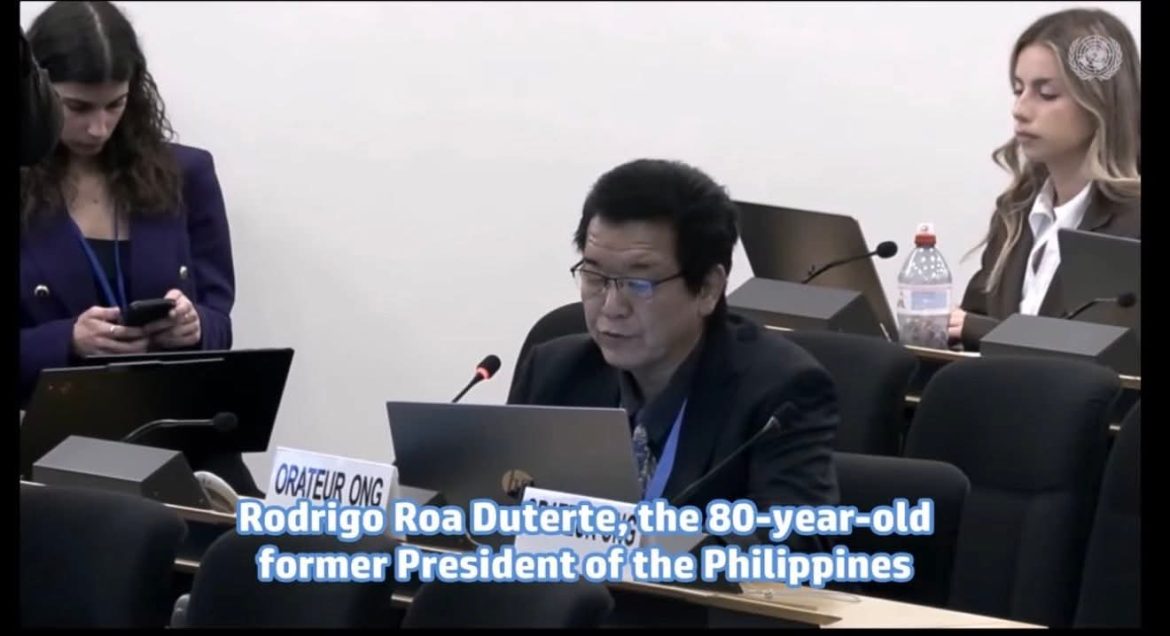
A JAPANESE researcher and representative of the International Career Support Association (ICSA) has called on the United Nations Human Rights Council (UNHRC) to intervene in the detention of former Philippine President Rodrigo Duterte, labeling his situation a case of “political persecution.”
Speaking during a General Debate at the UNHRC on March 11, 2026, Shunichi Fujiki—who also serves as a senior researcher for the International Research Institution of Controversial Histories (iRICH)—demanded a humanitarian review and the interim release of the 80-year-old former leader.
“I stand here to denounce the grave injustice. 80 years old former President Rodrigo Roa Duterte, Philippines, who bravely fought illegal drugs to protect millions, has been unlawfully removed from the homeland and held in prolonged pretrial detention by the ICC in The Hague. This is a political persecution, and not justice. The current administration extradited him without due process, bypassing Philippine courts and violating national sovereignty,” Fujiki said.
“He was extradited without any due process. Incidentally, since March 11, 2025, exactly one year ago today, this elderly leader has endured detention, separated from family amid serious health issues. Global rallies and protests in The Hague and throughout the world demand an interim release, which has been unlawfully denied by the ICC three times. This over one year pre-trial detention raises profound questions about compliance with the Rome Statute’s guarantees of humane treatment and speedy trial,” he said.
“It is an affront to human dignity and an abuse of international justice for political ends. We urge this council to demand a humanitarian review and the interim release of President Duterte. Justice must be fair, not a weapon against the people. The majority of the Filipino voice will not be silenced or depressed. Thank you very much,” he further said.
Fujiki’s statement marked the first anniversary of Duterte’s controversial arrest at the Ninoy Aquino International Airport on March 11, 2025.
The former president was reportedly extradited to the International Criminal Court (ICC) in The Hague to face charges related to his administration’s anti-drug campaign.
“I stand here to denounce a grave injustice,” Fujiki told the council. “The current [Philippine] administration extradited him without due process, bypassing Philippine courts and violating national sovereignty.”
Fujiki argued that the ICC’s jurisdiction is misplaced, citing the principle of complementarity in international law, which states that international courts should only intervene if a country’s legal system is unable or unwilling to prosecute.
He further alleged that the administration of President Ferdinand “Bongbong” Marcos Jr. is utilizing the ICC proceedings to dismantle the political influence of the Duterte family.
The researcher highlighted the former president’s deteriorating health and the fact that he has remained in pre-trial detention for over a year without a formal trial.
“This over one-year pre-trial detention raises profound questions about compliance with the Rome Statute’s guarantees of humane treatment and a speedy trial,” Fujiki added, noting that the ICC has reportedly denied Duterte’s request for interim release three times.
The appeal is supported by the Republic Defenders for Peace and Unity (RDPU–DDS Japan), a group that has been organizing global rallies to bring international attention to what they describe as a “weaponization of justice.”
As of press time, the Philippine government and the ICC have yet to issue a formal response to Fujiki’s statements before the council.
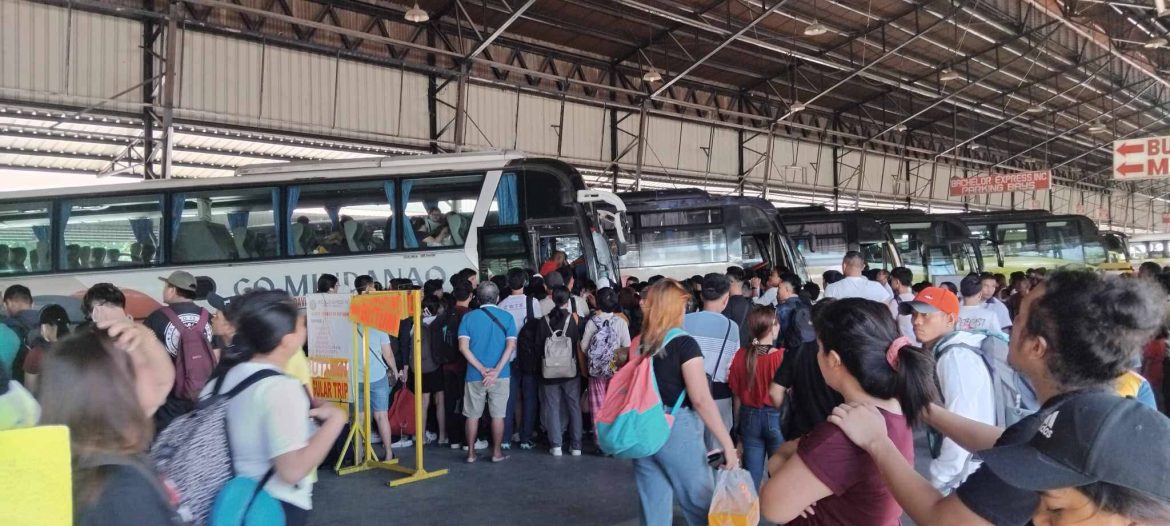
THE LAND Transportation Franchising and Regulatory Board (LTFRB) announced on Saturday, March 14, that it approved the implementation of a P0.35-P1 fare increase for provincial buses due to the increasing fuel prices due to the Middle East conflict.
The agency released on Saturday the updated fare guide for provincial public utility buses (PUBs) after the issuance of an order on Friday, March 13, granting a provisional fare increase.
“The approved adjustments have already been reflected and incorporated in the newly issued Fare Guide to ensure uniform implementation across all provincial bus operators and routes,” LTFRB stated.
Under the updated fare guide, the following fare adjustments for various provincial bus classifications shall apply:
Provincial bus operators are directed to strictly follow the updated fare guide and to properly post the newly approved fares inside their units as a guide to the riding public.
Passengers, on the other hand, are advised to verify the correct fares based on official information from the LTFRB and report any violations or overcharging incidents.
“The LTFRB remains committed to ensuring that public transport fares remain fair, transparent, and responsive to prevailing economic conditions while protecting the welfare of commuters and transport operators alike.”
The updated fare guide for various provincial bus classifications can be accessed on the LTFRB’s website through the link: https://ltfrb.gov.ph/ltfrb-releases-updated-fare-guide-for-provincial-public-utility-buses
Aboitiz Equity Ventures, Inc. (AEV) started 2026 with a series of milestones and international recognitions across its portfolio of businesses, reflecting the strength of the Aboitiz Group’s diversified platform and its continued focus on operational excellence, innovation, and sustainable growth.
Across Aboitiz Equity Ventures’ core sectors—power, banking and financial services, infrastructure, industrial and real estate, food and beverage, and its construction affiliate—the Group delivered key achievements. These reinforce AEV’s role in supporting economic development in the Philippines while strengthening its regional presence.
Among the major developments was the formal turnover of the 797-megawatt Caliraya-Botocan-Kalayaan Hydroelectric Power Plant complex in Laguna to a consortium led by Aboitiz Renewables, Inc., the renewable energy arm of AboitizPower. The facility, particularly its pumped-storage units, plays a critical role in stabilizing the Luzon grid by storing energy and delivering power during periods of peak demand, supporting both system reliability and the country’s transition to renewable energy.
AboitizPower’s renewable energy platform also received regional recognition at the 2025 Asian Power Awards. Aboitiz Renewables was named Independent Power Producer of the Year, while SN Aboitiz Power Group received awards for innovations in information technology and power technology. Several renewable facilities across the portfolio were likewise recognized by the Department of Energy and the Safety and Health Association of the Philippine Energy Sector for sustained workplace safety performance, reflecting the Group’s continued emphasis on operational discipline and employee wellbeing.
Within the financial services sector, Union Bank of the Philippines earned regional recognition after ranking 140th in the 2026 TIME–Statista Asia-Pacific’s 500 Best Companies list. The ranking evaluates organizations across revenue growth, employee satisfaction, and environmental, social and governance transparency. UnionBank also placed 37th in employee satisfaction, highlighting the bank’s continued investments in digital innovation, employee development, and a strong organizational culture.
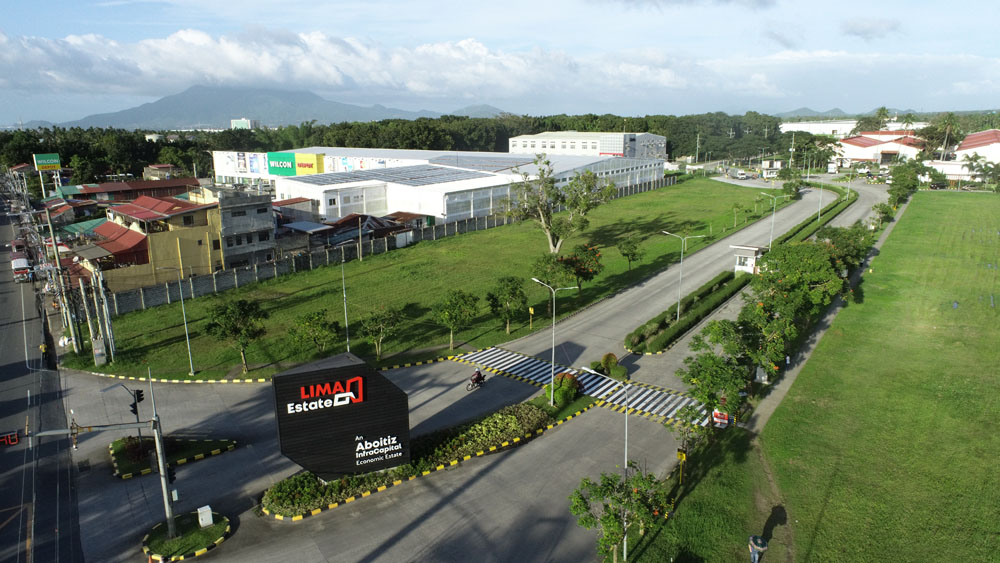
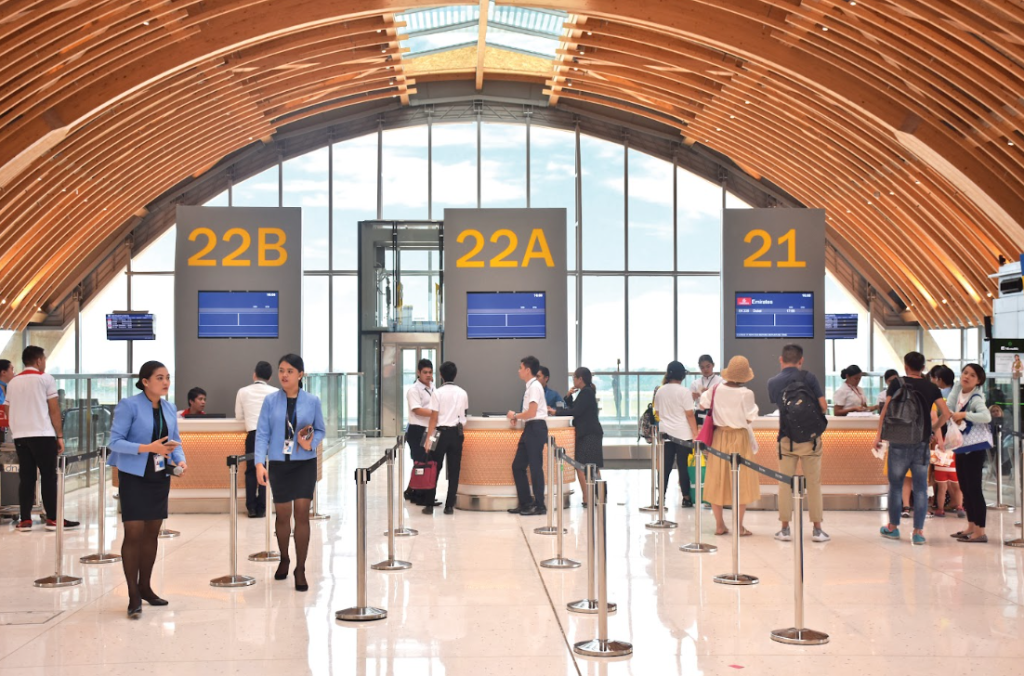
AEV’s infrastructure sector likewise continued to gain international recognition. Aboitiz InfraCapital, Inc. was named Most Innovative Infrastructure Investment Company in the Philippines at the International Finance Awards 2025, marking the second consecutive year it received the distinction. The Mactan-Cebu International Airport also won the 2025 Airport Service Quality Best Airport Award in Asia-Pacific for airports handling five to fifteen million passengers annually. The award, based on real-time passenger feedback collected worldwide, reinforces the airport’s reputation for delivering a high-quality travel experience and its role as one of the country’s premier tourism gateways.
Aboitiz Economic Estates, the industrial and commercial arm of AEV’s integrated real estate platform, received four laureates at the 2026 Asia-Pacific Stevie Awards, highlighted by a Gold for Social Impact and three Bronze laurels for workforce development, sustainability, and community-building. These honours highlight the Group’s integrated approach to developing industry-anchored ecosystems that attract foreign direct investments, generate meaningful employment, and strengthen both local and regional economies.
Aboitiz Construction further strengthened its operational credentials after receiving recertifications for its Quality Management System, Environmental Management System, and Occupational Health and Safety Management System following audits conducted by global certification body Bureau Veritas. The company also earned a gold at the 2026 Asia-Pacific Stevie Awards for its sustainable supply chain management practices, and was honored by the Department of Education Region III as a partner in education for supporting school infrastructure and learning initiatives across communities.
Meanwhile, Aboitiz Foods expanded its regional platform through the acquisition of Singapore-based Diasham Resources Pte. Ltd. by its subsidiary Gold Coin Management Holdings Pte. Ltd. With nearly five decades of expertise and established distribution networks across key Asia-Pacific markets, Diasham strengthens Aboitiz Foods’ portfolio of animal nutrition and health solutions while expanding the Group’s presence in the region’s growing agriculture sector.
In the area of sustainability, AEV ranked among the top three Philippine conglomerates in the 2025 S&P Global ESG ratings based on the latest Corporate Sustainability Assessment released in December 2025. The ranking highlights the Group’s strong performance in corporate governance, business ethics, and enterprise risk management, supported by robust disclosure practices and institutional systems aligned with global standards.
Together, these developments signal a strong opening chapter for AEV in 2026. Guided by disciplined capital allocation, strong governance, and long-term partnerships, the Aboitiz Group continues to strengthen its businesses across critical sectors while contributing to the Philippines’ economic progress.

Manila, Philippines — Is it possible for customers to create feel-good moments today while also feeling wrapped up in our country’s historic past? For McDonald’s Philippines, the answer is a resounding yes.
At present, there are five McDonald’s stores operating in heritage structures and locations— proving that enjoying one’s favorite McDonald’s meal and spending valuable time with one’s loved ones and friends can become an opportunity to appreciate the country’s rich cultural and architectural history
Just this January, residents of Santa Rosa City, Laguna came together for the official opening of a new McDonald’s store, which also happens to be a reconstruction of an over-100-year-old heritage structure. Formerly the ancestral home of one of Santa Rosa City’s most prominent families, the new structure incorporates some of the adobe stones of the original structure that stood on the site while the architecture and design elements depict the same historical period of the original house. This gives customers the experience of a bygone era while enjoying the latest McDo offerings.
As part of its commitment to preserving the character of the ancestral home, McDonald’s Philippines followed the National Historical Commission of the Philippines (NHCP) guidelines and approval processes, ensuring that the restoration upheld the building’s historical and cultural significance.
Customer reaction to the creative and seamless melding of past and present has been highly appreciative. On social media, various individuals remarked on how the store brings the much- loved McDonald’s experience into a space that maintains classic Filipino architectural features.
“Should be like this sa mga establishments natin, hopefully to preserve culture,” one Facebook user said. Another Facebook user said: “Hope to see more restoration projects like this in the future.” On TikTok, someone commented: “Eto naman talaga dapat ‘yung style per house, per store. Dapat may culture pa rin tayong pinapakita and tradition, mixed with modern.”
Architects and heritage advocates define “historic reconstruction” as the creation of an homage to a non-surviving or heavily damaged structure, rebuilt to depict its appearance during a specific historical time period. In the Philippines, historic reconstruction is guided by strict laws and requires approval from agencies such as the NHCP. Construction plans, materials, and methods undergo thorough review before any alteration is made.
By adhering to these stringent standards and processes, the integrity of built heritage is not compromised, but instead preserved and newly appreciated.


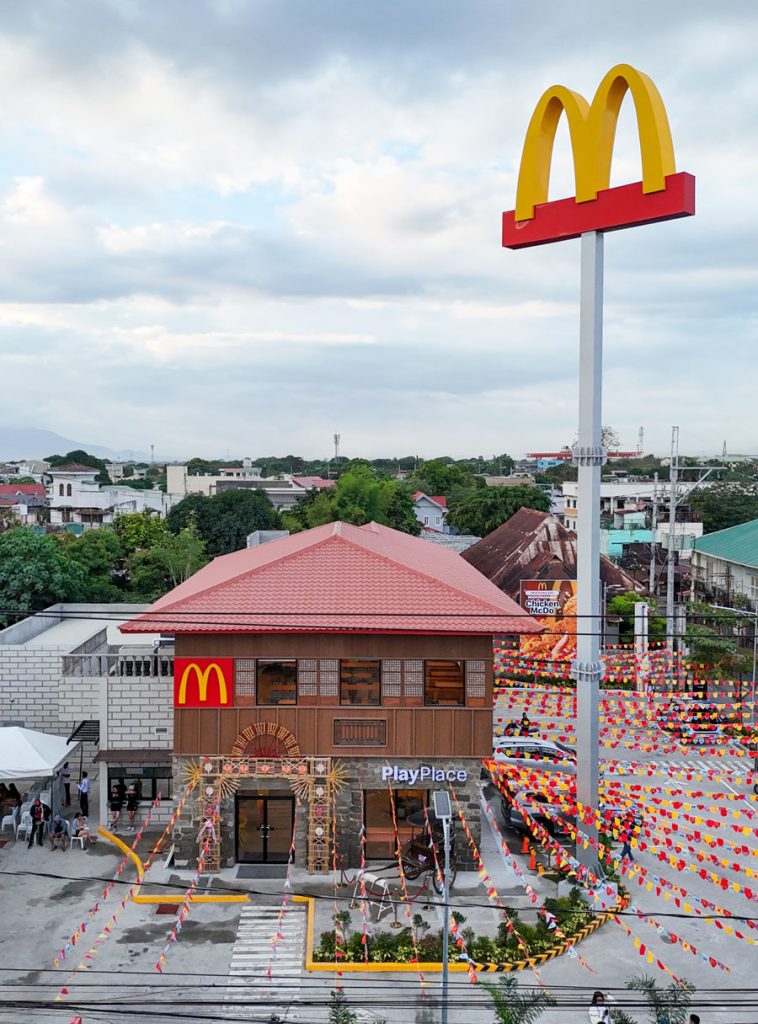

“McDonald’s Philippines has enormous respect and love for Filipino culture and history,” said Margot Torres, McDonald’s Philippines Managing Director. “As a proudly 100% Filipino‑owned company, we stay connected to what customers value—time with family, celebrating local traditions, and preserving our heritage structures.”
Aside from the Santa Rosa store, other McDonald’s heritage branches can be found in some of the country’s most historically and culturally relevant cities. These include McDonald’s Vigan, located within the UNESCO Heritage City of Vigan, Ilocos Sur; McDonald’s Muralla, located within the walls of historic Intramuros, Manila; McDonald’s Silay, in a city called the Paris of Negros Island for its beautifully preserved mansions and thriving arts and culture scene; and McDonald’s San Pedro Bayan, which operates in one of the oldest houses in San Pedro, Laguna.
These heritage stores have kept most of the original architectural and design elements, including stonework and woodwork, pillars and beams, windows, and more. Where modern construction materials are introduced, they are used in a way that harmonizes with the old structure. For the stores located in major historical sites such as Vigan and Intramuros, much care has been taken to ensure they don’t clash with the overall look and feel of their surroundings.
“So if you’re wondering what it would feel like to enjoy a Chicken McDo meal or score the hottest Happy Meal toy while being immersed in spaces that proudly preserve Filipino history and culture, now’s your chance to visit any or all of our five heritage stores.”

Globe is strengthening its position as a leading enabler of the Philippines’ digital economy under the leadership of its President and CEO, Carl Cruz, building on the company’s sustained growth momentum in recent years. With a sharper strategic focus and disciplined execution, Globe has increased data habituation and improved data monetization, clear indicators that its priorities are translating into measurable results.
In 2025, Globe grew its fiber subscriber base by 43 percent, lifting the company’s broadband subscribers to 2.1 million from 1.7 million the previous year. Affordable solutions like GFiber Prepaid reached over 820,000 subscribers by year-end, while fiber now accounts for 91 percent of total home broadband revenues, demonstrating strong consumer trust and adoption. Fiber enables students to access online learning platforms, supports businesses with cloud and enterprise IT systems, and connects remote workers across cities and regions. By expanding fiber networks, Globe ensures more Filipinos can participate fully in the digital economy.
Execution and clarity continue to anchor Globe’s transformation. By simplifying strategic priorities and aligning the organization around performance and accountability, the company has reinforced its commitment to consistent, reliable connectivity. Rather than competing aggressively on price, Globe differentiates on network quality and customer experience. “Customers only notice the network when it fails. Our goal is to make customer experience reliable and seamless,” Cruz said.
Globe’s enterprise solutions are also gaining traction. Through Globe Business, companies adopt cloud platforms, AI and automation tools, and cybersecurity measures to improve operations and customer engagement. API-enabled network capabilities, including Number Verification APIs and the Bridge Alliance API Exchange, allow enterprises to innovate securely. Corporate data revenues reached an all-time high of 20.7 billion pesos in 2025, while overall service revenues hit a record 165.1 billion pesos. “Mobile remains strong, but the real runway is in fiber and enterprise,” Cruz emphasized. “To lead in AI, digital services, and enterprise solutions, our fiber backbone must be strong.” Fiber sits at the heart of Globe’s strategy, supporting fiber-to-the-home expansion, enterprise connectivity, tower backhaul, and the surge in data traffic from streaming, cloud adoption, and AI applications. By sustaining mobile leadership while accelerating fiber and enterprise growth, Globe is creating a future-ready, multi-network ecosystem to power the next wave of digital transformation in the Philippines.

When the world is in the brink of another collapse, women do not just agonize, they organize. That’s what the Women Strong Network is all about that came to Davao and Mindanao for the first time last March 12 to 14, 2026 at SM Lanang, Davao City.
Initiated by the Women’s Business Council Philippines, or WomenBizPH, the Women Strong Network is an ASEAN-focused capacity-building program for women entrepreneurs that fosters a “women helping women” community to boost visibility, skills, and networking opportunities.
Atty. Lorna P. Kapunan, who served as Past Chair and President of WomenBizPH and still serves as one of its Trustees, shared that they organized WomenBiz as a response to what they felt was women’s lack of representation in business councils such as chambers of commerce, employers federations, and exporters groups.
“Women lead and run majority of the micro and small enterprises in the country while the big corporations that are dominated by men form just one percent,” Atty. Lorna said. “Women must be leading the decision-making in industries that we run and operate and that is why we formed our own business council.”
With the Philippines chairing ASEAN this 2026 with the theme of “Navigating Our Future, Together,” WomenBizPH is making sure women entrepreneurs are visible and participating in all the decision-making processes at all levels and all areas in realizing the ASEAN Community Vision 2045.
Aside from the Women Strong Network Hybrid Trade Fair in Davao, WomenBizPH also organized the “ASEAN Knowledge Exchange on Regenerative Entrepreneurship for Mindanao and BARMM” at SMX Convention Center Davao. They were joined by the ASEAN Women Entrepreneurs Network (AWEN), UN Women, Small Business Corporation (SBC), and the Department of Trade and Industry (DTI).
For ASEAN 2026, they want to make sure Mindanao women entrepreneurs are visible and have a voice in the regional cooperation body and that their contributions are recognized in ASEAN’s women-driven growth.
Yes, the evidence from ASEAN clearly shows that women are not just participants in the region’s growth — they are a primary, yet often under leveraged, engine driving it. Women in ASEAN are 625 million strong, half of the total population. Their contribution spans from the grassroots level of micro-enterprises to the highest echelons of trade policy.
But women are not just driving economic growth, they are transforming it through regenerative entrepreneurship.
Regenerative entrepreneurship is a paradigm shift from the dominant extractive economic model. It is not just about “doing less harm” such as reducing pollution or using recycled materials. It is about actively designing human systems and businesses that restore, renew, and revitalize their own sources of energy and materials, creating conditions for all life to thrive.
If we think of it in stages, they are: (1) Conventional – the dominant extractive economic model that “take-make-waste”; (2) Sustainable – do less harm like minimize waste and reduce energy use; (3) Restorative – return systems to a healthy state like restoring a land it once polluted with harmful chemicals; (4) Regenerative – actively improving the health of the entire system where the business becomes a net positive force, enriching its community, its ecosystem, and its people.
A regenerative business is not just a profit-making entity. It is viewed as a living system nested within larger living systems — community, society, nature. Its success is measured not just by its bottom line, but by its contribution to the health and resilience of those larger systems.
Key characteristics of a regenerative enterprise include holistic design that is inspired by nature, where there is no waste because the output of one process becomes the input for another. There is also stakeholder integration — employees, community, customers, suppliers, and the environment — not just shareholders. It is place-based and contextual because it is deeply rooted in and responsive to its local ecology and community. It seeks to build capacity of its systems to thrive like improving soil health, building community wealth, and fostering employee well-being.
Women are leading regenerative entrepreneurship because of their social, historical, and structural positioning.
This is not about biological essentialism — the idea that women are inherently “more nurturing” (which is a gender stereotype). It is because under capitalism and patriarchy, women have been systematically assigned to the sphere of life that regenerative entrepreneurship seeks to elevate and emulate.
Women’s leadership is not just beneficial, but essential. Regenerative entrepreneurship requires a complete dismantling of the values at the core of the capitalist-patriarchal system — domination, extraction, hierarchy, and infinite growth.
Women, and particularly women of color and indigenous women, have been the primary “other” in this system. They have been excluded from its centers of power and suffered most from its negative consequences. This outsider status gives them a crucial vantage point. They are less invested in defending a broken system that excluded them and are freer to imagine and build something entirely new.
Patriarchy has systematically devalued the work of care — raising children, tending to the sick, maintaining community, and ensuring daily well-being. This work has been made invisible, unpaid, and considered “women’s work,’ despite being the very foundation of a functioning society and economy.
Regenerative entrepreneurship, at its core, is about bringing this ethic of care into the heart of the economy. Women have centuries of lived experience in this domain. They understand that care is not a soft, fluffy concept, but a rigorous, demanding, and essential practice for sustaining life. Leading regeneratively means making this invisible work visible and placing it at the center of value creation.
Patriarchal leadership tends to be hierarchical, competitive, and focused on a single, dominant “hero.” Regenerative systems thinking, by contrast, is collaborative, networked, and cyclical. It sees the whole, understands interconnections, and values the health of the entire web.
Women’s leadership styles, often socialized to be more collaborative, communicative, and inclusive, are a natural fit. Numerous studies show that diverse teams, especially those with significant female leadership, are more innovative and make better decisions. This is because they naturally incorporate more perspectives, mirroring diversity and interconnectivity of a healthy ecosystem. They are also more attuned to the long-erm consequences of today’s decisions on the next generation.
Grassroots solutions to social and environmental problems are overwhelmingly led by women. They are the ones organizing community gardens, starting mutual aid networks, and protecting local water resources. Regenerative entrepreneurship must be rooted in these lived realities.
Women’s leadership ensures that the solutions being built are not top-down, technocratic fixes, but are co-created with and by the communities most impacted. It is about healing the social fabric, repairing the damage done by centuries of extraction, and building local, resilient economies from the ground up.
Regenerative entrepreneurship is the economic expression of a post-patriarchal world. It is an economy designed to sustain life, not to accumulate capital. To build it, we must be led by those who have been the primary sustainers of life under the old, broken system. So women’s leadership is not just a matter of equity; it is a matter of strategic necessity and collective survival.

Last Friday, the crawl from Matina to downtown felt less like a commute and more like a collective test of endurance. As the afternoon heat shimmered off the asphalt and traffic stalled near a gasoline station, the taxi driver, Lando, heaved a weary sigh that seemed to carry the weight of the entire transport sector.
He didn’t complain about the gridlock—in Davao, that’s just the norm these days. Instead, he pointed toward the neon glow of the price board at the pump.
“Ma’am,” he said, his voice dropping into that low, candid tone drivers use when they’re about to deliver a hard truth. “If that hits 100 pesos per liter, I’m done. I’ll park this taxi for good and just look for manual labor. At least then, my sweat won’t be evaporated by a fuel tank I can’t afford to fill.”
For Lando, the ongoing war in the Middle East isn’t a distant headline or a subject for academic debate. It is a ghost sitting in his passenger seat, silently calculating his take-home pay before he even shifts into second gear. When he hears of escalating tensions across the globe, he doesn’t think of geopolitics, he thinks of the kilo of rice that might have to be cut from his family’s table.
There is a raw, unfiltered sociology that happens sitting at the passenger seat. For him, “hope” has become a luxury item, much like the fuel he burns while idling in the Matina traffic.
He spoke of the “stabilization” of oil prices as if it were a memory from decades ago. To Lando, the volatility of the world has finally reached a tipping point where the labor no longer outweighs the financial toll. “Maypa balik ta ani pag-uma (It’s better if we go back to farming),” he mumbled.
Getting stuck in traffic is usually a nuisance, but it offers one distinct advantage – it forces us to listen. In the stillness of that Friday afternoon, Lando’s ultimatum felt like a warning bell. If the people who move our city lose the hope that they can sustain their lives by doing so, we aren’t just looking at a transport crisis—we’re looking at a disconnection of the city’s very heart.
As we finally cleared the congestion and headed toward the city center, the meter kept clicking. But for Lando, the real countdown isn’t on the dashboard; it’s on the price board at the station, inching ever closer to that 100-peso mark.
Just as Lando has his breaking point, the daily wage earner also bears the burden of the oil increase. This breaking point happens when the cost of living (fare+food+utilities) goes beyond the daily wage. There is a growing, heavy realization that no matter how hard they work, they are running on a treadmill that is speeding up faster than their feet could carry them.
Daily wage earners feel the oil price hike most acutely at the carinderia or the market because every vegetable, grain of rice, and piece of fish in Davao traveled there on a truck or boat fueled by diesel, the price of oil is essentially the price of food.
When the “listahan” or the credit notebook at the local sari-sari store grows longer, it’s because the oil prices have shortened the reach of the daily wage. There is a quiet, desperate dignity in choosing which meal to skip because the transport of that meal became too expensive for the consumer to absorb.
Whether it’s Lando behind the wheel or the passenger behind him, the sentiment is identical, when the oil price moves, a family’s future shifts.