

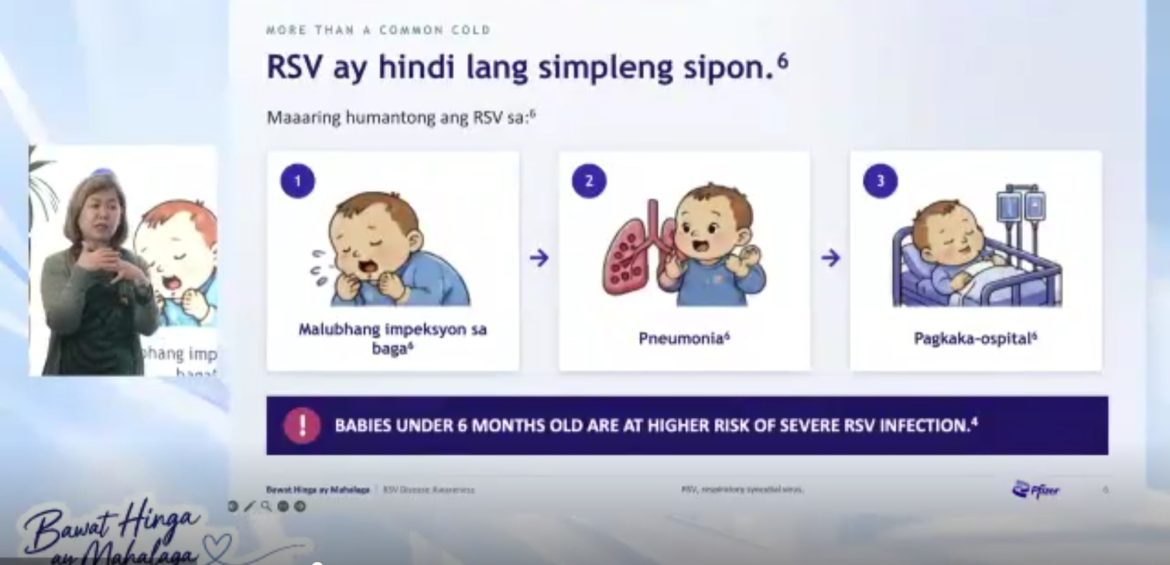
HEALTH experts warn about the burden of respiratory syncytial virus (RSV) in young children, highlighting the need for early detection and recognition of concerning symptoms.
In line with this, they launched the “Bawat Hinga ay Mahalaga” campaign launched on Friday, Oct. 16, to give renewed attention to RSV and the importance of seeking timely medical advice.
The discussion highlighted a nine-year case-series study that identified RSV as the most common virus detected among Filipino children below five years old who were hospitalized with severe pneumonia.
Through the campaign, families can turn awareness into responsible action: learn the signs of RSV, reduce exposure to respiratory infections where practical, and seek timely professional advice.
Babies under 6 months old are vulnerable to RSV
Dr. Anna Ong-Lim, current adviser and past president of the Pediatric Infectious Disease Society of the Philippines (PIDSP), explained RSV is a contagious respiratory virus that poses a serious health risk to infants and young children in the Philippines.
“In a certain proportion of patients, you can actually develop problems like difficulty of breathing, coming from infections in the lung and pneumonia and this can lead to hospitalizations,” Dr. Ong-Lim said.
The Research Institute for Tropical Medicine (RITM) Department of Virology 2024 Annual Report shows that RSV-related infections mainly affected children under two years old, with one in four reported cases occurring in infants aged five months and younger.
RSV affects the airways and lungs and may lead to serious respiratory illness, including pneumonia, in infants.
In the country, Ong-Lim said most of the patients are under the age of six months. “RSV is very common, with most children experiencing at least one infection by their second birthday,” Ong-Lim said.
The first infection may occur when a child is only a few months old, while the immune system is still developing, and infants have smaller airways that can become inflamed, which may contribute to more serious illness.
A year-round burden
Dr. Ong-Lim discussed RSV circulates every month of the year, and can affect individuals both in the outpatient setting, in the hospital and out detecting both severe flu and COVID-19 in severe disease.
Citing the RITM Department of Virology 2024 Annual Report, Ong-Lim said RSV is present every month but surges towards the wetter and colder months of the year: September to February.
Across the 2024 surveillance, RSV peaked detection in October to December. She added that there is also an overlap between RSV and flu detections once the colder and wetter months start.
Meanwhile, RSV strikes beyond the hospital, and outpatients with influenza-like illness can test positive from RSV. Ong-Lim said these patients have a 6% chance of being RSV positive.
“RSV presents with a spectrum of illnesses, can be mild and severe and is found all-year round,” she said.
Maternal immunization: Babies’ first defense vs. RSV
Maternal health expert Dr. Martha Aquino, president of the Philippine Infectious Diseases Society for Obstetrics and Gynecology (PIDSOG), discussed the importance of vaccination for pregnant women.
Aquino emphasized that maternal immunization or the administration of vaccines during pregnancy protects both the pregnant person and the newborn infant.
“When you introduce a harmless vaccine, it’s a part na nakikilala ng body natin pagka na inject, gagawa ng panlaban ang ating body sa kanya, eventually, dadami yun. Pag dumami siya, nandun yung inunan na nagde-develop, so mayroon siyang highway para ma-transmit papunta kay baby, that is what you call passive immunization,” Aquino said.
She added the Immunoglobulin G reaches the baby, developing ready-made protection from the antibodies it got from the mother.
“Automatic, mayroon na siyang protection laban sa sakit. Doon sa mga bakunang natanggap niya and long-lasting immunity na mayroon ang mommy na pwede niyang ipasa kay baby, hindi siya magta-take ng time para mag-develop ito kasi ready-made na siya,” Aquino said.
Published evidence notes that antibodies passed from mother to baby during pregnancy contribute to an infant’s early immune protection. But these antibodies naturally decline over the first months of life, hence young infants remain vulnerable to respiratory infections such as RSV.
Every breath matters: recognizing the warning signs of RSV
Dr. Catherine Joile Carelle Roux Ong, chair of the OB-GYN Tondo Medical Center and president of Philippine Society of Maternal Fetal Medicine in 2025, discussed the warning signs of RSV.
Ong said possible symptoms in infants and young children include wheezing or unusual breathing sounds; fast, shallow, or labored breathing. It also includes low-grade fever, unusual irritability or fussiness, and reduced activity, lethargy, or increased sleepiness.
She added that warning signs also include poor feeding or decreased fluid intake of the baby.
“If you will look at the symptoms, it is not specific for RSV but more on respiratory problems, sa mga mommies wag na magpatumpik-tumpik you have to consult a doctor,” she noted that symptoms may vary, and a healthcare professional should assess any concerning change.
Ong stressed that the mothers should recognize that there is something wrong and bring the babies to the pediatrician.
“Karaniwang supportive ang pangangalaga sa RSV, kaya mahalaga ang maagang pagkilala at konsultasyon,” she stressed.
Simple habits to help reduce RSV exposure
Dr. Ana Belen Ignacio-Alensuela, board trustee of the Philippine Obstetrical and Gynecological Society (POGS), said good and simple habits help reduce RSV exposure.
Alensuela stressed that anyone can acquire RSV, as the virus can spread through respiratory droplets, direct contact with an infected person, or contact with contaminated surfaces.
Understanding how RSV spreads can help families follow practical measures that reduce exposure to respiratory infections.
Alensuela emphasized these include hygiene and sanitation practices, staying away from others when unwell, and following applicable public-health and clinical guidance.
“You can never tell who has the virus and there is no such thing as a high period of communicability because kahit early pa lang viral infections ng pasyente, pwede na yung makahawa,” she said.
Alensuela said every family can play a part in reducing exposure to respiratory infections.
Simple habits at home, including regular handwashing; covering coughs and sneezes, and keeping babies away from people who are unwell, can make a difference, especially for very young infants.