



BY ALEX ALAGON
BY ALEX ALAGON

IT IS our take that the suggestion of Davao City Police Office (DCPO) director P/Col Mannan Muarip to add prison time to the penalty for violating the liquor ban is worth considering by the Sangguniang Panlungsod.
Yes, for now violators are only slapped with fines that most of them can very well afford. Just think of this. Violators are mostly those who have the money to squander while enjoying the city’s nightlife. They are those who can afford to buy not just beer by the bottle but by the cases. They are also those who spend their time inside watering holes drinking imported wine and liquor that are priced exorbitantly.
In other words, if these people can afford to splurge money on an expensive vice like drinking, without doubt they, too, can afford to pay the fines. They are also the ones who are generous enough to offer bribes to law enforcers who catch them violating the liquor ban. And oftentimes, with a few hundreds, or maybe thousands of pesos surreptitiously slipped inside the arresting authorities’ pockets, suddenly, the violators go scot-free.
With prison time added to the penalty, there is certainty that liquor drinkers will have second thoughts doing their thing. That is, for wine and liquor merchants, or drinkers, to think not just twice but many more times if they have to pursue their desire to have bigger sales, or satisfy their craving for the intoxicating liquid.
We would be eagerly waiting who among our councilors will be the first to look into the viability of adopting Colonel Muarip’s recommendation.
*********************************
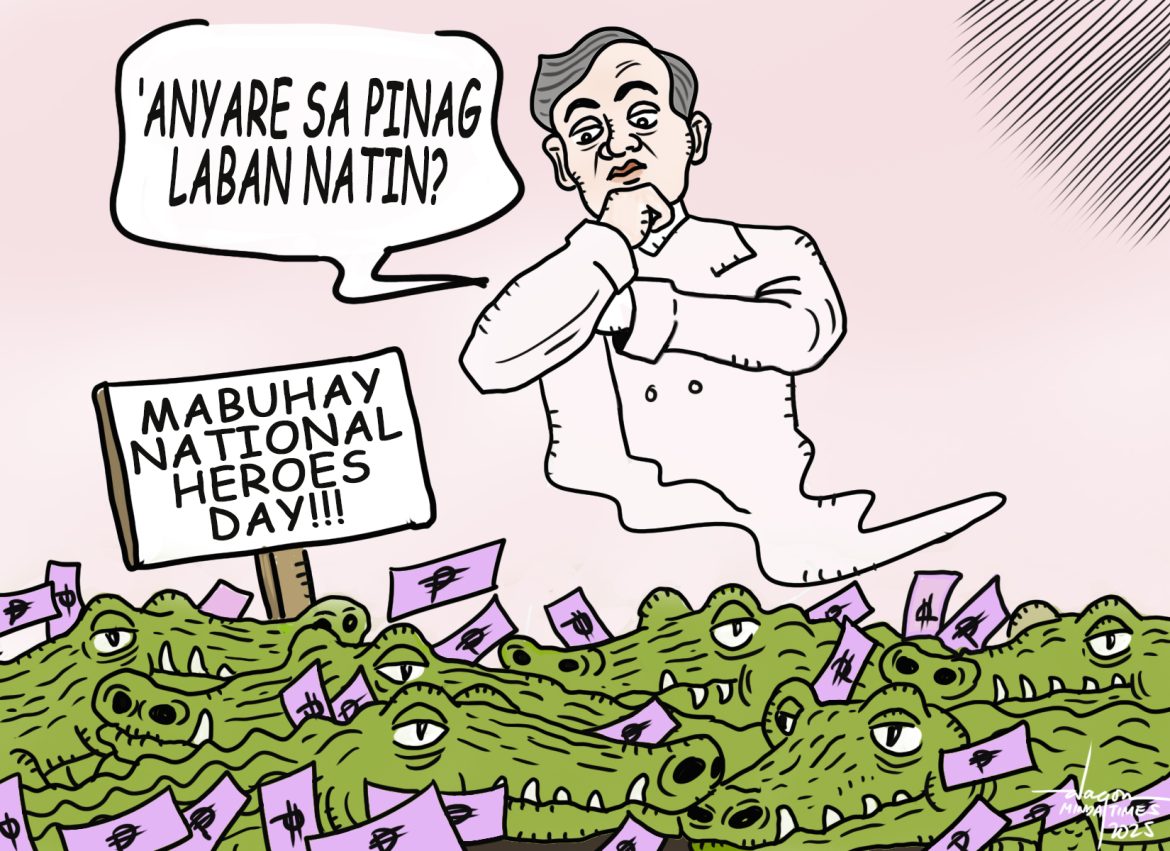
In some regions and local government units, this is how officials of government agencies and the contractors of infra-related projects, and the contractors themselves, are perpetuating corruption and giving supposedly “fairer” opportunities for contractors to get projects.
“We can only agree to claims that corruption in government, mostly through its many agencies and offices,
is indeed “systemic.” Meaning, it has adopted an elaborate system that allows its perpetuation.”
With the knowledge – perhaps the “blessing” of the agencies’ regional directors – the various accredited contractor firms craft some kind of an “agreement” every time a project is bidded out. They agree among themselves who will get to win in the bidding. The one scheduled to get the project will advise the others on the amount of its bid. The rest will submit higher bids than that of the one slated to win in the bidding.
But the catch is, the winning bidder commits to give certain amount of money to the supposed “losing” bidders. That is one scheme that earns easy money for the “losing” contractor. No sweat. No expense. Perhaps only the amount of the premium of the bidder’s bond and other documentary requirements in the submission of bids.
The concerned agency officials? Well, the rule has long been established as to the percentage after deducting the take of the project sponsor, whoever he or she may be. That gives the contractors assurance of having a continuing business relations with the concerned government agency or office.
And the winners in the succeeding projects to be bid out? Well, as per their “honorable” men’s agreement, they will be rotated.
And in some local governments where project costs are usually lower than those of the national government, contractors, mostly with lesser capital, have organized themselves into cooperatives. But, again, the members agree to give contractors their fair chance of undertaking locally funded projects. To make sure that no non-members will get the chance of barging into the co-op’s domain, the group gets the services of a “contactor,” one insider at the local government, to feed the cooperative information of projects in the pipeline for implementation.
Of course, to ensure getting hold of the project, the cooperative of contractors has already an existing unwritten agreement as to who gets how much and when, so contracts are facilitated.
Availability of cash resources of winning contractors? Well, there is not much need. The signed contract between the winning bidder and the concerned local government is more than enough guarantee that materials needed for the project can be acquired through credit from suppliers who also bloat the supplies’ prices.
How do we know this scheme, our readers may be quick to ask. Well, with the years that our previous work allowed us to deal with contractors doing business with government agencies, and with our agency insider sources established during the many years that we worked as a media person, getting this information is some kind of a “walk in the park.”
Meanwhile, we can only agree to claims that corruption in government, mostly through its many agencies and offices, is indeed “systemic.” Meaning, it has adopted an elaborate system that allows its perpetuation.
Two such systems are imbedded in the schemes we have mentioned early on in this column today.

“Mahiya naman kayo (You should be ashamed of yourself),” President Ferdinand Marcos Jr. told corrupt contractors and politicians tagged in failed flood control projects which affected Filipinos nationwide in three typhoon visits in July.
The president in his fourth State of the Nation Address on Monday, ordered a crackdown on all failed and ghost flood control projects and the involved personalities.
“Mahiya naman kayo sa mga kabahayan nating naanod o nalubog sa mga pagbaha! Mahiya naman kayo lalo sa mga anak natin na magmamana sa mga utang na ginawa ninyo, na binulsa niyo lang ang pera,” Marcos said.
He emphasized that politicians and government officials could not deny getting a percentage from every project.
“Huwag na po tayong magkunwari. Alam naman ng buong madla na nagkaka-racket sa mga proyekto. Mga kickback, mga initiative, errata, SOP, for the boys. Kaya sa mga nakikipagsabwatan upang kunin ang pondo ng bayan at nakawin ang kinabukasan ng ating mga mamamayan, mahiya naman kayo sa inyong kapwa Pilipino,” the president stressed.
A week before the SONA, the country was battered with flashfloods brought about by typhoons Crising, Dante and Emong and southwest monsoon rains.
Marcos said upon his inspection, the projects were either failed, damaged or non-existent.
He stressed in his SONA, he is directing the Department of Public Works and Highways to immediately submit a list of all flood control projects from every region that started or completed in the last three years.
“The Regional Project Monitoring Committee shall examine that list of projects and give a report on those that have been failures, those that were not finished, and those that are alleged to be ghost projects,” he added.
The list will be published for public scrutiny to help in the probe of the projects.
The president also called for an audit and performance review regarding these projects to ensure the money was well-spent.
“Sa mga susunod na buwan, makakasuhan ang lahat ng mga lalabas na may sala mula sa imbestigasyon. Pati na ang mga kasabwat na kontratista sa buong bansa,” he stressed.
The president vowed that in 2026 National Budget, he will return any proposed General Appropriations Bill that is not fully aligned with the National Expenditure Program, even if it means ending up with a reenacted budget.
“Hindi ko aaprubahan ang kahit anong budget na hindi alinsunod sa plano ng gobyerno para sa sambayanang Pilipino,” Marcos stressed.
Photo from the Presidential Communications Office
