
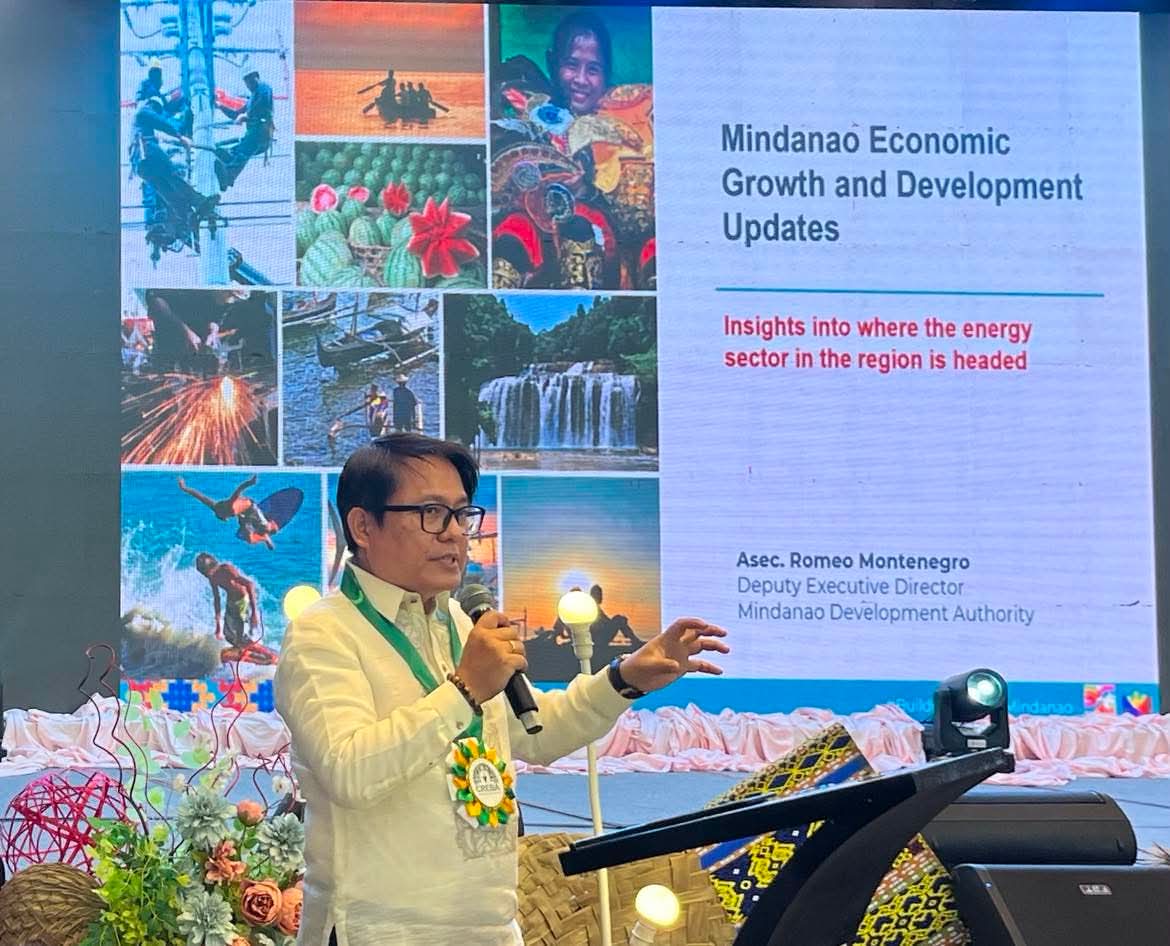
THE MINDANAO Development Authority (MinDA) has called on the property development sector to align its project programming with the island’s ongoing transition toward renewable energy.
Speaking at the 2026 Regional Housing Conference hosted by the Chamber of Real Estate and Builders’ Associations Inc. (CREBA) last Friday, July 24, an official from MinDA emphasized the critical role of private sector cooperation as Mindanao expands its economic growth.
“This is where we wanted the property sector, CREBA, to take into account in terms of joint planning and programming for property sector development, at the same time, energy transition,” Asec Romeo Montenegro, MinDA deputy executive director, said.
“Ang dream po namin sa Mindanao, bawat tower, bawat property development will be powered by renewable energy,” he stressed.
Montenegro pointed out that major industrial facilities and warehouses across the island are already tapping into clean energy options such as geothermal and hydroelectric power to enhance product competitiveness and reduce environmental impact.
The agency envisions the property sector adopting similar approaches by embedding solar, hydro, and other clean power sources directly into real estate frameworks.
He cited the Nestlé manufacturing plant in Cagayan de Oro, Holcim Cement here in Davao, and several other warehouses and mega warehouses that are powered by renewable energy.
“Ganun din ang gusto natin in terms of presenting the development of the property sector for this to be powered by renewable energy,” he added.
In his report, Montenegro highlighted the call amid macroeconomic growth across the region.
In his report, five out of Mindanao’s six regions ranked among the top 10 fastest-growing nationwide in recent economic reporting.
Leading the growth trajectory is the Caraga Region, driven by its massive mineral and nickel processing potential, alongside sustained performance from the Davao Region, Northern Mindanao, and the Bangsamoro Autonomous Region in Muslim Mindanao (BARMM).
However, regional growth remains uneven due to persistent grid issues in specific corridors, citing the Zamboanga Peninsula lagging due to power transmission and grid stability issues.
He said that being located at the far end of the island’s transmission network, the peninsula frequently experiences voltage fluctuations and power disruptions.
To address these energy bottlenecks and power future developments, MinDA is working alongside the Department of Energy (DOE) and energy regulators to resolve transmission challenges while aggressively promoting decentralized clean energy integration.
“When we have better energy reliability, then we can have a better economic situation and better living,” Montenegro stressed.
He reiterated that integrating green energy into property sector planning is essential to sustaining Mindanao’s economic transformation and attracting foreign direct investment, while also supporting the region’s expanding trade integration within the BIMP-EAGA.