
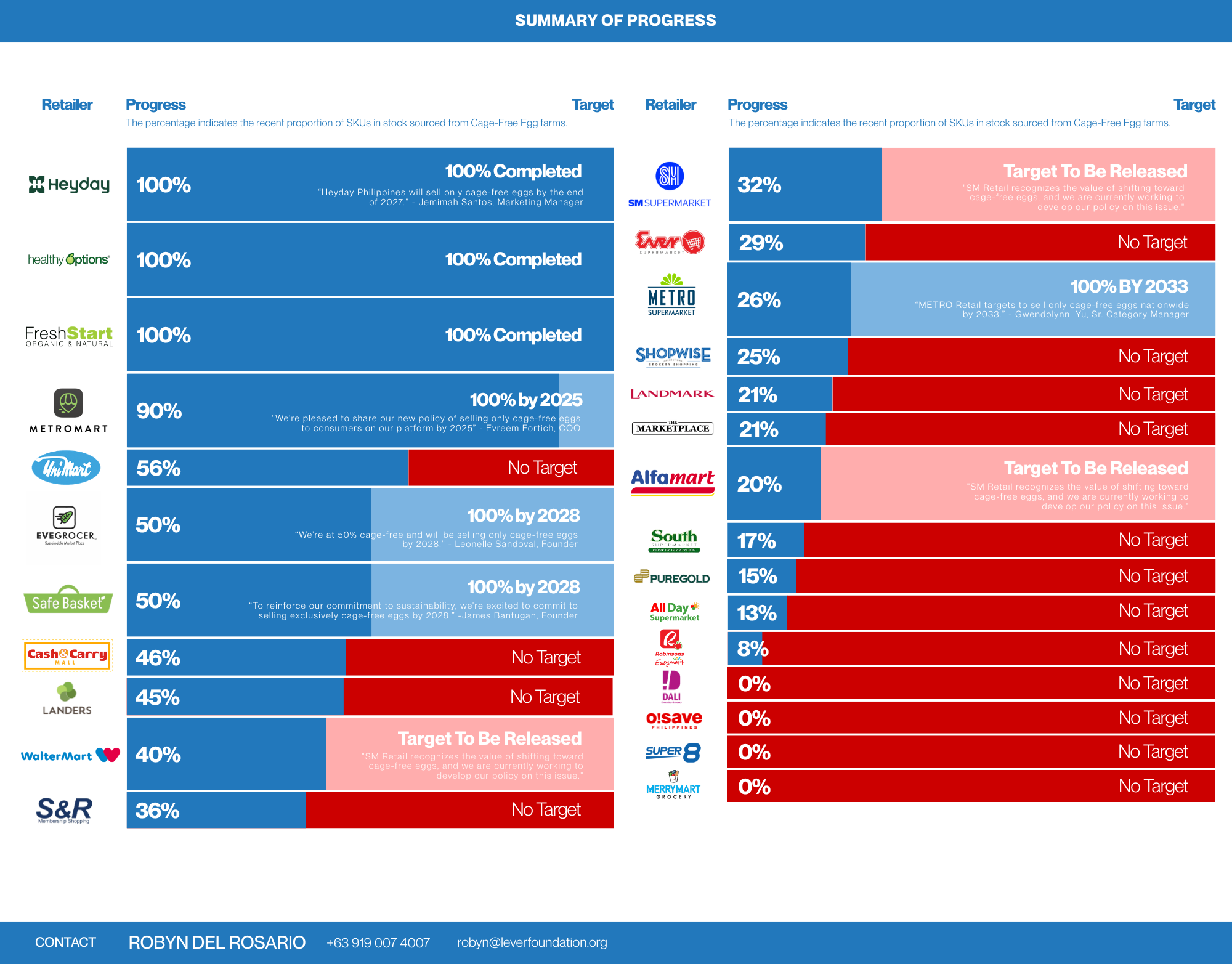
MANILA — Philippine retailers are making measurable progress on cage-free egg sourcing, with three major chains already having completed their full shift to cage-free and the majority of the sector expanding sales of cage-free eggs, according to the 2026 Philippine Retailer Industry Cage-Free Egg Progress Report released by Lever Foundation, an international NGO advancing humane and sustainable protein supply chains across Asia.
Among the 23 leading retail brands evaluated, 7 have already set a timeline for ending the sale of caged eggs across all operations. Three stand out for having already shifted to sourcing 100% cage-free eggs across all stores: Heyday, Healthy Options, and FreshStart, while e-commerce pioneer MetroMart follows closely, with 90% of its egg options cage-free. These retailers have marked the leading edge of a sector moving with increasing confidence toward responsible sourcing.
The sector also saw new commitments take shape. EveGrocer, an e-commerce retailer operating in key cities including Metro Manila and Cebu, has, in coordination with local government units, expanded the share of cage-free eggs it sells to 50%, with a pledge to source 100% cage-free eggs by 2028. METRO Retail, which operates more than 70 stores across Metro Manila, Luzon, and Visayas, has reached 26% cage-free eggs across its egg brands and has committed to reaching 100% cage-free eggs by 2033. Meanwhile, all brands under SM Retail—including Walter Mart, SM Supermarket, and Alfamart—have now transitioned 20%-40% of their egg SKUs to cage-free, as the group works on its own broader cage-free egg policy.
“The Philippine retail sector is taking meaningful steps toward more humane and sustainable sourcing,” said Robyn Del Rosario, sustainability program lead at Lever Foundation, which collaborated with several retail groups to develop their sourcing policies. “The progress we are seeing across the sector, from brands that have already completed their transition to cage-free to those that have set a target timeline for shifting 100% of their eggs to cage-free and are steadily building toward that goal, reflects a growing recognition that animal welfare, food safety, and sustainability are essential business priorities.”
The remaining retailers that have so far failed to set a timeline for ending the sale of caged eggs include Unimart, Cash&Carry, Landers, S&R, Ever Supermarket, Shopwise, Landmark, The Marketplace, South Supermarket, Puregold, All Day Supermarket, Robinsons Easymart, Dali, O! Save, Super8, and MerryMart. A growing body of peer-reviewed research suggests that well-managed cage-free egg production can help reduce the risk of Salmonella contamination compared with conventional caged systems. The Philippine government recognized the importance of shifting toward cage-free systems in 2020, when the Bureau of Agriculture and Fisheries Standards developed comprehensive animal welfare guidelines for cage-free egg production. Beyond sourcing standards, a growing number of consumers are choosing to leave eggs off their plates entirely, reflecting a broader shift in how Filipinos think about food and its impact.
“We’re encouraged by the momentum we’re seeing, and we’re confident that more retailers will set their own policy goals for shifting to 100% cage-free egg sourcing,” said Del Rosario. “We at Lever Foundation are eager to collaborate with additional retailers and share the learnings from those who have already begun or made the transition successfully. Cage-free sourcing is fast becoming the baseline expectation from consumers and the competitive standard in the Philippine market.”
The 2026 Philippine Retailer Industry Cage-Free Egg Progress Report evaluates retail brands on two dimensions: the proportion of egg SKUs currently sourced from cage-free farms, and the existence of a policy commitment to reach 100% cage-free sourcing within a specific timeframe. The retail sector’s progress also reflects the broader trajectory of the Philippines’ food industry. Nearly 80% of leading restaurant chains and nearly 85% of leading hotel groups across the country have already set timelines for phasing out the use of caged eggs, placing the retail sector’s advances in step with an industry-wide shift spanning the country’s food landscape.