


NORWEGIAN Ambassador to the Philippines Christian Halaas Lyster urged the local and national governments to continue implementing good policies to attract foreign investments and boost the economy.
Speaking at the “EFTA-Mindanao Dialogue: Maximizing Opportunities in the Regional Growth Corridor of Southern Mindanao” held at Seda Abreeza on Tuesday, April 28, Lyster noted that the good trade and investment opportunities between EFTA countries and the Philippines are attributed to the positive policies at the local and national levels.
The European Free Trade Association (EFTA) is an intergovernmental organization established in 1960 to promote free trade and economic integration for its member states. It consists of four countries: Iceland, Liechtenstein, Norway, and Switzerland.
The Philippines-European Free Trade Association (PH-EFTA) Free Trade Agreement, signed on April 28, 2016, became effective for Norway, Liechtenstein, and Switzerland on June 1, 2019, and for Iceland in 2020.
EFTA-PH FTA eliminated 99.9% of duties on industrial goods as of entry into force, and eliminated 89-99% of tariffs within seven years after entry into force.
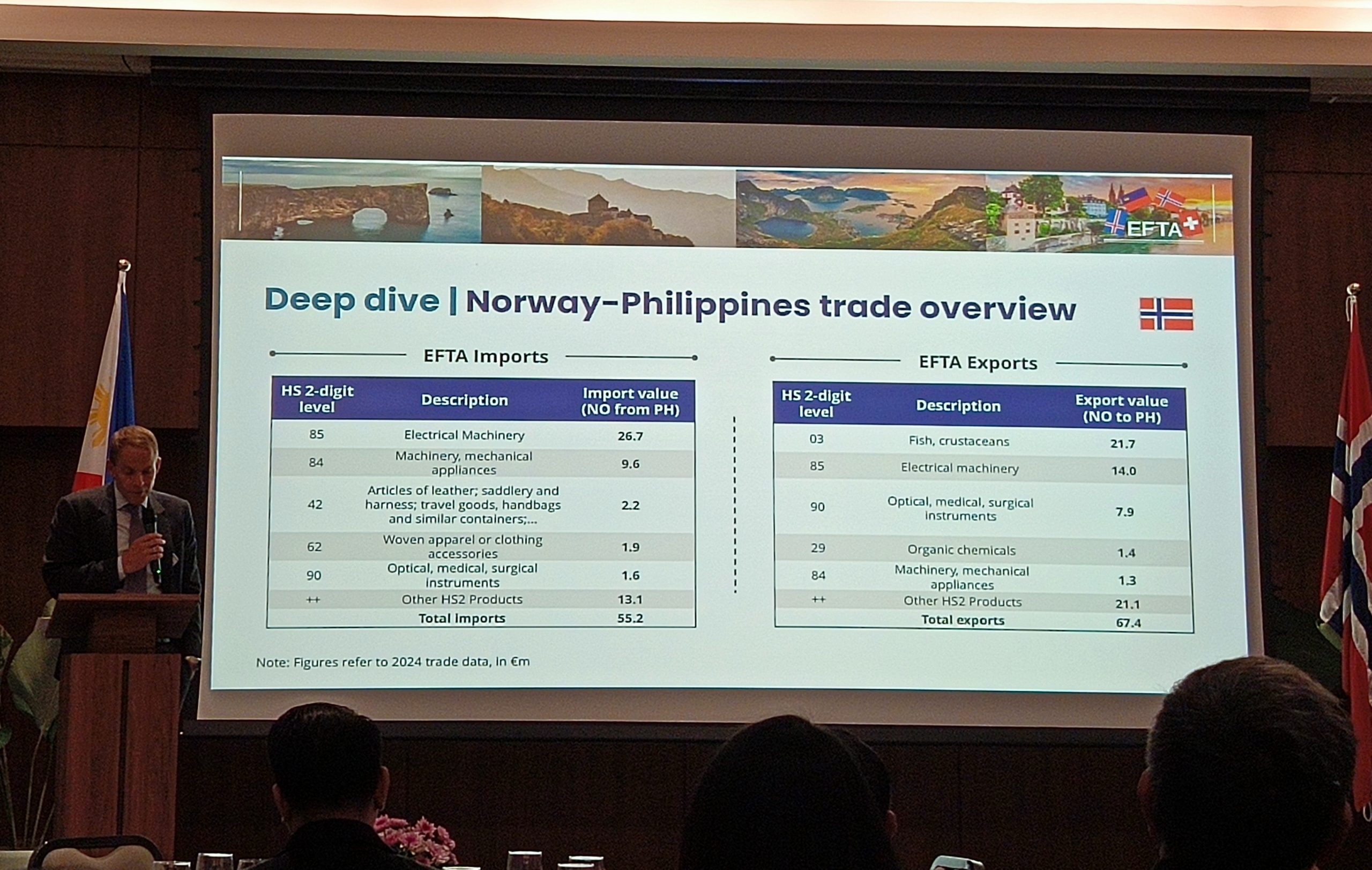
According to the trade data report of EFTA-PH, the total imports in 2025 are about EUR 297 million, while the total exports are valued at EUR 393 million.
The import average growth rate over the last five years is at 2.1%, while the export average growth rate over the same period is at 3.3%.
Lyster emphasized that the business environment in the country over the years has become better for foreign investors and also foreign businesses.
He cited the opening of 100% ownership of renewable energy and the ease of doing business law, which are positive for business engagements in the country.
The country now allows 100% foreign ownership in the renewable energy sector, removing the 40% caps to boost investments.
Through Department of Energy Circular No. 2022-11-0034, foreign entities can fully own projects in solar, wind, biomass, and ocean/tidal energy, in a bid to reach 35% renewable energy share by 2030 and 50% by 2040.
Meanwhile, the Ease of Doing Business and Efficient Government Service Delivery Act of 2018 (Republic Act No. 11032) amends the Anti-Red Tape Act of 2007 to streamline and expedite government transactions in the country, mandating a strict processing time (3-7-20-day rule), and promoting digital adoption.
“I think the most important thing now is for the Philippines to continue good policies in order to attract foreign investments and businesses and make sure that the Red Tape is being reduced,” Lyster said.
He emphasized that the policies should not stop at the national level but also be practiced at the local level, as businesses are concentrated at the local level.
“It’s not enough that we see positive developments at the national level; we also have good developments at the local level,” he said.
Lyster lauded the city government of Davao for developing policies and ordinances that make it easier to establish businesses and even incentivize them.
Christian Cambaya, chief of the Investor Assistance Servicing Unit of the Davao City Investment and Promotion Center, presented the City Ordinance No. 0148-25, further amending the Davao City Investment Incentive Code/
The Code was officially approved on its third and final reading on Dec. 12, 2025, providing a more competitive fiscal package and expanded investment areas.
Fiscal packages that new investors can avail of include a five-year graduated business tax exemption for new projects, where they can now enjoy 100% exemption for the first three years, 60% in the fourth, and 40% in the fifth year.
Additionally, new projects will receive a three-year exemption from basic Real Property Tax and up to five years of exemption from Mayor’s Permit fees.
“There have been a lot of good policies, and it’s important to keep that trend moving forward,” he stressed.
Lyster addressed the Davao business community, emphasizing Norway’s diverse portfolio in the Philippines, spanning seafood, shipbuilding, maritime industries, circular economy initiatives, renewable energy, and agriculture.
He said Mindanao businesses should capitalize on the trade agreements and reduced tariffs to explore the potential for even more exports from Mindanao to EFTA countries.
The ambassador emphasized that key economic sectors for trade between the Philippines and the EFTA countries include machinery, chemicals, watchmaking, oil and gas, fisheries, and services, including maritime transportation, among others.