



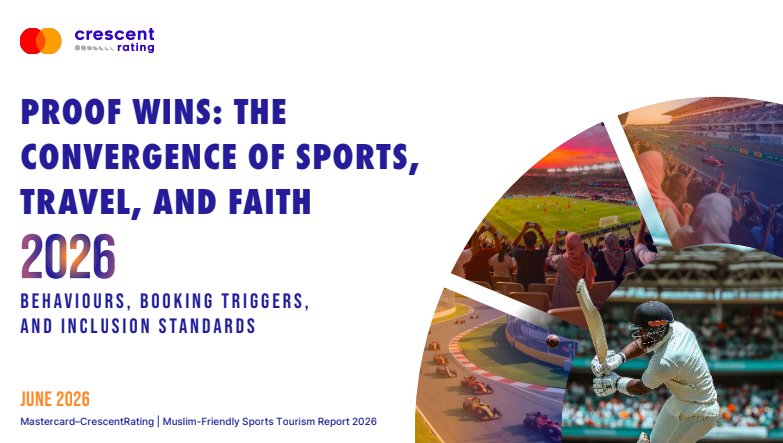
MASTERCARD, in collaboration with CrescentRating, released a report highlighting the growing economic potential of Muslim-friendly sports tourism, projecting the market could reach US$21 billion globally by 2030 if destinations and event organizers strengthen inclusion and confidence across the travel journey.
Proof Wins: The Convergence of Sports, Travel, and Faith examines how Muslim travelers discover, plan, and attend sports events, and identifies the key factors that convert interest into bookings. The research finds that while enthusiasm for sports travel among Muslim travelers is high, participation depends heavily on clear and trusted information around essentials such as Halal food availability, prayer facilities, transport logistics, and secure payment options.
A growing opportunity in sports tourism
With global Muslim travel continuing to expand, sports events represent an increasingly valuable tourism driver. Current projections show the Muslim sports-event travel spend pool growing from around US$11 billion in 2025 to US$17 billion by 2030. When destinations make Muslim-friendly readiness visible during the booking stage and deliver it consistently on the ground, the opportunity could expand further to US$21 billion by the end of the decade.
This potential growth is fueled by two measurable shifts: greater participation from Muslim travelers when faith-compatible services are clearly communicated, and stronger in-venue spending when Halal food options are well-labeled, accessible, and trusted.
Converting interest into attendance
Muslim international arrivals are expected to grow from 186 million in 2025 to 245 million by 2030, supported by a young and digitally connected population that is increasingly motivated by experience-led travel. Yet today, only around 6% of international Muslim trips include attendance at a sports event, highlighting a substantial untapped market for destinations and organizers that can convert interest into attendance.
Several factors shape whether travelers ultimately commit to a sports trip. Affordability and value remain the most important considerations, followed by access to Halal food and prayer facilities, and confidence in safety and crowd management. When these elements are visible early—particularly during ticket discovery and trip planning—travelers are significantly more likely to follow through with bookings.
Building confidence across the travel journey
Digital discovery plays a decisive role in the sports travel journey. Social media is the primary channel through which Muslim travelers learn about sports events, often inspiring group travel among friends and family. However, conversion happens only when that discovery leads quickly to trusted information, including official ticket links, venue access details, transport plans, and reliable digital payment options.
“Sports tourism is entering a new phase of global growth, where experiences, community, and cultural connection matter as much as the event itself,” said Aisha Islam, senior vice president, Customer Solutions Center, Southeast Asia at Mastercard. “Through Mastercard’s long-standing presence in global sports, including collaborations with the UEFA Champions League, the McLaren Mastercard Formula 1 Team, and the Australian Open, Mastercard sees how major sporting moments can connect fans, destinations, and businesses at scale. As major sporting calendars continue to make their way across Southeast Asia, the region is firmly establishing itself as a hub for high-profile sporting experiences. Muslim travelers represent one of the fastest-growing segments in global travel. When destinations provide clarity and confidence — from payment security to Halal dining and prayer access — they unlock significant participation and spending potential.”
“What this research clearly shows is that demand alone is not the constraint—confidence is,” said Fazal Bahardeen, founder and CEO of CrescentRating. “Muslim travelers are highly motivated by major sporting events. But participation increases only when essential needs such as Halal food, prayer access, and transport are clearly communicated and trusted well before travel begins. Destinations in Southeast Asia that connect iconic sports moments with visible Muslim-friendly readiness are best positioned to convert interest into attendance and sustained economic impact.”
For destinations and event organizers, the report findings highlight a clear opportunity to strengthen the appeal of sports events for Muslim travelers. When faith-friendly amenities such as Halal food assurance, prayer-ready spaces, and accessible venue infrastructure are embedded into event planning and clearly communicated before booking, they strengthen visitor confidence, increase attendance, and boost spending across the travel ecosystem.

