
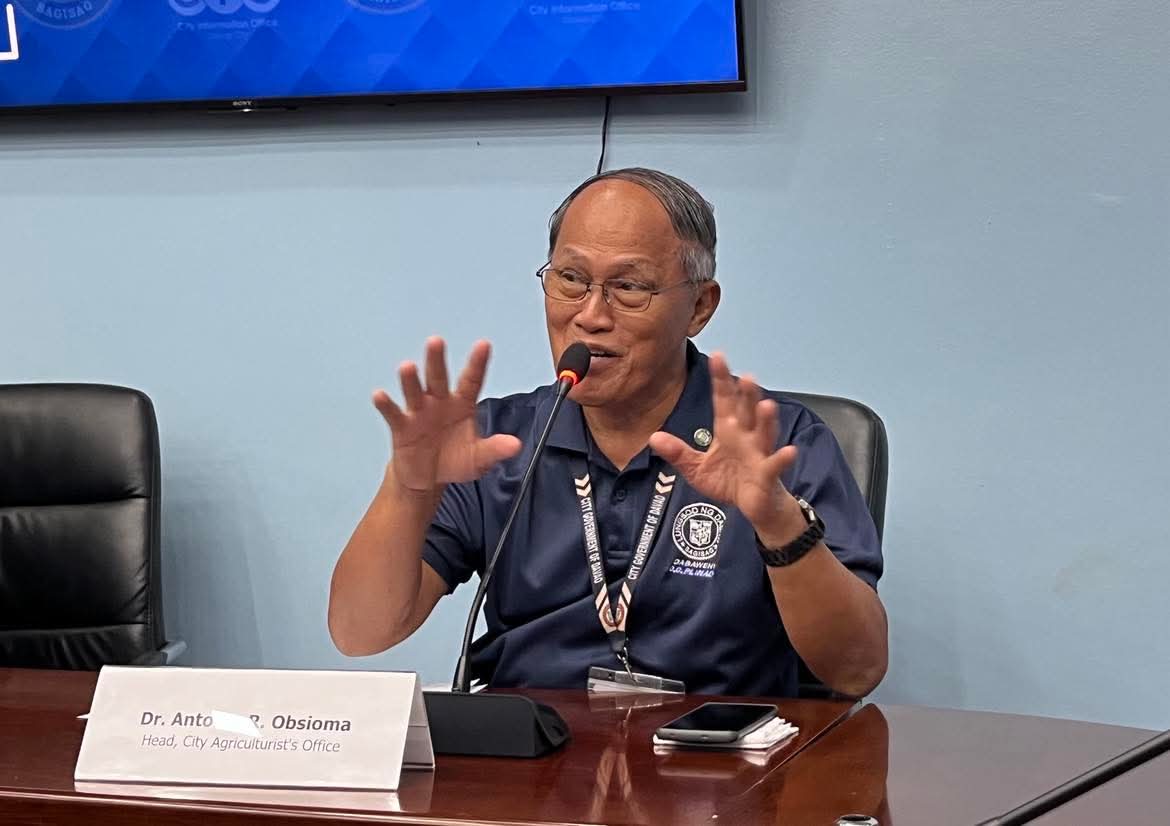
AN OFFICIAL of the City Agriculturist’s Office (CAgrO ) said the local government’s plan to establish its own soil and water laboratory is still pending.
CAgrO head Antonio R. Obsioma said the office drew up a plan for Davao City to have its own soil and water laboratory, allowing more frequent and accessible testing for farmers.
Obsioma said farmers continue to lack easy access to soil testing services as the cost is high and the process is slow and centralized.
“Ang problema sa soil testing kasi, mahal. Tapos, ang nagko-conduct lang niyan ay ‘yung Bureau of Soil and Water Management. At matagal din ‘yung proseso,” he said during the iSpeak media forum on Sept. 10.
The official said the plan has not moved forward, largely due to cost, as setting up a complete facility would require an estimated ₱100 million or more, with equipment alone requiring a high price.
In the meantime, the city is currently using a mobile soil laboratory provided by the Department of Agriculture’s Regional Field Office XI as CAgrO is pursuing potential funding partners to help establish a permanent facility.
Obsioma said an Australian group approached the office earlier this year expressing interest in initiating a research project in Barangay Marilog, and CAgrO has proposed the group to help establish a soil and water laboratory as part of that engagement.
The proposal, however, remains in its early stages and is contingent on funding approval.
The office has also engaged the Japan International Cooperation Agency (JICA), meeting with its representatives to request assistance with facilities.
He noted that any JICA-backed proposal must first pass through the National Economic and Development Authority (NEDA), which takes considerable time.
Other foreign entities, including from China and Japan, have separately expressed interest in offering agriculture-related assistance to the city.
To keep pace with funding opportunities, Obsioma said CAgrO has dedicated personnel to continuously draft project proposals, including large-scale ones.
“Hindi ‘yung nandiyan ang funding institution, tsaka pa lang gawa ng proposal. Kung may mga big project tayo na tinatanaw, dapat ready na, nandiyan na,” the official said.
The push for improved soil monitoring comes as CAgrO also promotes regenerative agriculture practices among local farmers.
Obsioma said this approach has shown early positive results on soil condition and pest resistance in pilot farms across Mindanao.
Regenerative agriculture focuses on restoring soil vitality by adding organic matter and beneficial microbes, reducing reliance on expensive synthetic inputs.
Trials in neighboring regions have shown significant cost savings for farmers, with rice growers utilizing regenerative methods reported lowering input expenses from over ₱1,800 per fertilizer bag down to under ₱1,000 to ₱2,000 overall.
He added that crops raised under regenerative conditions displayed better pest resilience and heavier grain weights compared to chemically treated plots.
“With regenerative agriculture, soil conditions improve over time. As soil health recovers, we expect production outputs to continuously rise while offering safer food for consumers,” he said.
CAgrO is partnering with non-governmental organizations to send local farmers, cooperative members, and city technicians to Claveria, Misamis Oriental for specialized training on regenerative farming practices on Oct. 12 to 14.