




Eight dugongs. Three weeks. Across Southeast Asia.
 01/04/26 – Lupon, Philippines 04/04/26 – Baganga, Philippines
 04/04/26 – Sultan Kudarat, Philippines 07/04/26 – Boston, Davao Oriental, Philippines 09/04/26 – Coron, Palawan, Philippines 09/04/26 – Yao Noi Island, Thailand 09/04/26 – Kaselok, Papua New Guinea 17/04/26 – Lucatan, Tarragona, Philippines
This is not coincidence.
This is not natural fluctuation.
This is collapse occurring in real time.
Dugongs are already among the most vulnerable marine mammals in the world—slow to reproduce, dependent on fragile seagrass ecosystems, and unable to recover quickly from sustained loss.
In parts of Southeast Asia, they are not just threatened.
They are disappearing.
So when eight die in three weeks, the question is no longer what happened.
The question is: why is nothing stopping it?
Protection Without Presence
The protection exists. The classification exists. The policy language exists.
But in the water—the only place that matters—presence is inconsistent.
No sustained visibility in known feeding grounds.
No reliable deterrence in high-risk coastal zones.
No clear evidence that protection is active at ecosystem level.
When animals continue to be entangled, struck, and displaced, protection becomes administrative—not physical.
And administrative protection does not prevent extinction.
Regulation Without Control
Fishing is regulated. Waters are managed. Gear is governed.
Yet dugongs continue to drown in nets and suffer preventable deaths tied directly to human activity.
The gap is not knowledge.
It is enforcement where it matters most.
If a protected species continues to die inside regulated waters, then regulation is not reaching the ecosystem it claims to control.
Authority Without Accountability
Coastal development continues across vulnerable shorelines. Sediment flows increase. Runoff intensifies. Seagrass beds—the only food source dugongs depend on—are degraded, fragmented, and buried.
Each loss of seagrass is not an abstract environmental change.
It is a removal of life support.
And without that foundation, survival becomes impossible regardless of protection status.
Deaths Without Answers
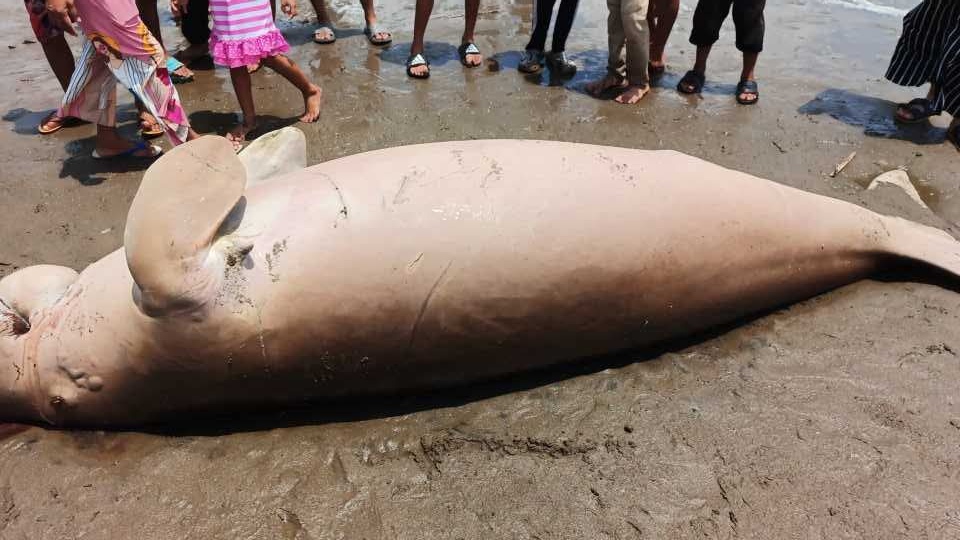
Every dead dugong is evidence.
Cause of death is not speculation—it is knowable science.
Entanglement. Vessel strike. Starvation. Toxic exposure.
Yet too often, carcasses are not fully examined.
Too often, decomposition replaces investigation.
Too often, data is lost before it is recorded.
There is no fully consistent national rapid-response system ensuring every stranding is treated as an urgent scientific case.
Without full understanding, prevention becomes repetition.
And repetition becomes decline.
A Pattern Without a System
There is no single national platform tracking dugong deaths in real time.
No unified alert when multiple deaths occur within days.
No centralized escalation when regional patterns emerge.
No immediate public signal when something is clearly wrong.
Instead, information is fragmented—scattered reports, isolated field updates, delayed acknowledgements.
Eight deaths in three weeks should be impossible to overlook.
Yet it is not visibility that is missing.
It is consolidation.
And without consolidation, urgency dissolves into noise.
A System That Sees Too Late
When loss is fragmented, it becomes easier to delay response.
Not because the events are unknown.
But because they are never assembled clearly enough, fast enough, or loudly enough to demand immediate action.
And in that delay, more loss occurs.
Silently.
More Than One Species
Dugongs are not isolated wildlife cases.
They are ecosystem engineers.
They maintain seagrass meadows that:
- Support fisheries
- Stabilize coastlines
- Store carbon
When dugongs disappear, seagrass declines.
When seagrass declines, fish stocks weaken.
When fish stocks weaken, coastal communities feel it directly.
This is not only conservation biology.
This is ecological infrastructure failure.
Loss Without Use
There are institutions capable of responding—recovering stranded animals, conducting necropsies, preserving skeletons, and turning loss into long-term scientific and public education.
That capacity exists.
But it is not consistently applied at the scale required.
Every unrecovered animal is lost evidence.
Every unexamined death is missing data.
Every missed case is a missed warning.
A report fades.
A physical specimen remains.
One disappears into archives.
The other cannot be ignored.
The Bottom Line
This is not a mystery.
Dugongs are dying from:
- Fishing pressure
- Habitat destruction
- Vessel strikes
- Pollution
And while protections exist, outcomes suggest they are not consistently reaching the ecosystems they are meant to defend.
Eight deaths in three weeks is not a warning.
It is a trajectory already in motion.
The Question
How many more?
How many more before protection becomes physical, not theoretical?
Before seagrass is treated as essential infrastructure, not background ecology?
Before every death is investigated as urgent data—not delayed recordkeeping?
Because dugongs cannot absorb continuous loss.
And when response lags behind reality, extinction does not arrive suddenly.
It arrives gradually.
Predictably.
Until only records remain.
And silence where a species used to be.
About the Work Behind the Silence
At the center of this work is D’ Bone Collector Museum Inc. Founded by Dr. Darrell Blatchley
A conservation and natural history institution built not on comfort, but on urgency.
Operating without consistent government funding, it works at the frontline of marine loss—responding when stranded wildlife becomes evidence, and when ecosystems fail in real time.
What is recovered does not end as loss.
It becomes science.
It becomes record.
It becomes education that cannot be ignored.
Through field recovery, skeletal preparation, and long-term preservation, the museum transforms marine death into permanent testimony. Each specimen is not an exhibit—it is proof that a life existed, and that its end can still teach something the living world refuses to forget.
Over time, this work has drawn international recognition in the fields of marine conservation, education, and natural history preservation, placing Philippine-based conservation and marine mammal skeletal documentation into broader global scientific and educational conversations.
But recognition is not the purpose.
The purpose is permanence.
In a system where reports fragment, attention fades, and losses are quickly reduced to numbers, this work exists to make sure disappearance is never silent.
Because when ecosystems collapse slowly, the first thing to vanish is not life.
It is evidence.
And this work exists to keep that evidence visible.

