
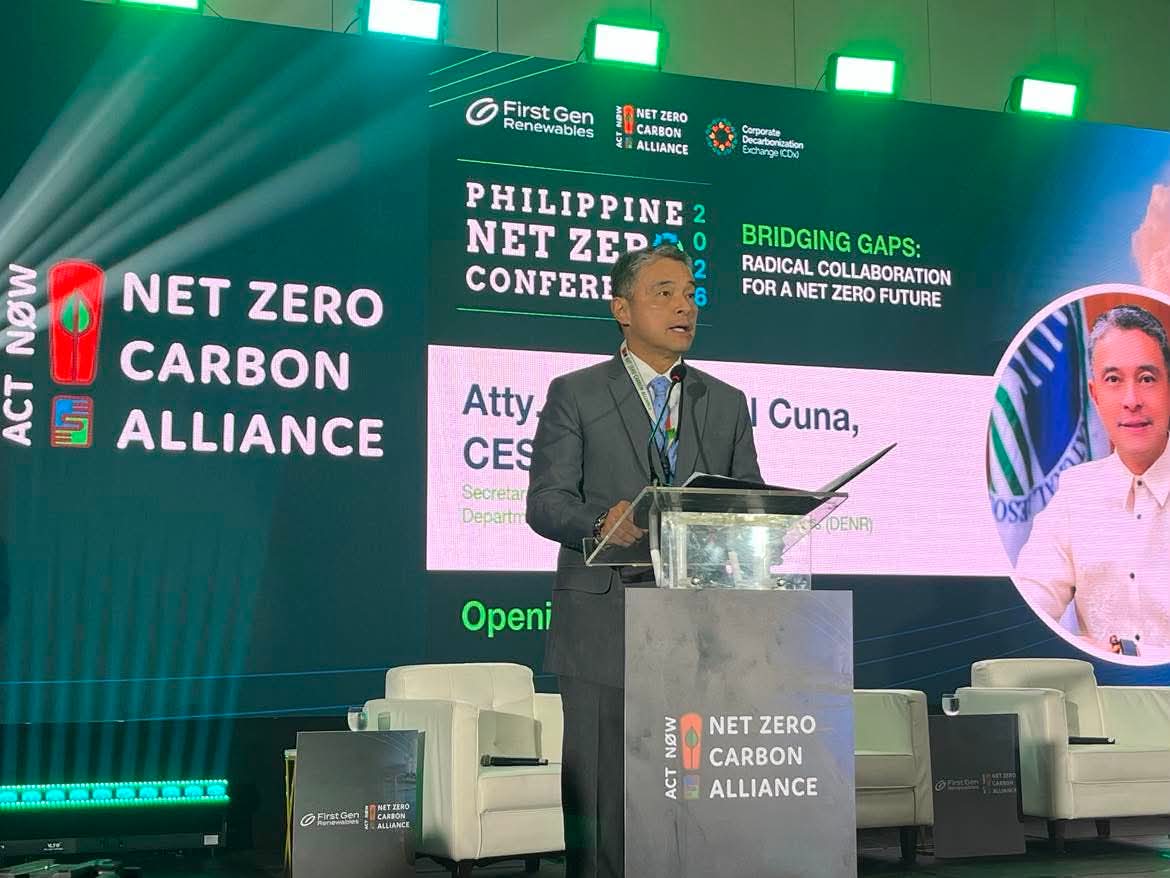
ENVIRONMENT Secretary Juan Miguel T. Cuna on Tuesday, Sept. 15, called on businesses, financial institutions, and local governments for accountable execution of the country’s climate commitments.
Cuna laid out the Philippines’ updated emissions-reduction roadmap at the Philippine Net Zero Conference 2026 on Sept. 15, at the Pasay Trade Training Center.
In his keynote address, Cuna said the Philippines has committed to cutting or avoiding 75% of its projected emissions from 2025 to 2035, a target anchored in the country’s enhanced 2026 Nationally Determined Contribution (NDC).
The 75% target is split into two components: a 7% unconditional contribution that the country will meet through domestic resources and capacities, and a 68% conditional contribution that depends on international climate finance, technology transfer, and capacity building.
Cuna described the 2026 NDC as the country’s “national economic platform,” linking climate action to energy security, fiscal resilience, and social protection.
He said delivering on the target requires a unified set of policy tools, including a Long-Term Strategy, an NDC Implementation Plan, a Just Transition Framework, a carbon market policy framework, and a financial and investment plan.
“A low-carbon transition cannot succeed if it is technically sound but socially disruptive,” Cuna stressed.
The Just Transition Framework, he added, is meant to ensure that decarbonization does not come at the expense of vulnerable sectors, informal workers, and local communities.
He reported that the Department of Environment and Natural Resources (DENR) is working to operationalize a corresponding implementation plan.
The secretary also highlighted the country’s reliance on nature-based solutions, citing Department Administrative Order No. 2026-30, which institutionalizes nature-based solutions in the Philippines under the International Union for Conservation of Nature (IUCN) Global Standard.
He said the country’s forests, mangroves, and coastal ecosystems position it as a “global lung” and net carbon sink, with sustainable forest management tied to tenurial security, community rights, and benefit-sharing.
Meanwhile, the country’s blue carbon ecosystems mangroves, seagrass meadows, and tidal wetlands provide coastal defense and storm surge mitigation in addition to carbon sequestration.
On carbon markets, Cuna said the Philippines is building its portfolio under Article 6 of the Paris Agreement, citing an Article 6.2 implementation agreement with Singapore, signed on April 30, 2026.
The agreement established a framework for internationally transferred mitigation outcomes.
He also reported the Joint Crediting Mechanism with Japan, featuring five approved methodologies, including alternate wetting and drying for agricultural emissions and afforestation and reforestation, with 31 more projects in development.
The country has emerging bilateral talks with New Zealand, Hungary, and South Korea.
Additionally, seven Clean Development Mechanism activities transitioned under the newer framework, alongside 14 new mitigation activities submitted for consideration.
“We welcome international capital, but we will not compromise carbon accounting integrity, double-counting protections, or national rights,” Cuna said.
The secretary appealed to private companies to audit their carbon footprints and join local carbon offset schemes such as the Voluntary Carbon Offsets (V-CAT) program.
He also called on financial institutions to stop treating climate projects as high-risk and instead make green financing more accessible, and co-create investable project portfolios.
Local government units and agencies are directed to integrate climate expenditure tagging into their budgets and streamline permits for green infrastructure, while the civil society and labor groups are asked to help monitor the just transition process.
International donors are called to deliver on grant-based support, technology transfer, and loss-and-damage financing to help unlock the country’s conditional target.
“The policy frameworks are set. The opportunities are here. Let us build the bridges together,” Cuna said.
Francis Giles B. Puno, president of First Philippine Holdings and First Gen, called on industry, government and academic leaders to act despite uncertainty in pursuing the country’s net zero goals.
In his remarks, Puno said the most urgent gap the sector must close is between stated ambitions and the choices made.
“The question before us is no longer whether we understand the urgency of the transition. It is whether we can make good choices despite the uncertainties, guided by the one constant before us: the future we envision and the conviction that our collective action must work for all,” Puno stressed.
Puno said no single company, government, financial institution, technology provider or academic institution can achieve net zero alone, and argued that the Net Zero Carbon Alliance’s success should be measured by outcomes rather than declarations.
The conference, themed “Bridging Gaps: Radical Collaboration for a Net Zero Future,” was organized by the Net Zero Carbon Alliance (NZCA) in partnership with Southeast Asia Corporate Decarbonization Exchange (CDx).
Running on Sept. 15–16 at the Philippine Trade Training Center in Pasay City, the two-day summit brought together business leaders and the private sector to push for fast-tracking of corporate decarbonization and building long-term climate resilience amid global energy crises.