
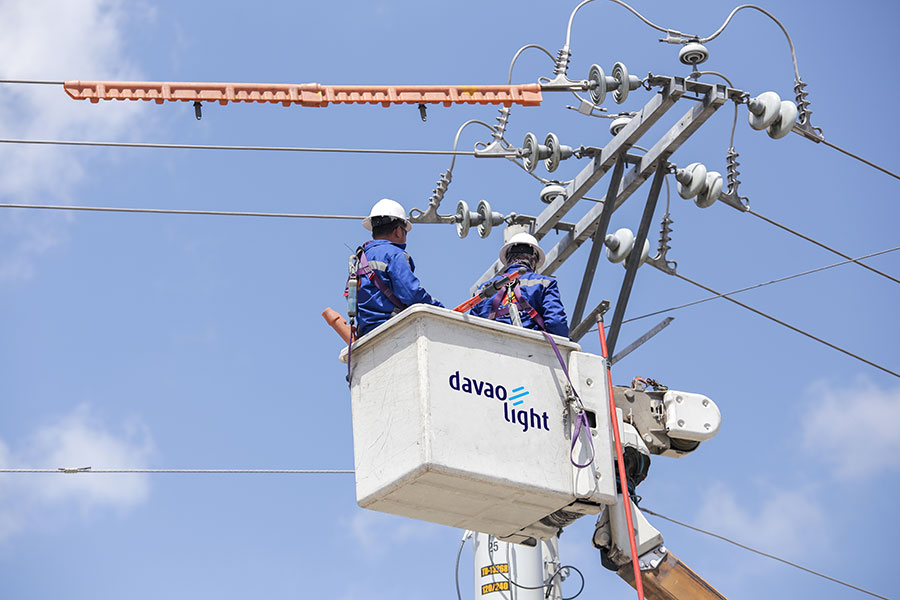
DAVAO Light and Power Co., Inc. (Davao Light) will conduct switching power interruptions on Monday, Dec. 8, 2025, in the Municipality of Sto. Tomas, Davao del Norte. These are necessary to facilitate the line-clearing activity along the Marsman footbridge and the line-upgrading works of the Kapalong line.
The first power interruption will be for 8 hours from 7 a.m. to 3 p.m., affecting customers from Marsman going to New Katipunan, including the entire Sto. Tomas Poblacion area.
The second interruption will be for 10 hours from 7 a.m. to 5 p.m., affecting customers from New Katipunan going to Luna Kapalong.
Meanwhile, the normalization or return of loads to their normal setup will be conducted for 45 minutes anytime between 4 p.m. to 5 p.m. Specifically affected are those from Sto. Tomas Fire Station to New Katipunan.
Davao Light apologizes for the inconvenience caused by these scheduled power interruptions. But it will exert all efforts to restore electric service as scheduled or earlier. However, there may be instances where restoration may extend beyond the schedule due to unavoidable circumstances.
Safety is paramount to the company, and Davao Light reminds the public to always take extra precautions when passing by activity areas where line repairs and maintenance are being done. Please heed and follow warning signs, especially in areas where personnel operate heavy equipment.
Please contact our 24/7 Customer Contact Service at (082) 229 3572 or 0919 056 3572 for any power interruption that will fall outside the given schedule.
Contributor
THERE are political questions that skim the surface, and there are those that land heavily because they mirror what many of us have long felt. After a coffee break with former co-teachers, a fellow educator quietly asked why the party-list system now feels like a reunion of familiar surnames rather than a home for neglected sectors. She said it lightly, but the tired half-smile on her face was something every teacher recognizes—the fatigue of explaining fairness to young people while the system itself refuses to practice it. Her question followed me on the ride home. The mechanism meant to lift the margins had slowly become a shortcut for people who were never truly on the edges.
When the party-list system was introduced, its promise was simple: widen the halls of power for those who rarely got a seat. Farmers, workers, fisherfolk, PWDs, women, senior citizens, youth, solo parents, LGBTQ++, indigenous peoples, caregivers, transport workers—those whose daily realities rarely reach the policy tables. It was supposed to be a political equalizer. Yet decades later, studies such as Kontra Daya’s 2025 report reveal that 86 of 156 accredited groups had ties to business interests or political clans. For teachers who try to instill civic ethics in their students, this number is not just concerning—it is disheartening.
The proof is scattered across past elections. DUMPER PTDA, supposedly for taxi drivers, ended up tied to a powerful provincial family. Agimat PL leaned on the Revilla name while claiming to represent workers. Duterte Youth spent years entangled in legal disputes over misrepresentation. Long before them, groups like 1-PACMAN raised eyebrows over corporate connections. These are not isolated scandals; they reveal what happens when weak rules meet strong incentives. Left unattended, loopholes do not stay small—they learn to grow.
Yet, in conversations with teachers, fisherfolk, student leaders, and health workers, the call is not to abolish the system. People still believe it can work—if we remove those who treat it as a backstage entrance to Congress. Public sentiment shows frustration, yes, but not resignation. Many say abolition risks muting the very voices the Constitution wanted to amplify. As one young organizer told me, the system is not broken; it has been borrowed by those who never needed it. What people want returned is ownership.
The loudest reform proposal is stricter screening. Communities now insist on actual proof of sectoral work, living membership, and advocacy that did not begin only when campaign materials were printed. It is similar to what teachers call authentic assessment: show your work, not just your slogan. A group with no grassroots presence is like a student who turns in a project without learning anything—impressive on the surface, hollow underneath.
Defining “marginalized” more clearly is another major demand. The Constitution left the term wide, which allowed bad-faith interpretations. People now ask for measurable criteria—income ranges, community vulnerability, occupational risks, cultural exclusion. One mother from an informal settlement in Jaro put it plainly during a community workshop: “Kun klaro sa layi kon sin-o kami, mas mahapos kami maprotektahan (If the law is clear about who we are, it becomes easier to protect us).” Clarity is not bureaucracy. It is respect.
Just as urgent is the public insistence that nominees must truly belong to the sectors they claim. This is not romanticism—it is common sense. A son of a farmer, my student, in Barotac Nuevo once told me he wanted representatives who knew the weight of a failed harvest, not just the vocabulary of one. His point mirrors what scholars like Hanna Pitkin, author of “The Concept of Representation,” argued decades ago: representation is strongest when lived experience and advocacy reinforce each other.
Transparency is another craving shared across communities. People want to know what their representatives filed, defended, or fought for. They want hearings attended, funds accounted for, and performance documented in ways ordinary people can understand. Groups like Mamamayang Liberal, Gabriela, ACT Teachers, Kabataan, Anakpawis, and Akbayan have offered visible legislative work, but others have become what teachers jokingly call “wallpaper congressmen”—present in designation, absent in contribution, suspect in corruption, and missing in execution. Democracy deserves more than placeholders.
Redundancy also frustrates voters. When five groups claim to speak for drivers or when multiple farmer blocs fight for the same votes, representation becomes splintered. Consolidation is not control; it is coherence. Teachers understand this intuitively. In class projects, we group students by common purpose because scattered voices rarely build something solid. Voters now seek the same logic in governance.
Even the framers of the Constitution, like Christian Monsod, have clarified that while the system was not meant to be exclusive to marginalized groups, it was always intended to deepen representation—not dilute it. The issue, he argues, is not the concept but the absence of firm anti-dynasty rules and poorly enforced guidelines. The Supreme Court’s Atong Paglaum decision widened eligibility, but it also created confusion that lawmakers never fully addressed. Reform—not demolition—is the remedy.
Senator Bam Aquino’s 2025 reform bill arrived at a time when the public was already articulating similar demands. The proposal—stronger screening, disqualification of nominees tied to incumbent officials, and community-vetted sectoral membership—echoes what many citizens have been calling for in consultations, classrooms, and barangay assemblies. Democracy strengthens not when everyone can run, but when those who do are genuinely rooted in the people they claim.
Where do we go from here? Reform requires political will, civic honesty, and patience. Teachers often tell students, “Show me your work, not your excuse.” Perhaps the same ethos must now guide policymakers. Representation must not be a theatrical role. It must be lived, demonstrated, checked, and renewed. If reforms succeed, faith in the system may finally grow again—not because it is perfect, but because it strives to be fair.
In the end, the party-list system does not need burial. It needs repair. It needs stronger filters, clearer rules, and representatives who approach public service the way good teachers approach their classrooms—with consistency, humility, and respect for the people before them. If citizens vote with both memory and conviction, the system can still fulfill its original purpose: opening the doors of Congress to those who were long kept waiting at the gate. That is the overhaul we owe to ourselves.
***
Doc H fondly describes himself as a “student of and for life” who, like many others, aspires to a life-giving and why-driven world grounded in social justice and the pursuit of happiness. His views do not necessarily reflect those of the institutions he is employed or connected with.
InLife@Work highlights retirement readiness during PMAP Annual Conference
First and largest Filipino life insurer InLife highlighted the importance of building a financially secure Filipino workforce as it served as a principal sponsor and key participant at the 2025 People Management Association of the Philippines (PMAP) Annual Conference, held at the Nustar Resort and Casino, Cebu City.
Through its flagship corporate program InLife@Work, InLife led the conversation on retirement preparedness and financial wellness during a featured session titled “Unleashing Financial Freedom: A Roadmap to a Secure Filipino Workforce.” The session unveiled data from its 2024 Retirement Study, the largest of its kind conducted in the country.
The study revealed that less than 30% feel confident about their financial preparedness for retirement and just half are actively taking steps to prepare. These findings point to a growing challenge for HR leaders: financial anxiety is now a workforce performance issue.
“Presenteeism, turnover, and disengagement are often rooted in financial stress,” said InLife Chief Risk Officer and Head of InLife@Work Efren Caringal Jr., who delivered the interactive session. “We launched InLife@Work to help companies embed financial care into their employee value proposition. We equip companies with the tools, data, and support they need to empower their people with confidence, clarity, and real financial solutions.”
InLife@Work also hosted an interactive booth experience featuring its new FinWell Ladder, a self-assessment and coaching framework, along with gamified engagement tools to spark conversation around retirement planning.
InLife@Work is the workplace and group engagement platform of InLife, dedicated to helping Filipino workers and their families achieve financial security and wellness through their employers, associations, or organizations. It brings together financial wellness education through its FinWell programs, insurance solutions tailored to personal needs, and strategic partnerships to scale impact.

The 62nd PMAP Annual Conference gathered more than a thousand of the nation’s leading people managers, HR professionals, and business leaders for three days of learning, collaboration, and inspiration. During the conference, PMAP Trustee Jerry Bonifacio underscored the importance of financial wellness as an organizational strategy. “A workforce that is financially secure is more focused, more loyal, and more empowered to perform at their best.”
To know more about InLife’s Retirement white paper, please visit https://bit.ly/RetireWithoutWorries. You may also try InLife’s Retirement Readiness Index Calculator at www.inlife.com.ph/retire-assure/retirement-readiness-index. To see how you can prepare for life after retirement, visit InLife Retire Assure at www.inlife.com.ph/retire-assure. Interested parties may also email inlifeatwork@insular.com.ph or visit www.linkedin.com/company/inlife-work/.
Beyond the Farm: How AECA Builds Leadership and Livelihoods Among Filipino Farmers
Manila, Philippines – For many Filipino farmers, success has long been measured by how well they can bring their harvests to the market. But across the country, a deeper shift is taking root: farmers are learning that progress becomes more attainable when they plan, decide, and grow together.

At the center of this transformation is the Agro-Enterprise Clustering Approach (AECA), a structured process that helps farmers organize themselves, develop leadership, and build agro-enterprises that can supply institutional markets reliably and competitively.
Clustering enables smallholder farmers to pool their produce, share resources, and make business decisions collectively. Instead of selling individually at low prices, clustered farmers operate as organized suppliers capable of meeting volume and quality requirements. This approach is a core component of the Agro-Enterprise for Inclusive Value Chains (AEIVC) Training Program developed by the Jollibee Group Foundation (JGF) in partnership with Xavier University (XU) – Ateneo de Cagayan in 2021.
Through the training, practitioners, agri-extension workers, and field partners gain the skills to guide farmer groups through the AECA process – from organizing members and studying markets to planning production and improving enterprise operations. By strengthening these AECA facilitators, more farmers are able to run their farms like business and pursue stable, long-term market partnerships.

Since 2021, the AEIVC Training Program has capacitated more than 339 agri- extension workers and partners who now guide farmer groups in applying AECA on the ground.
A strong example of AECA’s impact is seen in the work of KAISAHAN, a non- government organization that supports and empowers smallholder farmers and farmworkers in claiming their land rights. Through their participation in AECA Training, KAISAHAN gained a clearer direction and practical tools to guide the farmers they assist, helping them organize effectively and train farmer groups in collective marketing.
Agri-extension facilitators have been instrumental in this transformation. By coaching farmer groups and reinforcing good enterprise practices, they help clusters become more market-oriented and confident in engaging formal buyers.
“Before the training, I thought AECA was mostly about grouping small farmers into clusters and planning production on a larger scale. But as I got more involved and shared AECA with our partner communities, I realized it’s much more than that. The training gave me practical tools and a clear approach to help farmers improve their management and business skills, helping them overcome complex issues so they can actively participate in the agriculture value chain,” said Jec Magbato, KAISAHAN AECA Officer, Negros Occidental.

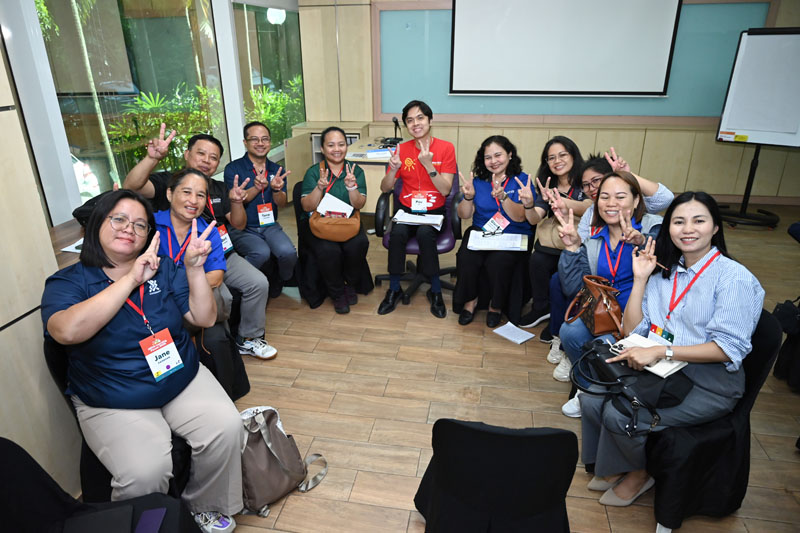
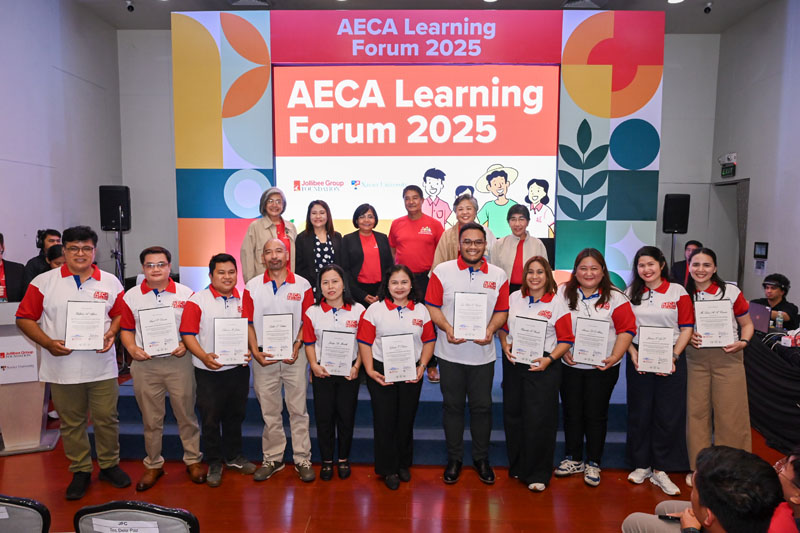
To support these practitioners, JGF and XU continue to provide platforms for collaboration and learning. One of these is the AECA Learning Forum, where trained implementers exchange field insights, share challenges, and strengthen their support for farmer groups nationwide.
Through AECA, smallholder farmers gain the confidence and capacity to plan production, negotiate prices, manage deliveries, and reinvest in their enterprises, thus making a shared, sustainable business out of farming. The approach embodies JGF’s commitment to promoting sustainable agriculture, contributing to food security, and helping communities achieve lasting progress.
When farmers work together and lead with purpose, the journey “beyond the farm” becomes one of dignity, resilience, and shared prosperity, contributing in meaningful ways to the country’s broader efforts towards Zero Hunger.
MAP says DTI’s P500 Noche Buena debate highlights struggle of Filipino Families
THE MINDANAO Alliance for Progress (MAP) says that the statement of Department of Trade and Industry (DTI) Secretary Cristina Aldeguer Roque — claiming that a P500 budget is enough to prepare a Noche Buena for a family of four — reflects a deeper problem of persistent poverty in the country.
The social advocacy group asserts that the issue is not about what P500 can afford, but the everyday struggle of Filipino families to put food on the table.
“The real issue is not the Noche Buena itself. It is the fact that many Filipinos remain so poor for the rest of the year that even a modest Christmas meal becomes a benchmark for what is considered ‘acceptable,’” MAP coordinator Mayet Valdez said.
MAP noted that wages have long failed to keep up with inflation, and families are increasingly forced to stretch meager incomes just to cover basic needs. For them, the debate over P500 symbolizes a bigger question about the quality of life.
“When wages are not enough, when monthly budgets never catch up with rising prices, and when families are forced to make do with less day after day — how can we say that one night of food, no matter how simple, is enough?” Valdez said.
MAP is urging the government to reframe the discussion, saying the issue is not about whether P500 can buy ham, spaghetti, and bread for Christmas Eve, but whether Filipino households can truly celebrate the season without hardship.
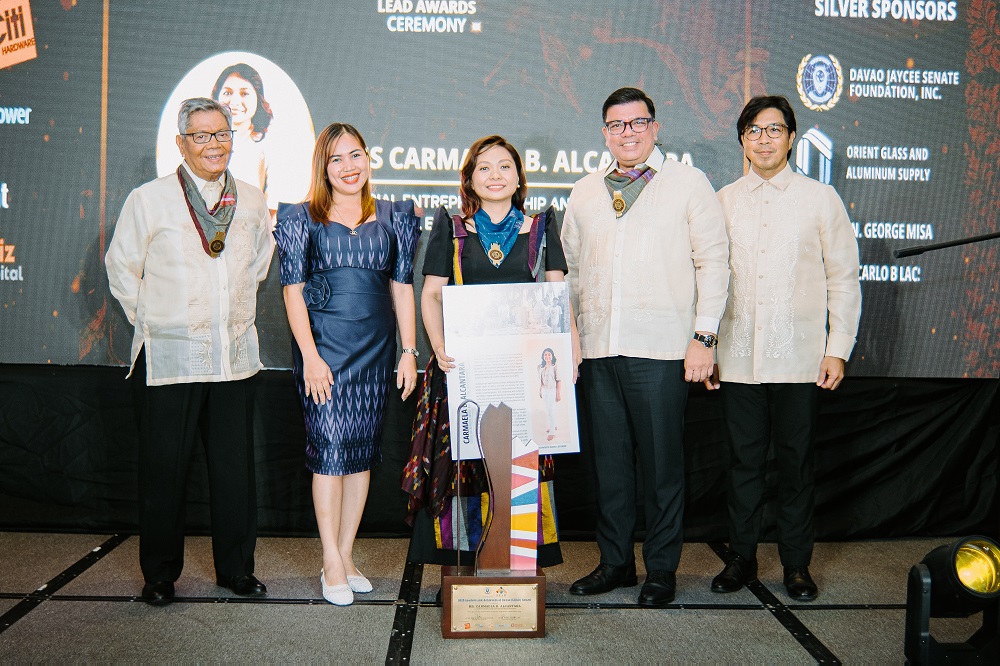
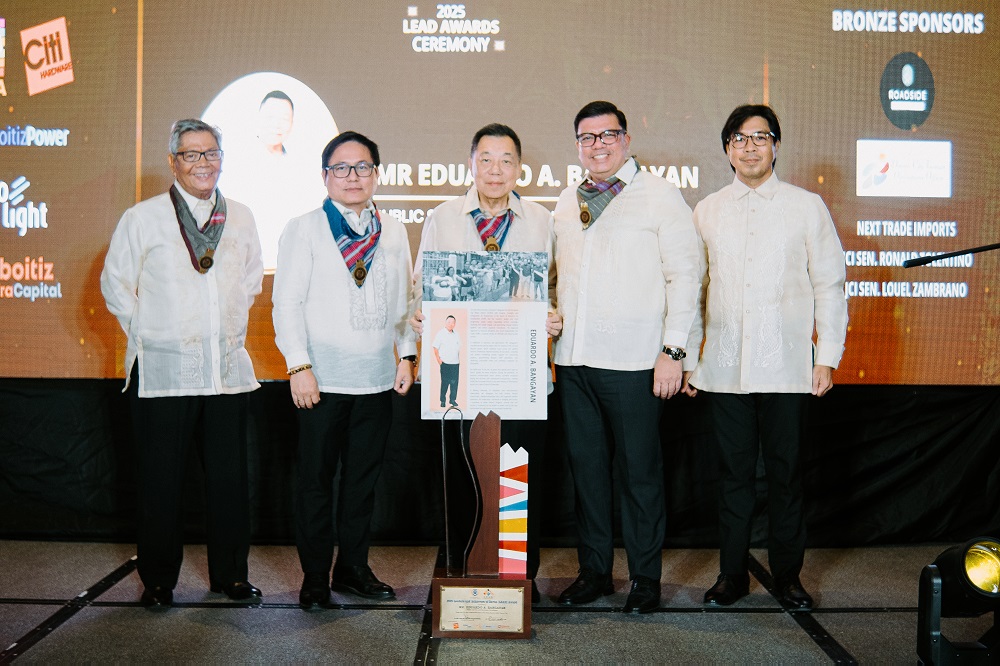
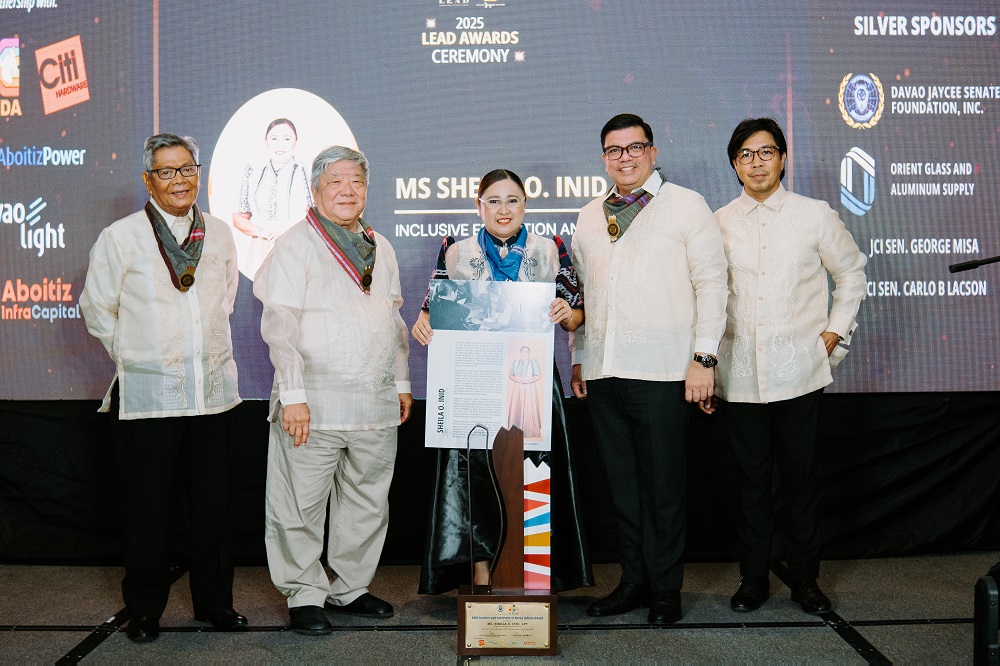
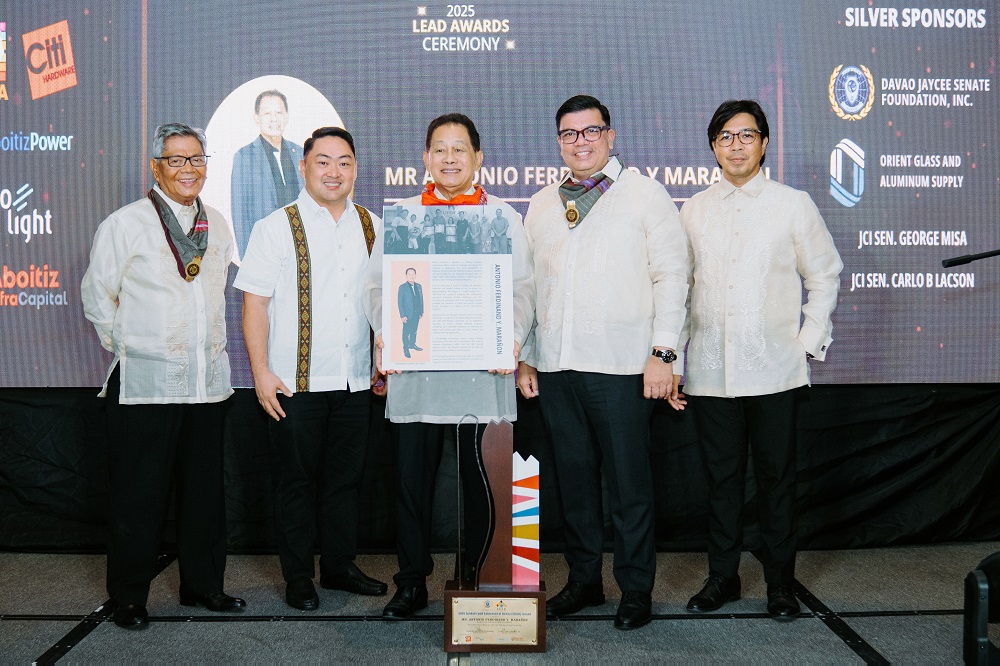
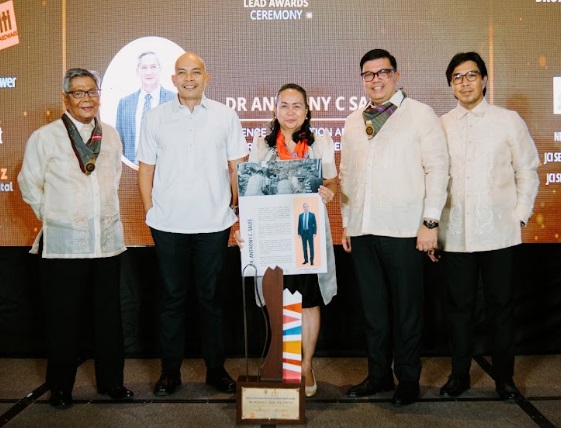
THE LEADERS and Achievers of Davao (LEAD), a flagship project of the Davao Jaycee Senate Inc., successfully held its 2025 Awarding Ceremony last November 21 at SEDA Hotel. The event gathered past honorees, institutional partners, and civic leaders, including esteemed Davao Jaycees members, in a celebration of leadership, service, and community impact.
The highlight of the evening was the recognition and awarding of this year’s five LEAD Honorees, whose exemplary achievements reflect the program’s theme, “Honoring Excellence, Inspiring Progress.” This year’s awardees are the following:
🏆 Carmaela B. Alcantara, Crystal Seas Inc. – Social Entrepreneurship and Cultural Empowerment

🏆 Eduardo A. Bangayan, Davao City Water District – Public Service and Business Excellence

🏆 Sheila O. Inid, Department of Education Davao City Division – Inclusive Education and Advocacy

🏆 Antonio Ferdinand Y. Marañon, SAGREX Inc – Agribusiness and Sustainable Development

🏆 Dr. Anthony C. Sales, HELP Davao Network – Science, Innovation, and Environmental Leadership

“Each honoree was celebrated for their outstanding leadership, integrity, and contributions that uplift their communities and professions”, said Jason C. Magnaye, 2025 president, Davao Jaycee Senate.
“The ceremony also reaffirmed the core objective of the LEAD program, which is to create a virtuous cycle of men and women who commit themselves to making Davao City a better place to live and work”, Magnaye added.
This year’s LEAD Awards was co-presented by the Mindanao Development Authority, Aboitiz Power Corporation, CitiHardware, Therma South, Inc., Aboitiz Infracapital, and Davao Light and Power Company.
Dusit Thani Davao hosts first-ever Kitchen Arena at Davao Food and Wine Festival 2025
DUSIT Thani Davao took centre stage in Mindanao’s culinary calendar as host of the first-ever Kitchen Arena, the highlight of the Davao Food and Wine Festival 2025. The three-week festival celebrated Mindanao ingredients, the chefs who champion them, and the community that continues to elevate the region’s culinary identity. Held at Dusit Thani Davao – Madayaw Café, Kitchen Arena delivered a dynamic showcase of talent, precision, and storytelling.
The festival, guided by Chairperson Carmina del Rosario, brought together chefs, producers, partners, and audiences in a shared mission to amplify Mindanao’s culinary voice and bring the region to a broader national and international stage.
A Vibrant Evening of Culinary Excellence
The Kitchen Arena programme was co-hosted by Kyle Jennermann of Becoming Filipino, whose warmth and enthusiasm matched the energy of the evening, and Kim Liu of Varigoods and Kozara Yakitori, who provided insightful culinary commentary and an accessible breakdown of the fast-paced action onstage.
Adding depth and balance to the competition was a distinguished panel of judges composed of JC Lo, a respected food columnist known for his refined and thoughtful critique; Pepper Teehankee, a veteran food and travel writer with a broad global perspective; and Nicole Hao-Bian Ledesma, a hospitality entrepreneur and industry leader who heads the JIB International Center for Hospitality and Culinary Arts and plays an active role in DATA (Davao Tourism Authority).
Four Chefs, One Stage, Countless Stories
This year’s Kitchen Arena gathered four chefs who each brought a unique culinary identity:
- Chef Rhea Rizzo – Mrs. Saldo’s | refined, heartfelt cooking shaped by global influences
- Chef Andrew Malarkey – Wild Siargao | bold “GLOCAL” cuisine with vibrant island character
- Chef Jeramie Go – Pilgrim | disciplined Toronto-trained technique grounded in Mindanao terroir
- Chef Dinan – Dusit Davao | luxury-hotel precision, calm leadership, and strong home-court presence


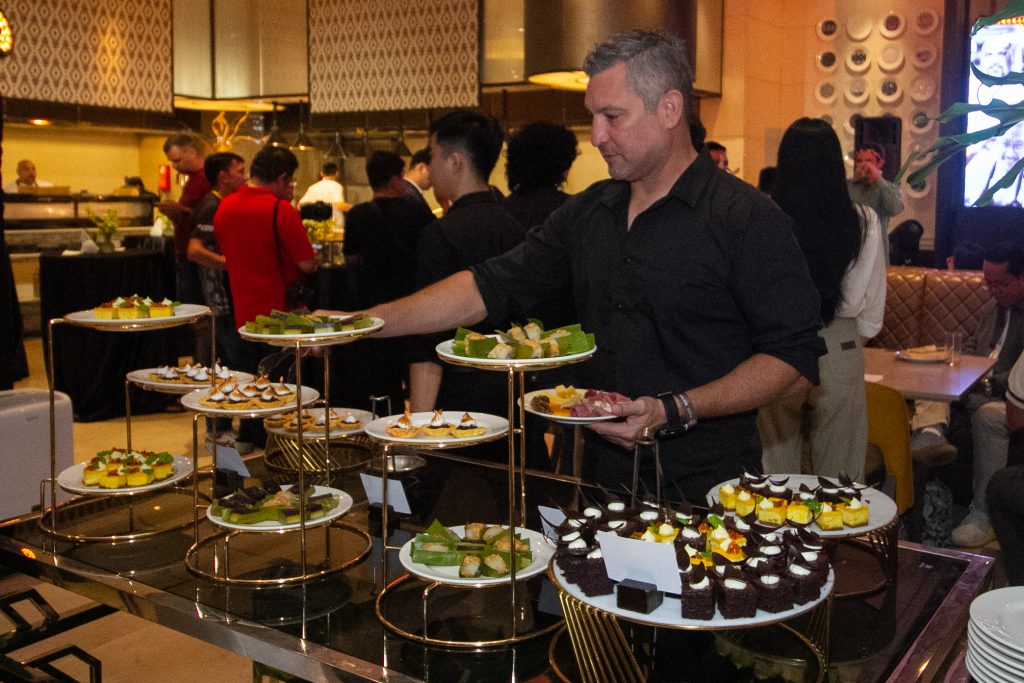
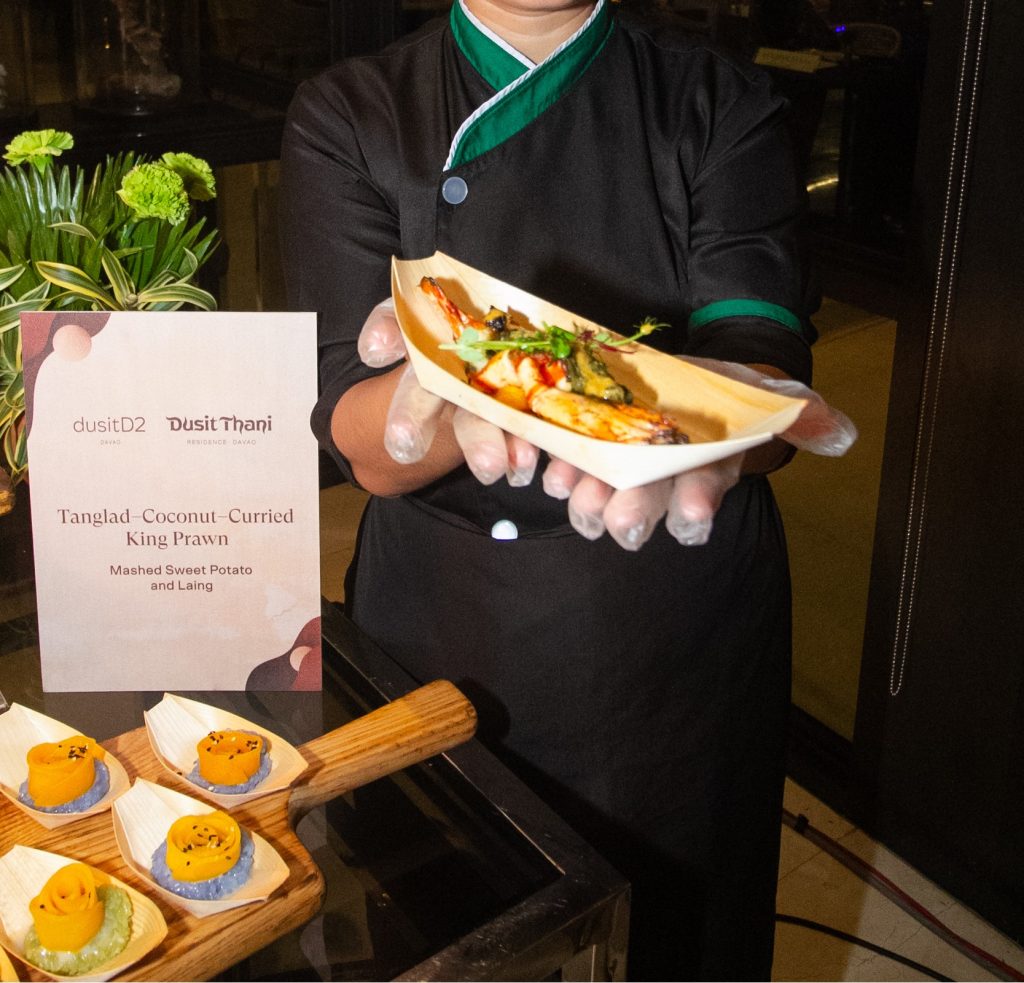
The evening opened with elegant tasting stations paired with Sula welcome cocktails and wines curated by Sommelier Selections, an intimate opportunity for guests to experience each chef’s culinary point of view before the competition unfolded.
The Heat of the Kitchen Arena
In true Kitchen Arena fashion, chefs crafted two dishes under timed conditions, drawing specialty equipment at random and gathering produce from the festival’s expansive pantry featuring Mindanao’s finest producers, including: Mindanao Butchers & Co., Alsons Aquaculture / Sarangani Bay, Hijo Fresh, Mothers Produce, Italian Specialists, Rafski, Agriya, Sula Spirits, Sommelier Selection, Sonic, Hoh Farm, Sonic, Pilgrim, Buyers Link, and Malagos Farmhouse.
Adding suspense to the night was the Secret Black Box, revealed only moments before the competition began. This year’s box featured Odong, the beloved Visayan noodle; fresh crabs sourced from Surigao; and Malagos Boracho cheese, an internationally recognised Davao icon—ingredients that pushed the chefs to showcase both creativity and mastery under pressure.
These ingredients challenged each chef to reinterpret regional staples with creativity and technical finesse.
A celebration of Mindanao’s culinary story


The night culminated in a guided tasting and final deliberation, followed by the announcement of the Kitchen Arena Champion — Chef Rhea Rizzo of Mrs. Saldo’s — a moment celebrated not only by the competitors but by the entire culinary community of Davao. The crowd’s favourite award was also presented to Chef Andrew Malarkey of Wild Siargao, whose dish resonated strongly with guests throughout the evening.
This year’s edition underscores Dusit Thani Davao’s steadfast commitment to nurturing local talent, supporting the culinary community, and championing Mindanao’s rich heritage, reinforcing the hotel’s role as a proud partner in elevating Davao as one of the Philippines’ most vibrant and compelling culinary destinations.
Many Filipinos still unaware of ICI; trust split among those informed — WR Numero November 2025 Survey
MANY Filipinos remain unaware of the Independent Commission for Infrastructure (ICI), and among those who are aware, trust is divided, but most support its recommendation to file charges over alleged corruption in flood control projects. These are among the findings of the November 2025 national survey by nonpartisan public opinion firm WR Numero.
The latest Philippine Public Opinion Monitor measured awareness and trust in the ICI, an ad hoc fact-finding body created by President Ferdinand “Bongbong” Marcos Jr. on Sept. 11 to investigate and recommend charges against officials and individuals linked to irregularities in flood control and related infrastructure projects.
The noncommissioned survey found that nearly 2 in 5 Filipinos (37%) have not heard of the independent commission. Meanwhile, 63% say they are aware of the body, but only 19% report being fully aware of it. (See Table 1)
Among those who know about the independent commission, trust is split. About 37% say they trust the ICI to conduct a fair and impartial investigation into corruption in the government’s flood control projects, while 32% say they do not. Another 31% are unsure. (See Table 2)
Trust in the commission also reflects factional divides. A large majority (67%) of Filipinos who support the Marcos family and their allies trust the commission established by President Marcos Jr. Distrust is highest among pro-Duterte supporters at 50%. (See Table 2)
Among those who identify with the opposition, trust is similarly divided: 37% trust the ICI, 35% are unsure, and 27% distrust it. Uncertainty peaks among independents at 44%. (See Table 2)
The Opinion Monitor also asked Filipinos about their views on the ICI’s recommendation to file charges against government officials allegedly involved in corruption in flood control projects,
including Sens. Joel Villanueva and Jinggoy Estrada, former Rep. Zaldy Co, and former officials of the Department of Public Works and Highways.
Among Filipinos aware of the ICI, nearly 7 in 10 (69%) say they agree with the body’s recommendations. Some 12% express disapproval, while roughly 2 in 10 (19%) remain unsure. (See Table 3)
The nationwide survey, conducted from Nov. 21-28, was done through face-to-face interviews with a nationally representative sample of 1,412 Filipinos residing in the Philippines, at a ±3% margin of error and 95% confidence level. At the subnational level, the margin of error is ±7% for the National Capital Region, ±4% for the rest of Luzon, ±6% for the Visayas, and ±5% for Mindanao, all at the same 95% confidence level. These findings form part of the WR Numero Philippine Public Opinion Monitor, Volume 2025, Issue 5 (November 2025 National Survey). The latest WR Numero November 2025 National Survey includes Filipinos’ latest perception on the flood corruption scandal and the Independent Commission for Infrastructure investigations, performance assessment of President Ferdinand “Bongbong” Marcos Jr., Vice President Sara Duterte, Senators, Congress, and the Judiciary, as well as views on the latest International Criminal Court proceedings, and policy priorities of Filipinos, among others.
Maxim Rides & Food Delivery Provides Relief to Typhoon Tino Victims in Cebu
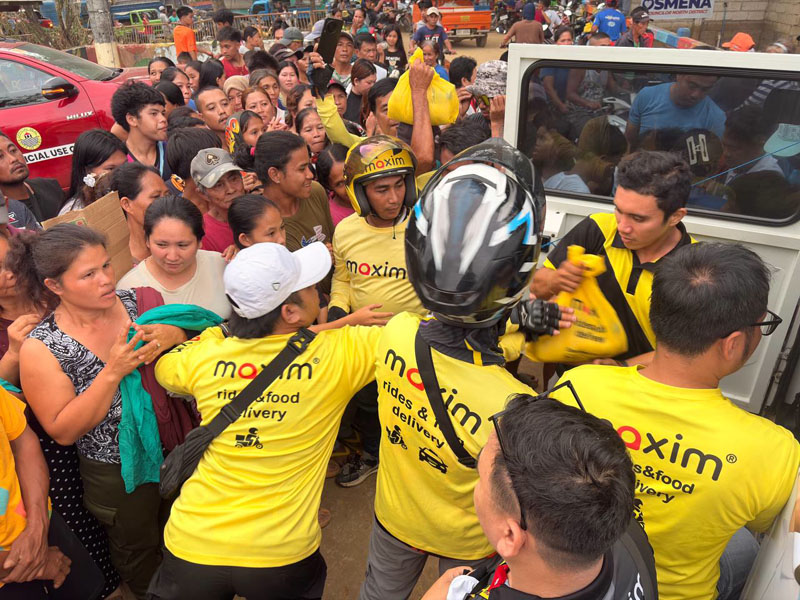
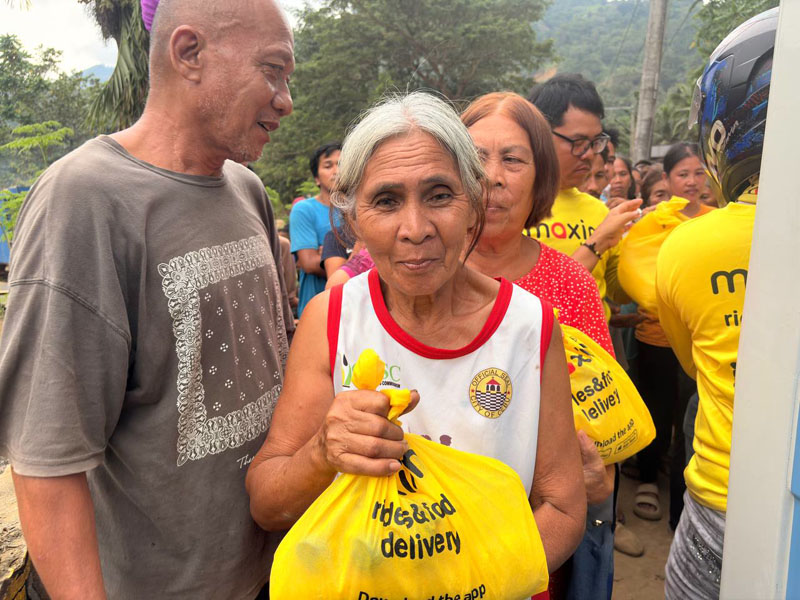
Cebu, Philippines – Maxim Rides & Food Delivery organized a series of relief operations to support residents affected by Typhoon Tino. The initiative aimed to provide immediate aid to severely impacted communities through the distribution of rice and bottled water.
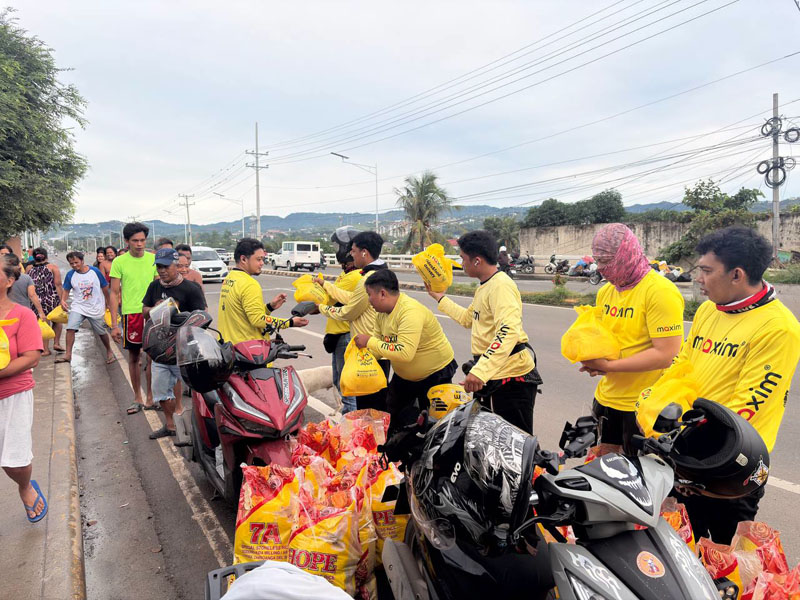
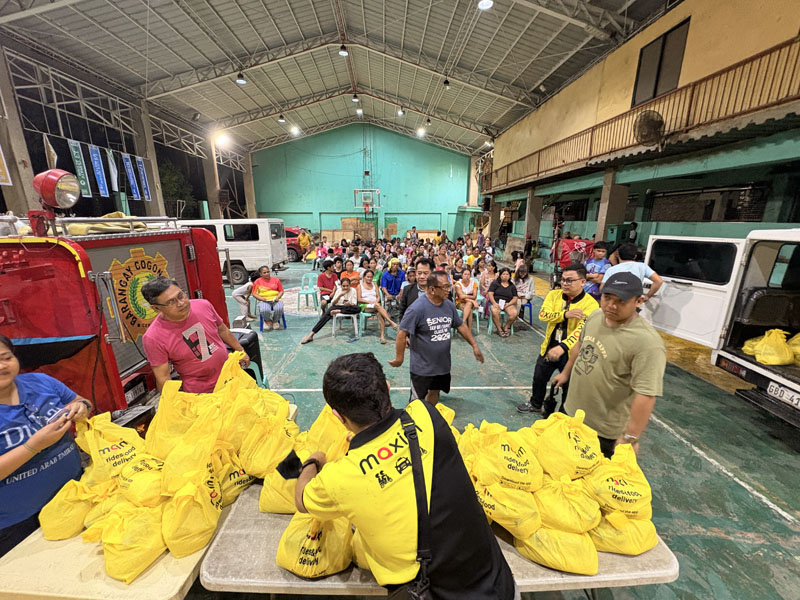
On November 14, Maxim distributed relief goods to 270 constituents in Barangay Cogon Pardo, Cebu City, with support from Councilor Eran and local barangay officials. The team provided rice and bottled water to help residents recover from the storm’s aftermath.


Maxim also extended assistance to upland communities, distributing rice and water to 130 beneficiaries in Lusaran, Cebu City, with the help of Councilor Harold Kendrick Go. The activity was held at Lusaran Elementary School. Before proceeding to Lusaran, the team stopped by Barangay Sirao, where they assisted an additional 20 beneficiaries.
On November 15, Maxim reached 170 beneficiaries in Talisay City, continuing its distribution of rice and water. This leg of the relief effort was an initiative led solely by the Maxim Management team.
“Maxim remains committed to supporting communities in times of crisis. We extend our solidarity to all affected families and will continue to provide assistance whenever needed,” said Christopher Poliran, Head of Maxim Cebu. Maxim Rides & Food Delivery will continue coordinating with local government units and community leaders as Cebu works toward recovery in the coming weeks. The company also recently extended similar relief support to communities affected by Typhoon Tino in Negros Occidental.