

SEVERE transmission constraints and the absence of green financing and a Net Zero pledge hinder clean energy production and investments across the country.
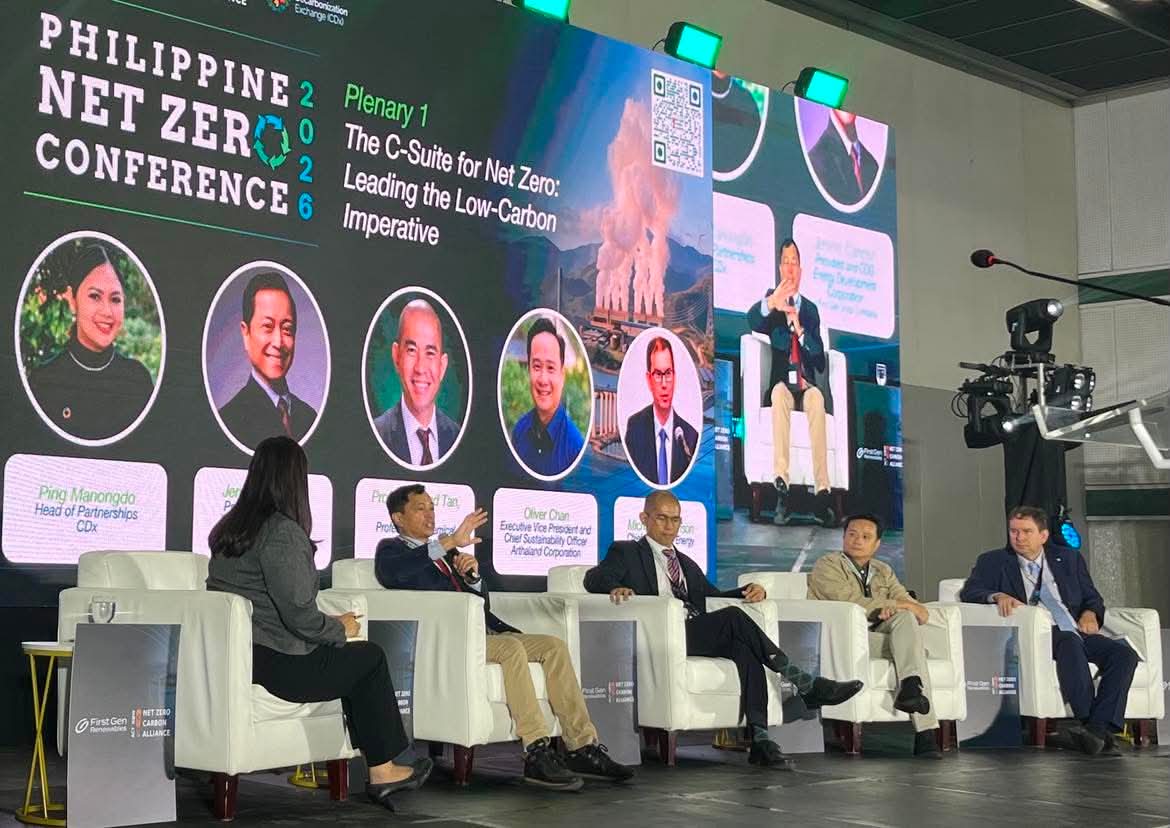
Renewable energy and sustainable development experts echo these bottlenecks in the industry during the Philippine Net Zero Conference 2026 on Sept. 15, at Pasay City.
In a fireside chat, Jerome Cainglet, president and chief operating officer of the Energy Development Corporation, highlighted that transmission line capacity has failed to keep pace with existing generation assets, causing substantial volumes of renewable electricity to go unused.
Cainglet cited that inadequate transmission infrastructure regularly forces EDC’s geothermal facilities in Leyte to curtail power output by up to seven gigawatt-hours (GWh) per month.
“Imagine 7,000 households of steam that were forced to be thrown away because our power plants cannot produce, or the electricity that our power plants could produce cannot be transmitted,” Cainglet said.
He noted that grid bottlenecks hamper both daily operational generation and the financial viability of developing new greenfield projects.
The transmission gap poses a critical hurdle as EDC advances its exploration of sufficient geothermal resources. Geothermal energy, he said, requires site-specific extraction facilities where permeable ground and steam reservoirs exist.
“We have lots of projects, not just projects, lots of renewable energy projects that are not able to proceed again because we don’t have enough transmission capacity,” he stressed.
Developers often must build up to 50 kilometers of dedicated transmission lines to connect isolated fields to the national power grid, which drives upfront capital expenditures.
Cainglet urged power grid operators and energy regulators to modernize grid management protocols and accelerate transmission line expansions.
Professor Raymond Tan of De La Salle University’s College of Chemical Engineering emphasized the absence of that national net-zero pledge as a binding constraint to go all-out with net zero.
“I still don’t fully understand what it is that prevents such a commitment from being made, because there are already bits and pieces, there are already elements of what a net-zero pledge would entail,” he said.
He cited that the Department of Energy has a Clean Energy Scenario, which would start with the early part of a net-zero transition.
He reported that the Philippines, along with Timor Leste yet to make a pledge to commit to a net-zero carbon commitment.
Having no Net Zero pledge puts the country at risk of losing out on as much as $6 trillion worth of green investments and 60 million new jobs in green sectors that will emerge in the coming decades.
“A net-zero commitment today at the level of the country and at the level of individual corporations will pave the way for the Philippines to be able to capitalize on a global trend that we cannot stop,” he stressed.
For real estate, Oliver Chan, Executive Vice President and Chief Sustainability Officer of Arthaland Corporation, said moving toward Net Zero must go beyond using renewable energy for operations, but for the shift of the materials being used.
In the industry, Chan said there are other materials that should also be considered that are locally sourced and can provide new jobs, citing bamboo.
“I think one is to take out that notion that as long as we buy renewable energy or use renewable energy, that’s enough. But it’s to discover new sources of building materials to be able to really reduce carbon emissions,” Chan said.
Michael Williamson, Chief of Section, Energy, United Nations Economic and Social Commission for Asia and the Pacific, said that while technology solutions have raced, finance has not kept up despite many competing demands for finance within companies.
“We have no shortage of good technologies and good ideas, but the challenge that companies face is how to finance them. What companies can do in terms of behind-the-meter energy systems, electric vehicles, energy efficiency upgrades, they’re all very capital intensive,” he said.
He stressed the clean energy transition is not simply the availability or the volume of green finance, but really what is the cost of that finance.
“If you can push down the cost and make more green finance available, and this is a conversation between business and government, what are the mechanisms to accelerate green finance- low-interest loans, zero-interest loans for specific activities? This would have a very large impact, I would suggest,” he stressed.