

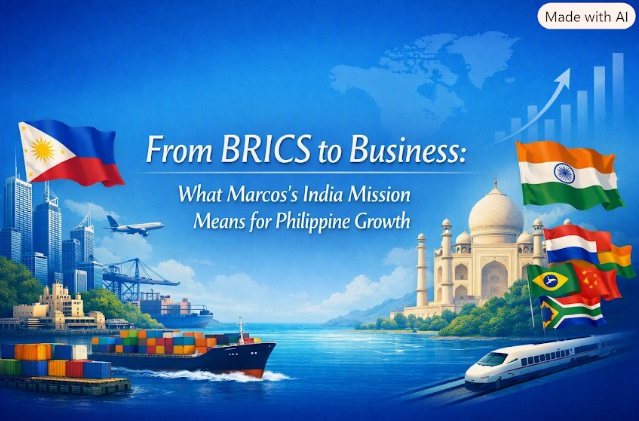
THE PHILIPPINES is not seeking BRICS membership. It is seeking wider economic choices, stronger ASEAN engagement and a deeper strategic partnership with India.
When President Ferdinand R. Marcos Jr. entered the BRICS Summit in New Delhi, he was entering a forum that has changed considerably from the original BRICS of Brazil, Russia, India, China and South Africa.
The grouping now has 11 full members, including Indonesia, Saudi Arabia, Egypt, the United Arab Emirates, Ethiopia and Iran. Its expanding membership gives it substantial weight in the economies of the Global South.
For the Philippines, however, the significance of New Delhi does not lie in any immediate ambition to become a BRICS member. Manila has indicated that it is not seeking immediate membership and instead intends to engage constructively with the evolving grouping.
That distinction matters.
The Philippines does not need to choose between different economic worlds. It needs to widen its ability to participate in them.
The global economy is becoming increasingly interconnected through overlapping arrangements—ASEAN, RCEP, BRICS, the G20, bilateral partnerships and numerous regional and sectoral initiatives. For a middle-income, trade-dependent economy such as the Philippines, maintaining access to several centres of growth can be more valuable than identifying itself exclusively with any one grouping.
President Marcos’s presence in New Delhi therefore represented an exercise in strategic economic diversification.
It was also an opportunity to bring an ASEAN perspective into a conversation increasingly concerned with the economic priorities of the Global South.
Marcos Brings ASEAN to the BRICS Conversation
Perhaps the most revealing feature of President Marcos’s intervention was that he did not speak simply as the leader of the Philippines.
He spoke with the wider responsibility of the 2026 ASEAN Chair.
The Philippines’ ASEAN Chairship carries the theme “Navigating Our Future, Together,” built around peace and security anchors, prosperity corridors, and people empowerment. The Philippine Embassy in New Delhi has emphasized that the Chairship seeks to promote a forward-looking, innovative, inclusive, and people-centred ASEAN while upholding ASEAN centrality and international law.
President Marcos brought this perspective into the BRICS discussion.
His intervention stressed the importance of an open, inclusive and outward-looking ASEAN, and the need for practical cooperation in dealing with global disruptions. He highlighted peace and security, economic resilience, climate action, responsible technology, disaster preparedness and inclusive development.
This was important because ASEAN’s economic future cannot be separated from the larger transformation taking place across Asia.
The region is confronting supply-chain disruptions, geopolitical tensions, climate shocks, technological change, food and energy-security pressures and the continuing need to create productive employment for a young and increasingly connected population.
For ASEAN, therefore, engagement with major emerging economies is not necessarily a question of alignment. It is a question of maintaining room for cooperation.
That is an important distinction.
ASEAN centrality should not mean standing apart from the emerging economic architecture. It should mean retaining the ability to engage different partners while preserving ASEAN’s own collective interests and strategic autonomy.
Beyond BRICS Membership
The most interesting question arising from the Philippine participation in New Delhi is therefore not:
Will the Philippines join BRICS?
The more consequential question is:
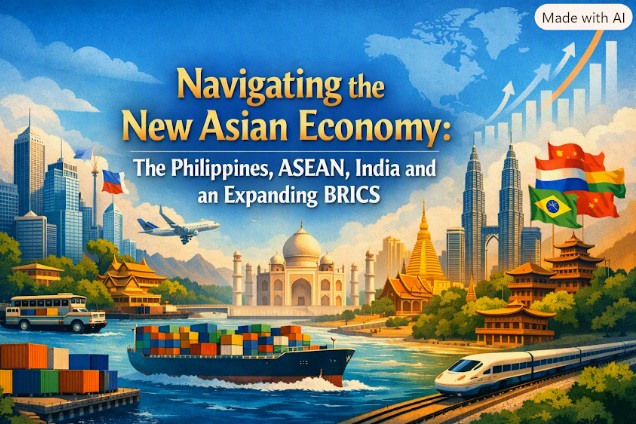
How can the Philippines benefit from the economic opportunities emerging around BRICS while retaining ASEAN centrality and strategic flexibility?
There is a substantial difference between membership and engagement.
A country does not have to become a member of every economic grouping to trade with its members, attract their investment, cooperate in technology, participate in infrastructure projects or develop new financial and commercial links.
For the Philippines, this distinction provides considerable policy space.
It can strengthen its relationships with the United States, Japan, South Korea, Australia, the European Union and other established partners while simultaneously expanding economic engagement with India, Indonesia, the Gulf economies, China and other emerging markets.
That is not inconsistency.
It is economic pragmatism.
The India Dimension Is Perhaps the Most Important Bilateral Outcome
If the BRICS Summit provided the multilateral setting, the meeting between President Marcos and Prime Minister Narendra Modi provided one of the most tangible bilateral opportunities.
The Philippines and India elevated their relationship to a Strategic Partnership in August 2025. Since then, both sides have been seeking to translate that political decision into a broader programme of cooperation.
The September 2026 meeting in New Delhi continued that process.
The two leaders reviewed progress in the Strategic Partnership and discussed ways to deepen cooperation in defence and security, trade and investment, railways, space, fintech, pharmaceuticals, agriculture and disaster resilience. India also welcomed the Philippines’ decision to join the Coalition for Disaster Resilient Infrastructure, an India-led international initiative.
This is significant because it moves the relationship beyond traditional diplomacy.
Defence and maritime security are important. But the long-term strength of a bilateral relationship also depends on whether it produces economic opportunities.
Railways, digital payments, pharmaceuticals, agriculture, space technology, infrastructure and disaster resilience are therefore not merely sectoral subjects.
They are potential building blocks of a broader economic partnership.
From Strategic Partnership to Economic Partnership
The Philippines and India now face a more difficult task: converting a promising diplomatic relationship into measurable economic outcomes.
This is where the 2025 State Visit of President Marcos to India becomes relevant.
During that visit, Indian companies announced potential investments of about $5.8 billion across areas including technology, healthcare, energy, and infrastructure.
Such commitments are encouraging. But investment announcements are only the beginning.
The real development sequence is:
investment pledge → actual investment → productive capacity → employment → technology transfer → exports → higher productivity.
The Philippines needs to concentrate on the entire chain.
The question should not simply be how much Indian investment is announced.
The more important questions are:
How many projects actually materialize?
How much domestic value is created?
How many Filipinos acquire new skills?
How much technology is transferred?
How much of the production becomes export-oriented?
And how much does this contribute to Philippine productivity?
These are the measures by which economic diplomacy ultimately has to be judged.
From Government-to-Government to Business-to-Business
This is why the meetings between Philippine and Indian business communities are particularly important.
The groundwork was already being laid before the BRICS Summit. In June 2026, the Philippine Embassy in New Delhi and the Federation of Indian Chambers of Commerce and Industry discussed expanding business, investment, tourism and creative-industry partnerships. FICCI had also worked with the Philippines during President Marcos’s 2025 business engagements in Delhi and Bengaluru.
During the New Delhi visit, President Marcos also met Indian business groups on opportunities involving airport development, digital payments and other areas of commercial cooperation.
This is precisely where political diplomacy has to become economic diplomacy.
The Philippines needs Indian companies not merely to express interest in the country but to see the Philippines as a location for long-term production, services, infrastructure and technology.
And Philippine businesses need to look at India not simply as a large market but as a source of technology, capital, expertise, partnerships and access to a wider economic ecosystem.
The relationship must increasingly become two-way.
Digital Payments Could Become More Than a Technology Story
Fintech deserves special attention.
India’s experience with digital public infrastructure and interoperable payments offers possibilities for cooperation with the Philippines as the latter expands its own digital economy.
The discussions between President Marcos and Prime Minister Modi included fintech and digital cooperation.
The potential significance goes beyond any single payment platform.
Easier and more interoperable digital payments can eventually reduce transaction costs for tourists, migrant workers, small businesses, exporters and consumers.
For small and medium-sized enterprises, such changes can matter enormously.
A digital transaction that is faster, cheaper and more reliable may appear insignificant at the level of an individual payment. Across millions of transactions, however, lower transaction costs can influence trade and productivity.
This is where technology cooperation becomes development policy.
Infrastructure: From Announcements to Capacity
The railway discussion between President Marcos and Prime Minister Modi also deserves attention.
The Philippines has substantial infrastructure needs. Better railways, airports, logistics systems and resilient infrastructure can lower the cost of moving people and goods, improve connectivity between regions and make investment outside the traditional economic centres more viable.
Indian expertise in infrastructure, engineering and technology could therefore become useful to the Philippines.
But again, the objective should be larger than completing individual projects.
Infrastructure should help create an integrated domestic market.
A railway is not simply a railway.
It can connect workers to jobs, farmers to markets, manufacturers to ports, students to educational opportunities, and smaller cities to larger economic centres.
That is why infrastructure cooperation with India could have a development impact well beyond the value of the individual contracts.
The ASEAN–India Opportunity
There is another reason why President Marcos’s New Delhi visit carries significance beyond bilateral relations.
The Philippines is currently both ASEAN Chair and Country Coordinator for ASEAN–India Dialogue Relations. The Philippine Embassy in New Delhi has emphasized that Manila intends to help advance the ASEAN–India Comprehensive Strategic Partnership during its coordinatorship.
This gives the Philippines a particularly useful diplomatic responsibility.
India has already become an important economic partner for ASEAN. The relationship encompasses trade, investment, connectivity, infrastructure, technology, education and people-to-people exchanges.
The Philippines can contribute to that relationship not by speaking for every ASEAN member on every issue, but by helping sustain practical cooperation between ASEAN and India.
President Marcos’s presence at the BRICS Summit consequently had a dual significance.
He was representing Philippine interests while also bringing the perspective of ASEAN’s current Chair into a major forum involving several of the world’s largest emerging economies.
That is a meaningful diplomatic opportunity.
A Wider Asian Economic Landscape
The larger Asian economic landscape is becoming more complex.
Indonesia’s participation in BRICS adds a major Southeast Asian dimension to the grouping. Other ASEAN economies are also exploring different forms of engagement with emerging economic networks.
The Philippines therefore faces a strategic choice—but not the conventional choice between one bloc and another.
Its choice is whether to remain sufficiently open and competitive to participate in multiple economic networks.
That requires domestic capability.
No amount of diplomacy can compensate indefinitely for weak infrastructure, high logistics costs, inadequate skills, regulatory uncertainty or insufficient productive capacity.
Foreign economic policy and domestic economic policy must therefore reinforce each other.
A country can sign a trade agreement, attract investment missions and participate in international summits.
But investors ultimately ask a more basic question:
Can we produce competitively here?
That is where Philippine economic policy must meet Philippine foreign policy.
Can Economic Diplomacy Become Industrial Policy?
This may be the most important question arising from President Marcos’s New Delhi visit.
The Philippines has become increasingly active in economic diplomacy. It is attracting foreign investors, pursuing infrastructure partnerships, strengthening strategic relationships and participating in major regional initiatives.
But the ultimate objective cannot be the accumulation of memoranda of understanding.
The objective must be productive transformation.
If Indian investment enters the Philippines, can it help develop local suppliers?
Can Philippine workers acquire higher-value skills?
Can technology move in both directions?
Can infrastructure reduce logistics costs?
Can pharmaceutical cooperation improve access to affordable medicines?
Can digital cooperation help small businesses?
Can agricultural technology raise productivity?
Can stronger connectivity encourage investment outside Metro Manila?
Can these relationships create new Philippine exports?
These are the questions that will determine whether economic diplomacy produces development.
The New Delhi Test
The 18th BRICS Summit has therefore presented the Philippines with both an opportunity and a test.
The opportunity is to engage a changing global economy more confidently.
The test is whether the Philippines can turn engagement into outcomes.
President Marcos’s participation does not mean that Manila has chosen BRICS over other partners. Nor does it need to.
The Philippines can remain firmly anchored in ASEAN while maintaining strong relations with the United States, Japan, Europe, Australia, South Korea and other partners—and at the same time deepen economic relations with India and other emerging economies.
Indeed, diversification may become increasingly important in an uncertain global economy.
The objective should be neither geopolitical exclusivity nor indiscriminate openness.
It should be strategic economic diversification.
Beyond the Handshakes: What Happens Next?
The photographs from New Delhi will eventually disappear from the news cycle.
The speeches will become part of the diplomatic record.
The summit declaration will move into the long machinery of implementation.
But the real significance of President Marcos’s participation will be determined later.
It will be seen in factories that actually open, infrastructure that actually gets built, digital systems that actually work, medicines that become more accessible, businesses that enter new markets, workers who acquire better skills and entrepreneurs who find new opportunities.
That is ultimately what international economic diplomacy is supposed to achieve.
The Philippines does not need to become a member of every emerging economic grouping.
It needs to become sufficiently competitive to benefit from the opportunities those groupings create.
And India can be an increasingly important partner in that effort—not because India offers a substitute for the Philippines’ existing relationships, but because the India–Philippines relationship itself is becoming broader, deeper and more economically consequential.
For ASEAN, the lesson is similar.
An outward-looking ASEAN does not have to choose between competing economic centres. It can engage them all while preserving its own centrality and collective voice.
For the Philippines, President Marcos’s journey to New Delhi therefore carries a significance that extends well beyond the 18th BRICS Summit.
The real story is not whether the Philippines moves closer to BRICS. The real story is whether the Philippines can use a changing Asian economic order to create more choices—and then turn those choices into better opportunities for Filipinos.