

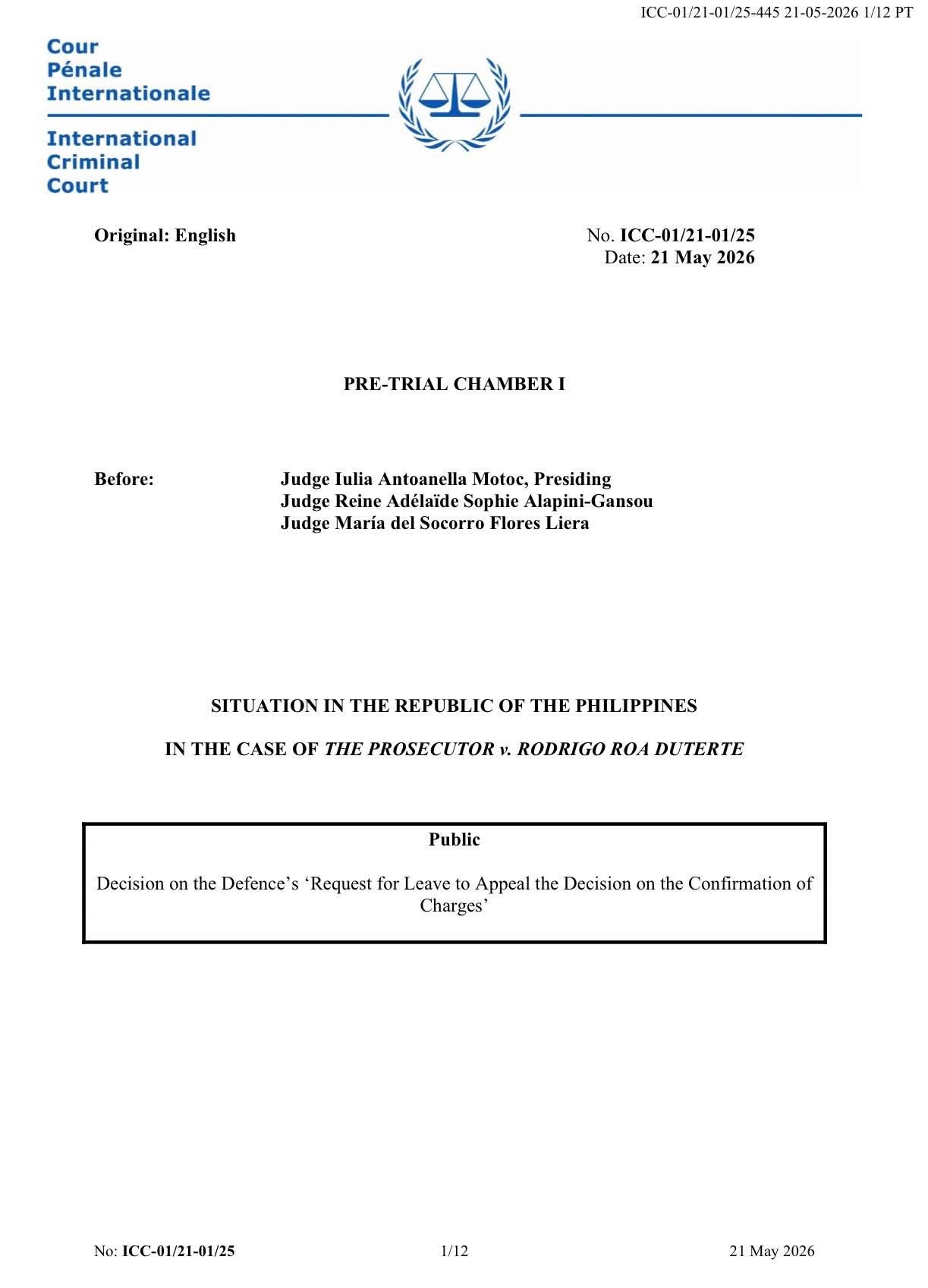
THE INTERNATIONAL Criminal Court (CC) Pre-Trial Chamber I has officially rejected a high-stakes bid by the defense team of former President Rodrigo Roa Duterte to appeal the confirmation of criminal charges against him, clearing the final procedural hurdles toward a historic full-scale international trial.
In a 12-page decision dated Thursday, May 21, 2026, from The Hague, Netherlands, Presiding Judge Iulia Antanella Motoc, alongside Judges Reine Adélaïde Sophie Alapini-Gansou and María del Socorro Flores Liera, ruled to throw out the defense’s request for leave to appeal.
The ruling means the existing charges for crimes against humanity—stemming from the controversial anti-narcotics campaign during Duterte’s presidency—remain firmly in place and are now insulated from further preliminary challenges.
‘Mere disagreement’ not grounds for appeal
Duterte’s legal defense team had petitioned the court to appeal the initial confirmation of charges, arguing that the scope of the accusations was too broad and that the Chamber had misappreciated the evidence presented by the prosecution.
However, the three-judge panel sharply dismissed those assertions, clarifying that the defense had failed to present a genuine, distinct legal issue that would meet the strict appellate threshold under Article 82(1)(d) of the Rome Statute.
“The Chamber emphasized that the defense’s arguments were mostly disagreements with the Court’s reasoning and interpretation rather than genuine, certifiable legal errors,” the judicial briefing noted.
Addressing the defense’s complaints regarding the sprawling nature of the indictment, the judges explained that because the case explicitly involves allegations of systemic, large-scale state criminality, the charges must necessarily be broad in scope to accurately reflect the true scale of the operations.
The Chamber maintained that the parameters of the case are already clearly defined by specific timelines, localized geographies, designated perpetrators, and distinct victim categories.
Confirmation is not a final judgment
The Pre-Trial Chamber also corrected the defense’s expectations regarding evidentiary burdens at this stage of the prosecution.
The judges clarified that a confirmation hearing is not a full-blown criminal trial. Consequently, the Chamber was under no legal obligation to produce a meticulous, incident-by-incident forensic analysis of every single casualty or police operation in the preliminary phase, as would be required in a final judgment.
According to Pre-Trial Chamber I, the court had already sufficiently detailed the core evidentiary baseline necessary to support its findings and had fully addressed the primary counter-arguments raised by Duterte’s lawyers.
Parallel legal pressures mount
Just 24 hours before this international development, the Philippine Supreme Court En Banc voted 9-5-1 to deny an emergency Temporary Restraining Order (TRO) sought by Duterte’s co-accused and close ally, Senator Ronald “Bato” Dela Rosa.
Dela Rosa had attempted to legally bar domestic law enforcement agencies—including the PNP, NBI, and the Armed Forces—from executing any pending ICC warrants or Interpol Red Notices against him on Philippine soil.
With the local high court refusing to grant an interim shield to Dela Rosa and the ICC Pre-Trial Chamber formally cementing the charges against Duterte, the case officially pivots out of the pre-trial phase.
Meanwhile, the Office of the Prosecutor is now expected to coordinate with the Trial Chamber to schedule the formal opening of trial proceedings, marking the first time a former Philippine head of state will face international criminal prosecution.