

THE UNIVERSITY of Mindanao-Institute of Popular Opinion conducted an online survey from March 11 – 22, 2026, targeting 1,200 Davaoeños from the three districts of Davao City to describe their sentiment with regard to the ongoing conflict in the Middle East between Iran, Israel, and the United States.
Since the survey was done online via sponsored ads on three Meta Platforms (Facebook, Messenger, and Instagram), IPO relied heavily on online, pre-defined, targeted social media users who met the inclusion criteria and were targeted for contact within the defined geographical radius. Respondents were defined to be at least 18 years old, have valid/active email addresses, and a resident in Davao City.
The survey was done at a 95% confidence level and a +/- 2.83% margin of error. The questions asked are related to their awareness about the ongoing conflict, their perception of the possible effects of this conflict, and their stand on the military actions taken by the United States and Israel against Iran.
When asked about their knowledge of the ongoing Middle East conflict, an overwhelming majority of the respondents (99.0%) reported that they are aware, while only 1.0% indicated otherwise.

When questioned about their stand towards the military actions of the United States and Israel against Iran, 8 out of 10 Davaeoños strongly expressed that they do not support these actions, while 15.2% or at most 2 of 10 Davaoeños indicated support.

When clarified as to why they support the military actions of the US and Israel against Iran, the minority justified that such actions are necessary to prevent Iran from developing nuclear weapons (52.2%), for regional security (23.6%), and for the protection of allies in the Middle East (19.3%).
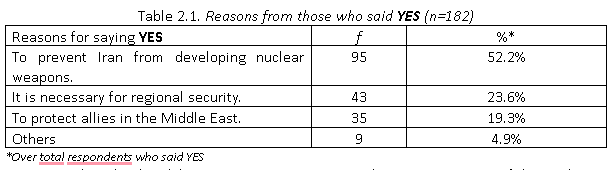
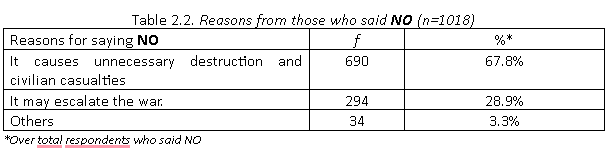
On the other hand, humanitarian concerns were the primary reasons for those who opposed the military actions. Nearly 7 out of 10 Davaeoños believe that such actions cause unnecessary destruction and civilian casualities while nearly 3 out of 10 Davaoeños expressed concern that the conflict may escalate further.
When asked about their perception of the possible effects of the Middle East conflict, Davaoeños were mostly concerned about the potential increases in oil prices (95.2%), followed by global economic instability (89.5%) and the safety of Overseas Filipino Workers (OFWs) in the Middle East (89.5%).
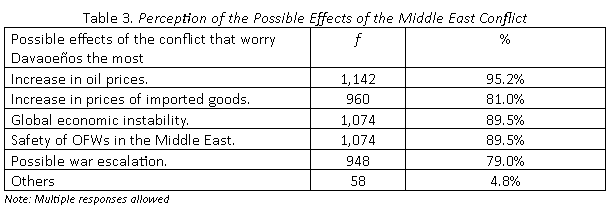
Approximately 8 of 10 Davaoeños were concerned about the possible increase in prices of imported goods (81.0%) and the escalation of the ongoing war (79.0%).