

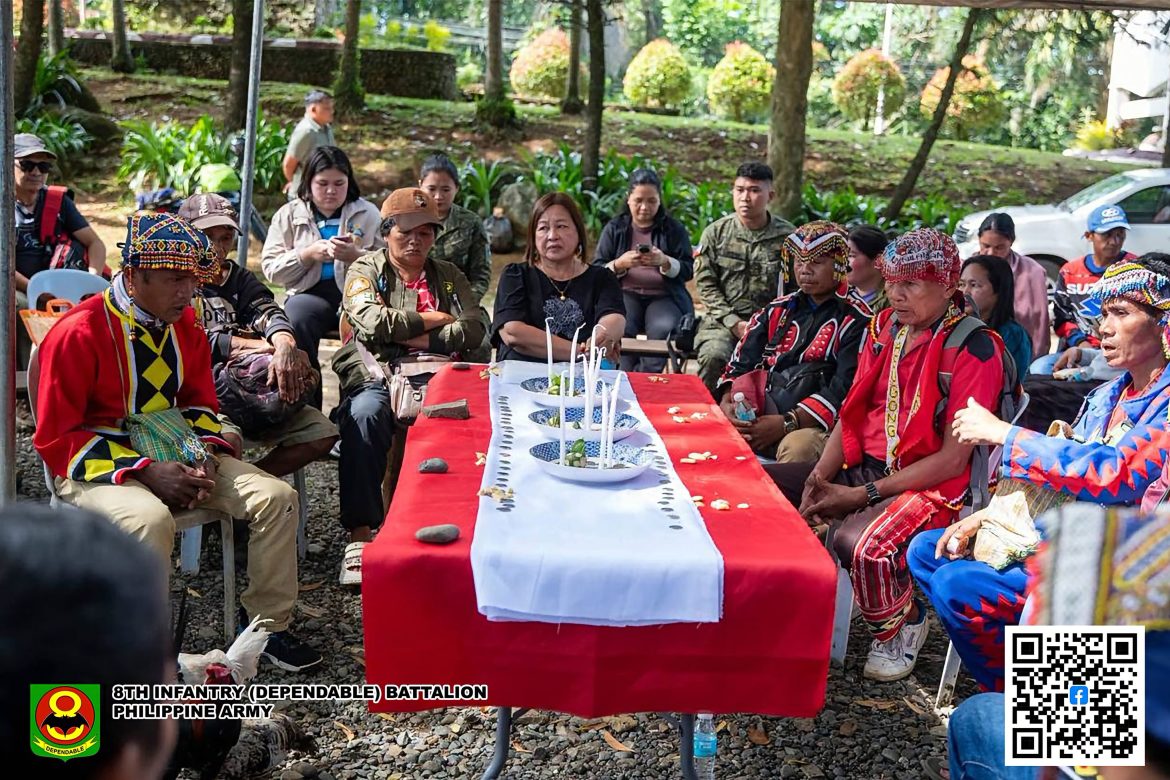
FOURTEEN families affected by killings and atrocities attributed to the New People’s Army (NPA) began a three-day psychosocial support program here on Tuesday, Nov. 24, aimed at addressing long-term trauma and supporting community reconciliation.
The initiative, held at the Tree Park Lounge, is jointly spearheaded by the 8th Infantry Battalion (8IB) and the local government unit (LGU) of Impasug-ong under the government’s broader healing and reconciliation program.
Opening activities started with a Panastas ritual—a traditional Higaunon gathering meant to honor the families’ grief and ground the recovery process in indigenous practices.
Among the participants was former Municipal Mayor Julia A. Okinlay, widow of slain former Mayor Mario T. Okinlay, who expressed hope that the three-day intervention would properly address the lingering emotional and social needs of the 14 participating households.
Municipal Mayor Mai Okinlay urged the families to embrace the support sessions and underscored unity and cooperation in sustaining peace in the municipality.
8IB commanding officer LTCOL Jeorge R. Jallorina thanked the families for stepping forward and stressed that caring for conflict-affected households remains a shared duty between the military and local leaders.
“The welfare and healing of affected families remain a shared responsibility,” Jallorina said during the opening program.
Over the three-day run, psychologists, psychometricians, and specialists from the Camp Evangelista Station Hospital, the Office of the Presidential Adviser on Peace, Reconciliation and Unity (OPAPRU), and the Department of Social Welfare and Development (DSWD) Field Office 10 will facilitate trauma-processing workshops alongside traditional Higaunon healing practices.
Glycee Faustino of OPAPRU’s Office of Social Healing and Peacebuilding (SHAPE) noted that providing a safe space allows survivors to process grief and gradually rebuild their lives, while Executive Assistant II Paul Richard A. Paraguya emphasized that the module specifically targets the psychological toll of insurgency-related violence.
Developed through prior stakeholder consultations and focus group discussions, the psychosocial module serves as the core “Healing” pillar of the government’s three-part framework, alongside the delivery of basic services and peacebuilding initiatives.