

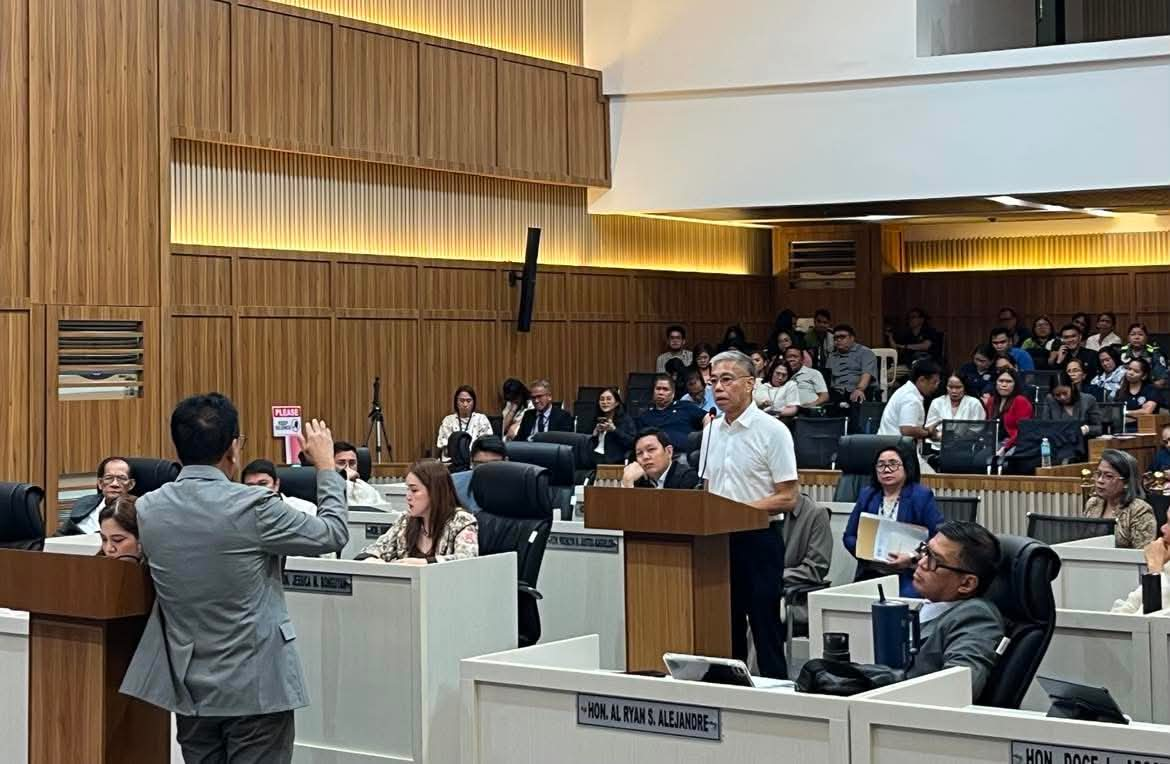
LAWMAKERS pressed Ateneo de Davao University (AdDU) administrators, the Department of Education (DepEd), the police, and the City Social Welfare and Development Office (CSWDO) on Tuesday over how schools handle bullying.
The questioning followed the Nov. 5 bullying incident at the school premises.
During the Tuesday session, board of trustees chairman Benjamin Lizada, representing the university president Rev. Fr. Karel San Juan, briefed the City Council on updates on the incident.
ADDU said it has dismissed the student found primarily responsible for the Nov. 5 bullying incident at its junior high school.
Meanwhile, school personnel named in the incident report are now under administrative investigation.
The university said the dismissal took effect immediately and was communicated to and accepted by the student’s parents on Nov. 12.
“We condemn bullying in all its forms,” he said, adding that the school rejects “a culture of silence.”
Lizada said other students involved have been sanctioned under the junior high school’s student handbook, while the involvement of one other student is still being investigated.
The affected student has received medical care, regular counseling with Ateneo psychologists,
and regular communication with and support for the family.
“Every allegation is being taken seriously, and every person is afforded due process. Where lapses are found, there will be accountability,” he said.
Ateneo said it has also offered other distressed students and parents options, including shifting to online classes.
Psychological first aid sessions for learners, teachers, and staff affected by the incident were also conducted, and the university met with parents to address their concerns.
It has also coordinated with the DepEd Schools Division superintendent, the Davao City Police Office, and other agencies, while preparing reports requested by the Commission on Human Rights and DepEd.
New measures
Dr. Gina Montalan, vice president for basic education, reported the school has introduced a QR code reporting system. It was developed after a Nov. 13 discussion with parents, and codes are posted in conspicuous places on campus and reports can be filed anonymously.
“The QR code kicked off as one of the actions that we are taking to improve our processes,” she said.
The system supplements existing channels such as email and direct reports made to the prefect of discipline.
Councilor Luna Acosta urged tighter security in areas such as restrooms, noting that CCTV inside is not allowed, and asked when schools should involve the Davao City Police Office (DCPO).
Ateneo’s prefect said the school calls police for extreme cases, with parents deciding on filing complaints in minor incidents, as DepEd said parental permission is not needed for severe incidents.
Acosta said serious physical injuries must not be “swept under the rug.”
Dr. Maria Carmela S. Abay, AdDU Junior High School principal, reported they have identified students to be closely monitored for discipline or special-needs reasons.
“As an offshoot of the November 5 incident, we are strict now in terms of monitoring the students in the classrooms,” Abay said.
Teachers are required to check at the start and end of class that those students are present as an addition to existing roving supervision, with personnel assigned per floor to check restrooms and other areas.
For victims, the school offers guidance counselors, two per grade level, along with university-level counselors and psychologists.
Parents may also bring in private professionals, and students who feel unsafe may opt for online classes.
The prefect of discipline said retaliation against a reporting student is met with continued monitoring and immediate sanctions where warranted.
Asked if an alleged bully could be moved to online classes during an investigation, an administrator said this is “very feasible” after review by the assistant principals for academics and administration.
The council requested DepEd to gather records of bullying cases in all schools, not only Ateneo.
Revisit anti-bullying policies
Councilor Enzo Villafuerte, author of the city’s anti-bullying ordinance, urged schools to align their policies with the 2025 implementing rules of Republic Act 10627.
He cited the three-tier classification of bullying cases and school responsibility for cyberbullying even outside school hours and coordination with the local government when a case becomes criminal.
There are three levels of bullying as stipulated in the new IRR. First is minor bullying cases, the second is serious bullying cases, and the third level is bullying cases that go beyond what can be handled by the moderator or the guidance counselor within the school.
“If there are cases of teasing or minor bullying cases, there should be action taken immediately so that it will not escalate into more serious bullying cases. So I hope this will be strengthened further by Ateneo and all schools here in Davao City,” Villafuerte said.
Julie Dayaday, CSWDO head, said a meeting of all school administrators, DepEd, and the Commission on Higher Education to review the new child protection protocol is set for Wednesday, November 25.
She said CSWDO offers psychosocial support to children in conflict with the law and to child abuse victims.