


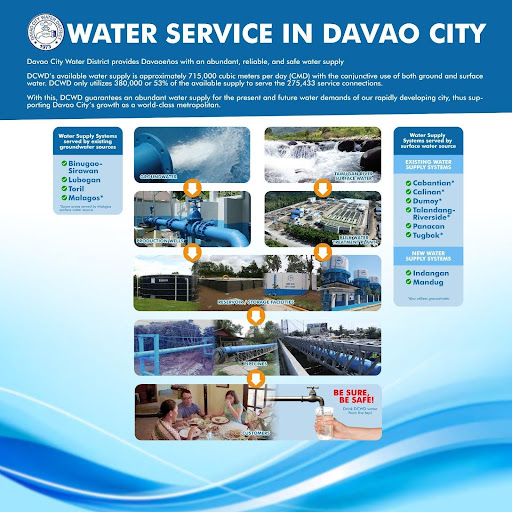
Photo/Credit: 2024 infographics by Davao City Water District (DCWD) on the city’s water supply systems
Water security is increasingly becoming one of the defining challenges for cities across the world. Changing rainfall patterns, stronger weather disturbances, and growing urban demand are forcing governments and utilities to rethink how water systems are designed and managed.
The Philippines is fortunate to be endowed with abundant natural water resources– from Surface water sources to productive groundwater aquifers that sustain communities across the country. With significant annual rainfall that varies from 965 to 4,064 millimeters annually and diverse watersheds, water availability has long supported growing cities and economies.
However, ensuring long-term water security also depends on how these resources are managed together. Changing climate and increasing demand make it essential for cities to balance surface water and groundwater through integrated systems that protect supply even during dry periods.
The Davao City Water District has increasingly turned toward a balanced approach, combining surface water and groundwater sources, to strengthen resilience against these uncertainties.
“Sa pagkakaron, we can claim that Davao City has achieved tung atong ginatawag na climate resiliency in terms of water service kay atoang napamatud-an during that time of El Niño when every place in the country has been experiencing drought ug water shortage, ang Davao City, opposite ang atoang scenario, abunda kaayo ta og supply,” Duhaylungsod said in a 2024 interview during the Davao Peace and Security Press Corps presser.
(As of now, we can claim that Davao City has achieved what we call as climate resiliency in terms of water service, as demonstrated during the El Niño period when every place in the country was experiencing drought and water shortages. In contrast, Davao City’s scenario was the opposite; we had an abundant supply.)
Through the Davao City Bulk Water Supply Project (DCBWSP), treated surface water sourced from the Tamugan River augments the existing groundwater supply managed by the Davao City Water District (DCWD), demonstrating how surface water integration is helping ease pressure on aquifers while maintaining stable supply for the city.
Learning From Changing Climate
A changing climate does not always announce itself through disasters. Sometimes it appears quietly through shifting river flows or unexpected dry periods.
Early Q1 this year, monitoring recorded lower river flow levels in parts of January despite it being within the rainy season– a reminder that even historically reliable water sources are not immune to changing climate conditions.
Yet across Davao, households and businesses experienced no noticeable disruption in supply.
DCWD was able to maintain stability by balancing surface water delivery with groundwater production, demonstrating how diversified sources can absorb environmental fluctuations without affecting consumers.
For residents, the adjustment happened largely behind the scenes. For the local water utility, however, it offered a practical example of how redundancy strengthens resilience.
Protecting Groundwater for the Long Term
Around the world, groundwater depletion has become an increasing concern. Aquifers that once seemed limitless are now under pressure due to population growth and expanding economic activity.
Supplementing groundwater extraction with treated surface water enables utilities to manage wells more responsibly, reducing strain during periods of peak demand and allowing natural recharge processes to take place.
Surface water provides additional supply when needed, while groundwater continues to serve as a stable foundation of the distribution system. Together, this balanced approach reduces dependence on a single source and strengthens overall water resilience.
This is the same strategy applied in Davao City through the treated surface water supplied by the DCBWSP.
