


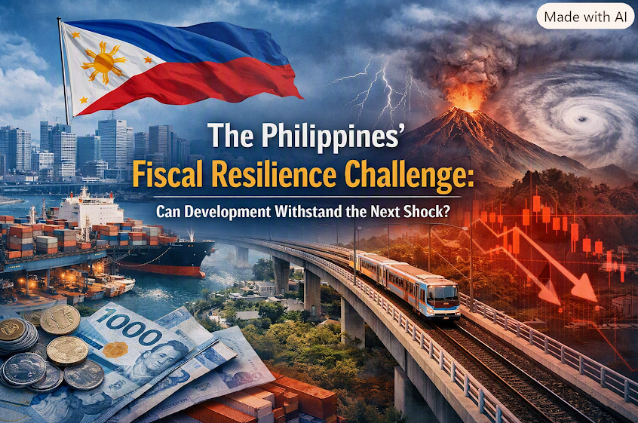
A TYPHOON does not arrive as a line item in the national budget. A flood does not announce its reconstruction cost in advance. An earthquake does not wait for the government to find additional fiscal space. A global slowdown does not ask whether the country is financially prepared before affecting jobs, investment, trade, and public revenues.
Yet every major shock eventually reaches the public finances.
This is why fiscal resilience deserves to be viewed not simply as a matter of deficits and debt, but as a fundamental condition for sustaining development. For the Philippines, a country repeatedly exposed to natural disasters and external economic shocks, the ability of government to absorb disruption without abandoning essential public services and development investments is particularly important.
The Philippines has made substantial economic and social progress. The challenge now is to ensure that temporary shocks do not repeatedly erase part of that progress.
Fiscal resilience is therefore ultimately about protecting development gains while preserving the capacity to finance the next stage of growth.
Why Fiscal Resilience Matters for the Philippines
Fiscal resilience means having sufficient financial space, sound institutions, and effective public spending systems to respond when conditions deteriorate.
It does not mean maintaining large amounts of idle money. Nor does it mean avoiding borrowing altogether. It means having the capacity to make difficult choices when circumstances require them without allowing a temporary crisis to become a long-term development setback.
This matters greatly for the Philippines.
The country faces recurring typhoons, floods, earthquakes, and other natural hazards. At the same time, it remains exposed to global interest rates, energy prices, trade disruptions, geopolitical tensions and fluctuations in global demand.
A country cannot prevent every shock. It can, however, determine how much damage a shock causes to its economy, its public finances and ultimately to people’s lives.
That is where fiscal resilience becomes a development issue.
Every Major Shock Has a Fiscal Cost
The fiscal consequences of a disaster are rarely limited to the immediate emergency response.
Government may have to repair roads, bridges, schools, hospitals, irrigation systems, power facilities and public buildings. It may need to provide emergency assistance to affected families, farmers and small businesses. At the same time, economic activity may weaken, reducing tax and other government revenues.
The fiscal equation can therefore deteriorate from both directions: spending rises while revenues come under pressure.
The same principle applies to external economic shocks. A global slowdown can weaken exports and investment. Higher international energy prices can raise domestic costs and affect inflation. Higher global interest rates can increase the cost of government borrowing.
The lesson is straightforward: fiscal resilience cannot be built only after a shock occurs.
It must be developed during relatively normal times.
Fiscal Space Gives Government Room to Respond
Fiscal space is one of the most valuable forms of economic insurance available to a government.
When public finances are already under severe pressure, responding to a disaster or recession becomes more difficult. The government may have to postpone infrastructure projects, reduce discretionary spending, increase borrowing, or redirect funds away from other priorities.
That can create a damaging cycle.
A shock weakens economic activity. The government responds by reducing development spending. Lower investment then weakens future productivity and growth. Weaker growth makes fiscal consolidation more difficult.
Fiscal resilience seeks to avoid this cycle.
The objective is not to eliminate fiscal deficits or debt as such. Development often requires public investment, and borrowing can be appropriate when it finances productive assets. The objective is to ensure that government enters a period of stress with enough credibility and financial capacity to respond without undermining longer-term development.
Prevention Costs Less Than Rebuilding
For a country exposed to frequent natural hazards, fiscal resilience cannot be separated from disaster preparedness and climate adaptation.
A resilient bridge, drainage system, school, hospital, or transport network may appear expensive before a disaster. But the cost of repairing or replacing damaged infrastructure, restoring disrupted services and supporting affected communities can be much greater.
This makes prevention a fiscal investment, not simply an environmental or engineering concern.
Public investment decisions therefore need to consider not only their immediate economic returns but also their ability to withstand future shocks.
Better drainage can reduce flood losses. Stronger infrastructure can reduce disruption. More resilient agricultural systems can protect rural incomes. Better early-warning systems can reduce human and economic losses.
The financial system of government must increasingly recognize these benefits.
Public Financial Management: Making Every Peso Count

This is where public financial management becomes central.
A government’s fiscal strength depends not only on how much money it raises, but also on how effectively it plans, allocates, spends, and monitors that money.
Good public financial management connects national priorities with actual budget allocations. It helps determine whether projects are properly appraised, whether procurement is competitive and transparent, whether funds reach intended programs on time, and whether completed projects deliver the expected results.
The Philippines has been pursuing reforms in this area through its Public Financial Management Reform Roadmap for 2024–2028 and its subsequent midterm update.
The direction is important. But reform should not be judged simply by the number of new procedures, systems, or reports introduced.
The real test is whether public financial management improves the quality of decisions.
Does government know which programs are working?
Are projects selected on the basis of clear economic and social returns?
Can implementation delays be identified early?
Are procurement problems addressed quickly?
Can agencies track whether public spending actually improves outcomes?
These questions matter because every peso that is poorly allocated is a peso that cannot be used elsewhere.
The Quality of Spending Matters
Fiscal resilience is sometimes interpreted mainly as a question of raising more revenue or reducing expenditure.
That is too narrow.
Two governments can spend the same amount of money and produce very different development outcomes.
One may invest in reliable infrastructure, human capital, digital systems, health, education and productive capacity. Another may spend heavily but obtain limited results because of weak project selection, delays, cost overruns, or poor implementation.
The quality of expenditure therefore matters as much as its quantity.
For the Philippines, improving expenditure efficiency can create fiscal space of its own. If government obtains better results from existing resources, it can strengthen development without necessarily requiring equivalent increases in taxation or borrowing.
This is why budgeting, procurement, project management, monitoring and evaluation are not merely administrative functions. They are part of the country’s development strategy.
Stronger Revenue Creates Greater Fiscal Resilience
Expenditure efficiency, however, cannot substitute indefinitely for adequate public revenue.
A country seeking better infrastructure, stronger health and education systems, improved social protection, climate adaptation and more productive public investment needs a sustainable revenue base.
The challenge is to strengthen domestic resource mobilization while maintaining economic incentives and public trust.
Tax administration, compliance, digitalization and the reduction of leakages can all contribute. But revenue collection is ultimately linked to the quality of government itself.
Citizens are more likely to accept taxation when they can see credible public benefits from the resources collected.
This creates an important relationship between revenue and trust: better public services can strengthen confidence in government, while stronger confidence can make sustainable revenue mobilization easier.
Fiscal resilience therefore requires not simply higher collections, but a more effective social and economic contract between the state and citizens.
Borrowing Must Strengthen Future Growth
Borrowing is not inherently a weakness.
For a developing economy, public borrowing can help finance infrastructure and other investments whose benefits extend over many years. The problem arises when borrowing increasingly finances current pressures without strengthening future productive capacity.
Debt sustainability therefore has to be viewed together with the quality of investment.
If borrowed resources improve transport, energy, digital connectivity, education, health, agricultural productivity and industrial capacity, they can strengthen future growth and government revenues.
If debt accumulates without a corresponding improvement in productive capacity, future budgets may become increasingly constrained by debt service.
The question is therefore not simply, “How much debt does the Philippines have?”
A more useful development question is: What is the country getting from the debt it takes on?
The Fiscal Risks Beyond the National Budget
Some fiscal risks are less visible because they do not always appear immediately in the headline deficit.
Government-owned or controlled corporations, public-private partnerships, guarantees and other contingent liabilities can eventually create financial obligations for the state.
Natural disasters can also generate large unforeseen expenditure requirements.
These risks do not mean that such instruments should be avoided. Public-private partnerships, for example, can support infrastructure development when projects are appropriately structured, and risks are properly allocated.
But transparency and risk assessment are essential.
A government that understands its potential future obligations is better positioned to prepare for them.
Fiscal resilience therefore requires looking beyond today’s budget to the commitments that may become tomorrow’s liabilities.
Fiscal Resilience Must Protect People
It is easy for fiscal discussions to become dominated by percentages, debt ratios, and budget balances.
But behind every fiscal number are people.
When a typhoon destroys a farmer’s crop, a family loses income. When flooding damages a small business, working capital disappears. When infrastructure is disrupted, workers lose time and businesses lose productivity. When government has insufficient fiscal space, the consequences can eventually appear as delayed repairs, weaker public services, or reduced support for vulnerable communities.
This is why fiscal resilience should ultimately be judged by its capacity to protect people during difficult periods.
A resilient fiscal system should allow government to respond quickly to emergencies while continuing to finance education, health, infrastructure, social protection, and other investments that determine people’s long-term opportunities.
Fiscal prudence and social protection are not necessarily opposing objectives. Well-managed public finances can make sustained social protection more possible.
From Disaster Response to Long-Term Resilience
The Philippines does not need to choose between responding to today’s problems and preparing for tomorrow’s risks.
The stronger approach is to integrate the two.
Budget planning should increasingly recognize climate and disaster risks. Infrastructure decisions should incorporate resilience. Public investment should be evaluated not only for immediate returns but also for its ability to withstand future disruption. Government agencies should have stronger systems for tracking results and correcting implementation problems.
The same principle applies to fiscal planning more broadly.
Resilience requires institutions that can see risks early, make decisions quickly, and redirect resources when circumstances change.
That requires better data, stronger coordination, more effective public financial management and greater accountability.
It also requires continuity. Fiscal resilience cannot depend on one administration, one budget cycle, or one reform program.
It has to become part of the way government manages public resources.
Protecting Today’s Gains While Financing Tomorrow’s Growth
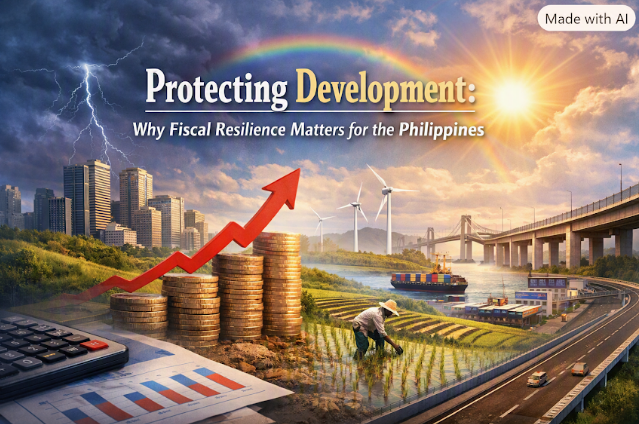
The Philippines has an opportunity to move from a model of fiscal management that primarily responds to problems toward one that systematically anticipates them.
That does not mean predicting every crisis. It means accepting that shocks will occur and building institutions capable of absorbing them.
The country needs adequate fiscal space, but it also needs better revenue mobilization, higher-quality public expenditure, sustainable borrowing, resilient infrastructure, and stronger public financial management.
None of these operates in isolation.
Revenue provides resources. Fiscal space provides flexibility. Good public financial management improves allocation. Productive investment strengthens future growth. Sustainable debt protects future budgets. Disaster preparedness reduces future losses.
Together, they create something more valuable than a balanced fiscal account: the capacity to protect development when circumstances turn unfavorable.
Fiscal Resilience Is About Protecting Development
The ultimate purpose of fiscal resilience is not to produce impressive fiscal statistics.
It is to ensure that when the next typhoon comes, when another global slowdown arrives, or when an unexpected economic shock hits, the Philippines does not have to choose between responding to the crisis and protecting its long-term development priorities.
A resilient fiscal system gives a country room to act.
It protects essential public services. It safeguards productive investment. It supports vulnerable households and communities. And it allows the country to continue investing in the future even when the present becomes difficult.
For the Philippines, this is more than a question of fiscal management.
It is a question of whether the development gains achieved over many years can be protected, deepened, and passed on to the next generation.
Fiscal resilience, ultimately, is the financial foundation of development resilience.