

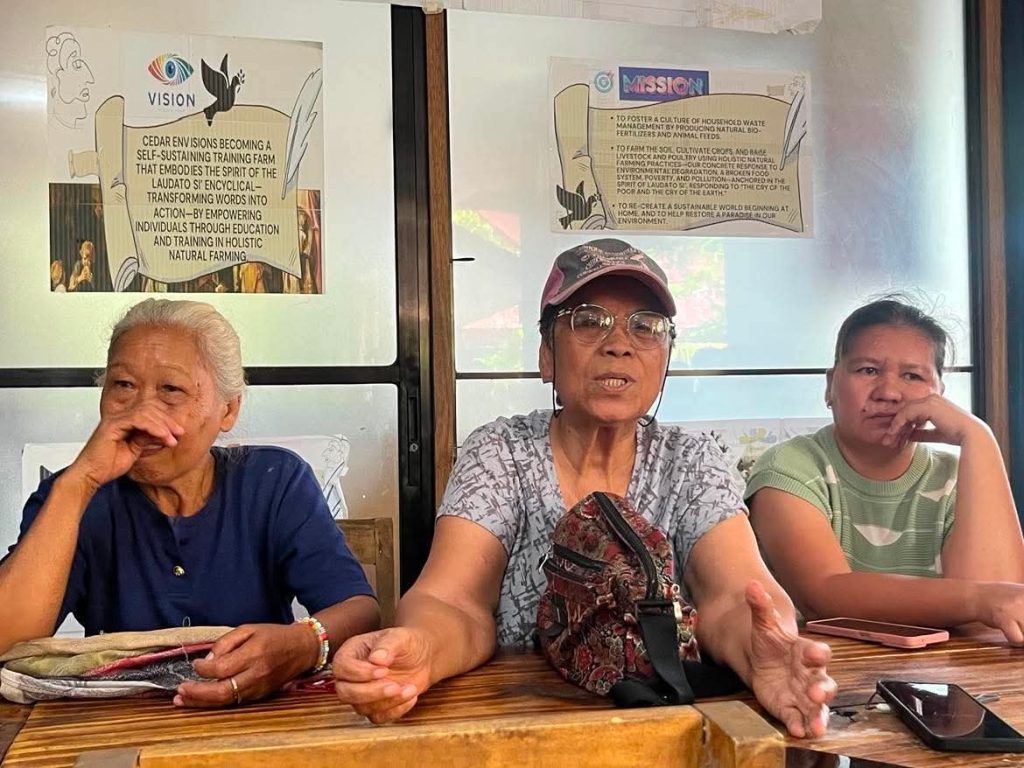
MATI CITY — Soledad Lumactod, one of the elders from the Mandaya Indigenous Cultural Community (ICC) of Barangay Macambol, City of Mati, Davao Oriental, insisted that there is no point in keeping the mining company if it would result in a divided community.
“Ang tanang kaigsounan nako tua na sa pikas kay gumikan anang mining, nagpakita sila nga naa silay kakaya tungod sa mining, mao na akong ingon nga mahunong na unta ang mining. Dili ko anti pero gusto ko mahunong gumikan sa kasamok karon sa tali sa igsoun, mga parente,” Lumactod said during the media conference at Nuestra Senora de Guia Parish in Barangay Dawan, Mati City on Aug. 18.
This follows the installation of barricades by the community asking for dialogue with the mining company when the first community assembly for free prior and informed consent (FPIC) with the National Commission on Indigenous Peoples XI did not proceed
The FPIC preparation was related to the renewal application for Mineral Processes Sharing Agreement (MPSA) No. 196-2004-XI by Hallmark Mining Corporation and MPSA 197-2004-XI for Austral-Asia Link Mining Corporation.
“Mao na among mga pangandoy nga moabot unta sa taas nga madungog unta nila among pag-agulo, kakapoy, pakigbisog,” Lumactod said.
For nearly two decades, the Mandaya ICC of Barangay Macambol has fought for its own 18,000-hectare ancestral domain, which the tribe first sought to have titled in 2008.
Today, that fight has gone into a multi-front dispute involving a contested tribal leadership, withheld royalty payments, and a list of alleged violations by mining companies operating in the area.
The community says it is no longer simply about rival factions vying for power but its right to be consulted, represented, and paid what it is due.
Divided leadership
The Mandaya of Macambol filed its application for a Certificate of Ancestral Domain Title on Aug. 13, 2008, under then-tribal chieftain Rufino Anacito Mapinogos, uniting four principal clans: Mapinogos, Valentin, Magtana, and Dianong, along with allied families Clemente, Datu, Magdagasang, Rojas, Rufino, and Wanay under Mapinogos.
That unity began to unravel on March 24, 2015, according to community accounts and records as reported by Eroll Aquino, Macambol councilor and Macambol Cabuaya Ancestral Domain Management Organization (MACAADMO) president, after the mining company MARS entered the area while AMCOR remained in its exploration phase.
Disagreements over how to handle mining operations split the leadership, and the National Commission on Indigenous Peoples (NCIP) Provincial Office subsequently recognized Heracleo Felizarta as tribal chieftain.
Remedios Mapinogos, interim IPMR, said that recognition was never fully legitimate since the process lacked proper notice, genuine consultation, and a customary Balaw-Balaw assembly. Also, the deciding assembly and FPIC were closed off to most IP members.
“Ang mina nahimugso jud na sa panglinla, bakak. Ang natawag na FPIC, kadtong mga tawo nga pabor nila mao ray makasulod, dili ka makapaniodto kung dili ka mopirma sa attendance nga maoy gigamit sa mina, pakaonon ka lang, uban sa saad nga makatrabaho tang tanan,” she said.
What followed, Aquino reported, were eleven years from 2015 to 2024 marked by the absence of regular assemblies, minimal consultation, a leadership they describe as rarely visible, and a rising number of non-members entering the ancestral domain.
Aquino said IPs were only remembered when signatures were needed for mining-related paperwork.
But on June 10, 2024, IP elder Angeline Mapinogos Galon led a request for an open forum with the NCIP where community members raised long-standing grievances, including the lack of assemblies, allegations against leadership, and unresolved royalty concerns.
Felizarta reportedly promised to step down by January 2025, a promise the community said was never fulfilled.
Petitions to the NCIP and the Mati City government continued through a validation process that, according to Aquino, produced no clear resolution.
Until April 2025, a community member’s question about a long-pending leadership petition prompted the NCIP to reopen the case and initiate a reorganization that recognized Norman S. Mapinogos as the new tribal chieftain of Barangay Macambol. His certificate of recognition was issued on April 29, 2025.
On July 28, 2025, the community approved a resolution formally separating leadership between Macambol and Cabuaya and affirming that decision-making authority should rest with the host community, that benefits be distributed fairly, and that job opportunities prioritize IP members.
But the leadership transition did not end the conflict; rather, an opposing faction of the community continued holding meetings and issuing resolutions that were never disclosed to the newly recognized chieftain.
This includes resolutions in January 2026 authorizing employment endorsements outside Chieftain Norman’s signature.
On Feb. 9, 2026, a joint validation by the NCIP provincial and regional offices found that several resolutions from the opposing group lacked community consultation.
This resulted in the six clans previously grouped under the Mapinogos name formally separated into distinct clan lines: a process that ultimately produced formal recognition of six clans.
On Feb. 24, 2026, the NCIP XI issued Memorandum No. 91 temporarily suspending the authority of incumbent Indigenous Peoples Structure (IPS) members and the IP Mandatory Representative (IPMR) pending resolution of the leadership dispute.
But the officials refused to recognize the suspension and continued to exercise their former authority, according to Aquino.
On March 14, 2026, all 10 recognized clans convened a large balaw-balaw at Macambol Elementary School Gymnasium, adopting resolutions that upheld Memorandum No. 91, recognized the ten clans, established temporary clan representatives, and adopted an interim governance protocol.
“During that forum, it was decided that from the four clans, magiging 10 clans na kami kasi yung six clans were recognized ng community at that time,” Aquino said.
However, the opposing group gathered outside the assembly with placards and a sound system, alleging that the group comprised individuals and non-IPs hired by the mining company to create chaos.
She added that the opposing faction continued acting as though the suspension order did not exist.
“Wala silang gina-honor na even NCIP kasi ang focus nila or ang loyalty nila nandun sa mina,” she stressed.
This prompted a further resolution recalling the suspended individuals from their positions, naming interim IPS officers.
The NCIP XI subsequently issued certificates of recognition for the interim IPS, the Council of Elders and Leaders, clan-level IPO representatives, and Remedios A. Mapinogos as interim IPMR, which the opposing group continued to reject the leadership.
Former IPMR Romeo Mapinogos was still recognized by the Barangay Council despite the NCIP’s actions.
The July 22, 2026, dispute
The dispute reached its peak on July 22, 2026, when the NCIP’s FPIC team attempted to convene the first community assembly for the renewal of two mining permits for Hallmark and AMCOR, which ends in January 2027.
“Technically, wala talagang appearance ng mina at that time kasi that activity was for the IP community, but unfortunately, andiyan yung presence ng community relations, trabahante, and non-IPs,” she stressed.
Aquino said the employees of the mining company who went there were allegedly paid double their daily wage, while non-IPs received P500 per day to create chaos in the assembly.
Prior to the July 22 assembly, Aquino said the group had signed a resolution for non-participation, fearing expected tensions would happen.
“Hindi talaga namin itutuloy ang FPIC because we don’t want to compromise the sanctity of the FPIC kasi pinoprotektahan natin hindi maulit yung first plebiscite sa pag yes sa mina because everyone is aware it did not go through an assembly with the host community,” she said.
“You have to imagine, magkamali ang IP community to say yes to mining with this kind of attitude. Imagine another 25 years of that attitude sa mina kung hindi natin yan ma check,” Aquino added.
She stressed that the group is not anti-mining but wanted the appropriate implementation on the ground.
The royalty trail
Parallel to the leadership dispute is the accounting of how mining royalties owed to the Mandaya community have and have not been released.
The Indigenous Peoples Organization tasked with receiving and managing royalty payments was created through a memorandum of agreement signed by the Tribal Councils of Macambol and Cabuaya, represented by then-chieftains Lemente and Felizarta.
Section 61 of the 2012 Revised Free Prior and Informed Consent Guidelines of the NCIP prescribes that indigenous cultural communities / indigenous peoples (ICCs/IPs) receiving royalties must formulate a CRDP for the management and use of royalties.
Mining companies are required to pay a minimum royalty payment of no less than 1% of the gross output under the Philippine Mining Act of 1995.
In the gross output report for the shipment of nickeliferous ore obtained by this reporter from MGB, HMC in 2022 was able to complete one shipment of 55,600 wet metric tons valued at ₱92.3 million. The amount rose to ₱1.12 billion in 2023 and ₱2.2 billion in 2024.
As of June 2025, HMC was able to complete 17 shipments with a volume of 943,539 wet metric tons, with a value of ₱1.5 billion, more than half the amount in 2024.
The IPO president prepared the required documentation with an estimated ₱1.1-million budget, without any budget allocated for the task itself.
The first royalty payment, covering 2016, 2022, and 2023, was released on Nov. 12, 2024, totaling ₱10,711,001.15.
Aquino explained that the community wanted to receive a tangible amount from the first royalty, hence the distribution of a P2,500 gift check to IPs and non-IPs in 2024.
A second release, covering 2024 and totaling ₱19,193,630.18, followed on February 18, 2025, after the IPO compiled the documents.
Aquino said an additional ₱800,000 owed by HMC cited in a letter from the company’s comrel officer Dr. Arvin Carlom, remains undeposited.
Tensions over the IPO’s handling of funds became public on May 29, 2025, when the Cabuaya and Macambol tribal councils, without chieftain Norman Mapinogos, whom the community said was neither invited nor informed, passed a joint resolution during a meeting in Mati City demanding the IPO submit financial records within 72 hours and withdraw funds for tribal council honorariums.
On July 17, 2025, a community assembly meant for the IPO to present its liquidation report instead descended into conflict after Felizarta and his family challenged the IPO over its handling of cash advances, according to the community’s account.
Aquino said the assembly ended without resolution, and rumors that the IPO had “used up all the money” spread afterward.
In December 2025, individuals who had sought those cash advances filed a qualified theft complaint against the IPO president, but it was dismissed for lack of prima facie evidence, and a subsequent motion for reconsideration was denied.
On Feb. 9, 2026, the IPO, with NCIP’s permission, presented its liquidation clan by clan to address the funding allegations directly, a process the community says was completed successfully.
Documents for the 2025 (third) royalty worth P33 million were prepared soon after, and the NCIP Provincial and Regional Offices carried out physical validation of IPO-implemented projects.
NCIP XI regional director Atty. Geroncio Aguio wrote to HMC management on April 21, 2026, requesting release of the 2025 royalty; a second letter followed on July 20, 2026, but the 2025 royalty remains unreleased as of this report.
Alleged violations of the mining company
Beyond the leadership and royalty disputes, the Mandaya community has alleged that Hallmark Mining Corporation ignored IP rights and damaged both the community and the land within its ancestral domain.
The community reported improper implementation of the company’s Social Development and Management Program (SDMP), with consultation limited to the planning stage and no transparency on fund use.
Jayson Rey Repisada, former Macambol Barangay secretary, said the community has not benefited from the SDMP.
“Every time the community relations would have an acknowledgement receipt signed at the barangay, I was just shown a photo with no official documentation, and I am fully aware there were no projects,” Repisada said.
Repisada alleged that the mining company did not provide anything to the community to the best of his memory.
“Bisan moingon sila nga nanghatag sila sa farmers, 2017- 2025 ko barangay secretary, wala pajud na sila kahatag sa mga livelihood o para sa mananagat. Wako kahinumdom nga naghatag ug pukot, taga ug mga bangka dira, pero kadtong panahon nga nagsukit-sukit nami, nikalit nag hatag,” he said.
DENR Administrative Order No. 2010-21, or the Revised Implementing Rules and Regulations of Republic Act 7942 (Philippine Mining Act of 1995), requires mining contractors and permit holders to allocate at least 1.5 percent of operating expenses to their host communities through the Social Management and Development Program (SDMP).
Part of the SDMP is the turnover of a school bus for the students, but Repisada claimed the company took it back for its own operations.
Repisada also reported labor violations affecting workers, including delayed wages and non-remittance of SSS, PhilHealth, and Pag-IBIG contributions while he was a mine statistician for the company in 2016.
Despite this, he alleged that every worker was forced to support the mining company at the risk of losing their jobs after the end of the season or every November.
He added that the mining company claims to be providing a scholarship to students, but in reality, every student only receives P5,000 per semester, which cannot cover their school expenses.
“Sa kamahal sa palitonon, boarding house pa daan, pagkaon pa, di ka sustain uy,” he stressed.
Soledad Lumactod said the mining company also promised to construct roads for them but that remained unfulfilled.
For Gloricel Bansag, IPO of Datu clan, recalled the elders were forced to do a bayanihan to repair the roads, believing that it should be the responsibility of the mining company to the community.
Aquino also reported that the mining company constructed along a floodplain or dead river that the community links to flooding in 2024 and unassessed cracks observed on Mount Matayam/Mataram, raising landslide and slope-failure concerns and other environmental violations including unauthorized tree-cutting and river backfilling.
This is on top of the unreleased 2025 royalty; the disruption of the July 22, 2026 FPIC assembly and other Balaw-Balaw assemblies; and possible liability on the part of government agencies and officials for failing to act on documented complaints.
It is also calling for an independent geohazard assessment of the Mount Matayam cracks, immediate release of the 2025 royalty, and DOLE claims over unpaid wages.
HMC’s response to the statements from the community was not available as of this writing.
The FPIC in question
Underlying the mining-related allegations is a legal question the community says has never been resolved: whether Hallmark Mining Corporation and Austral-Asia Link Mining Corporation are legally entitled to operate in the ancestral domain at all.
The original FPIC and accompanying memorandum of agreement were executed with the Mandaya-Manobo Tribe between 2001 and 2002, and the NCIP issued a Certificate of Precondition (CP) in 2002 to a group of six companies: Blue Ridge Mineral Corp., Hopewell Mining Corp., Patrick Mining, P.I. Goodman, Mr. Peak, and Oregon Mining, represented collectively by Asiaticus Management Corporation (AMCOR).
That CP was validated by the NCIP En Banc in 2004 under a “substantial compliance” standard.
Aquino said neither HMC nor Austral-Asia Link Mining Corporation was among the original FPIC holders, according to the community’s materials, and both are said to be operating in the same MPSA area spanning parts of Davao Oriental and Davao del Sur near Malita and San Isidro without securing a new, company-specific FPIC.
She cited that under NCIP Administrative Order No. 3, series of 2012, FPIC and the CP are described as project-specific and non-transferable; any change in the project proponent is meant to trigger a new consent process.
The community said they will petition the NCIP to investigate and suspend the existing CP, filing complaints with the MGB or DENR over the alleged unauthorized MPSA transfer, and demanded a new, project-specific FPIC process for HMC and Austral-Asia Link Mining Corporation.
What comes next
The community frames its position around a single principle: that royalty and representation rights belong to the whole Mandaya community of Barangay Macambol, not to any one leader or faction.
“Transparency is not about pleasing everyone,” the community’s materials state. “It is about being accountable to the whole community.”
Community leaders say they intend to continue pursuing formal investigation requests through a proper process, uphold customs and traditions, and settle disputes through dialogue rather than violence.
Shirley Iguianon, NCIP XI Technical Management Services Division chief, maintained it will not proceed with the FPIC after the July 22, 2026 conflict.
“Karon kay naa man tay concern sa company, ato lang pud klarohon ni nga dili ni ancestral domain sa Hallmark. This is the ancestral domain of the Mandaya. Therefore, ang Mandaya ang pwede magpahawa sa ila,” Iguianon said.
NCIP will set a compliance review with the IP community on their terms and conditions of the company on Sept. 8.
“They have to comply with the terms and conditions. I-exercise jud namo among visitorial powers and the suspension of the FPIC. NCIP said it will check the compliance, including the release of the fund,” she said.
Aguio warned that non-attendance of the mining company in the MOA review will entail penalties.
“Naa na tay daghang ebidensya, naa na tay duha ka notice, invitation, deliberate na, aggravating na ilang actions. Documented naman, so kung aggravating na mas bug-at na ang penalty,” Aguio stressed.
A MOA review by the NCIP evaluates existing agreements to ensure project commitments remain responsive to the welfare of Indigenous Cultural Communities and Indigenous Peoples (ICCs/IPs) under FPIC guidelines.
At present, the Hallmark mining company has yet to release a statement regarding the set MOA review.
To note, the mining company released a statement on Aug. 18 that the continuing barricades affecting road access to the Pujada Nickel Project are impacting mine operations and movement of people, goods and services along the project access corridor.
It claimed that the access blockades along the Provincial Road leading to the project area have disrupted the movement of approximately 2,000 employees and contractors, as well as vehicles transporting fuel, food, equipment, materials and other essential supplies, and approximately 300 students from local communities.
The company maintained that the Pujada Nickel Project operates under MPSAs approved by the Department of Environment and Natural Resources (DENR) authorizing mineral exploration, development and utilization within the approved contract areas, subject to Philippine laws, environmental requirements and government regulations.
HMC has formally notified the DENR Mines and Geosciences Bureau XI regarding the access obstruction.