


THE PHILIPPINES needs electricity that is not only cleaner, but cheaper, more reliable, and capable of powering the next stage of economic development.
A Filipino household does not experience energy policy as a government programme. It experiences it as an electricity bill at the end of the month.
A small business experiences it as the cost of keeping its refrigerators, computers, machines and lights running. A factory experiences it as part of the cost of producing goods. A farmer may experience it through the cost of irrigation and storage. A hospital experiences it as a question of uninterrupted power. And on a remote island, electricity can still mean expensive diesel transported across the sea.
This is why the Philippines’ energy challenge is much bigger than the question of how much electricity the country can generate.
The more important questions are straightforward: How much does electricity cost? How reliable is it? Where does it come from? And can the energy system support the country’s next stage of economic development?
These questions have become particularly important as the Philippines seeks stronger investment, more manufacturing, better jobs, and more inclusive growth.
The country has an unusual advantage. It possesses substantial geothermal resources, abundant sunlight, significant wind potential, and hydropower opportunities. Yet the power system remains heavily dependent on fossil fuels. In 2024, fossil fuels accounted for about 78% of power generation, with coal alone accounting for about 63%. Renewable energy contributed roughly 22%.
The paradox is striking: a country with considerable renewable-energy potential continues to carry a relatively high electricity-cost burden.
That paradox needs to be addressed not simply as an environmental issue, but as a development issue.
The electricity bill tells only part of the story
One technical distinction is important.
“Generation cost” and the final electricity tariff are not the same thing. Generation is only one component of the electricity bill. Transmission, distribution, system losses, taxes and other regulated charges also contribute to what households and businesses ultimately pay.
But generation remains fundamental. If the underlying cost of producing electricity is high, particularly when it depends heavily on imported fuels, the economy becomes vulnerable to international commodity prices, exchange-rate movements and supply disruptions.
There has been progress. Electricity-market prices have declined from earlier peaks, and renewable-energy investments are beginning to exert downward pressure. Yet the Philippines continues to have some of the highest electricity prices in ASEAN, creating a competitiveness problem, particularly for manufacturing.
The argument, therefore, should not be that Philippine electricity prices are simply getting worse. They are not.
The more important point is that even after recent easing, the underlying cost structure remains too high for an economy aspiring to attract more investment and move into higher-value production.
An investor comparing locations does not look only at wages, tax incentives, or market size. Energy costs matter. So does certainty.
A factory that pays slightly more for electricity but receives a stable supply may be more competitive than one facing unpredictable interruptions, voltage fluctuations or emergency generation costs.
The Philippines therefore needs to pursue two objectives simultaneously: lower the cost of electricity and improve its reliability.
A cheap kilowatt is of little value if it is not there when needed
Reliability is sometimes treated as a technical concern for engineers.
It is actually an economic concern for everyone.
A power interruption can stop a production line, spoil food, interrupt digital services, disrupt hospital operations, damage equipment, and force small businesses to close temporarily. For an economy becoming increasingly dependent on manufacturing, services, digital commerce and modern logistics, unreliable electricity carries a hidden economic cost.
Recent electricity-market conditions demonstrate the point. Renewable energy is gaining ground, but coal and natural gas still dominate the generation mix, while transmission constraints and regional supply conditions can create localized pressure.
This leads to an important lesson:
Adding renewable capacity is necessary, but capacity alone does not guarantee reliable electricity.
A modern electricity system needs sufficient generation, adequate reserves, flexible capacity, transmission, storage, forecasting, demand management, and resilient distribution networks.
In other words, the Philippines does not simply need more power plants.
It needs a better power system.
The grid is the bridge between energy potential and economic opportunity
This may be the least glamorous part of the energy debate, but it could be among the most important.
The Philippines is an archipelago. Energy resources are not necessarily located where electricity demand is highest.
The sun may be abundant in one location. Geothermal resources may be concentrated in another. Offshore wind may be strongest far from major cities. Hydropower depends on geography and water resources. Electricity demand, meanwhile, is concentrated around population centres, industrial zones and commercial hubs.
The grid must connect these pieces.
Without adequate transmission, a country can have excellent renewable-energy projects and still experience local shortages or high prices.
This becomes even more important as renewable generation expands. Solar and wind output varies with weather and time of day. Geothermal can provide relatively firm generation. Hydropower can provide flexibility where conditions permit. Batteries can shift electricity from periods of surplus to periods of greater demand.
The future therefore requires an integrated combination of generation, transmission, storage, and demand management.
The grid should not be treated as an afterthought to generation projects. It is the bridge that turns generation capacity into usable economic power.
The Philippines should not choose one green technology
There is sometimes a temptation to search for a single solution to the energy problem.
The Philippines should resist that temptation.
The country needs a portfolio.
Geothermal: an indigenous strength
Geothermal power deserves special attention because it is one of the Philippines’ most distinctive energy assets.
Unlike solar and wind, geothermal generation can provide relatively steady power and does not depend directly on sunlight or wind conditions. The Philippines has accumulated considerable experience in geothermal development and can build on that institutional and technical base.
Geothermal cannot solve the entire energy problem. Exploration risks, financing, resource availability, and environmental considerations impose limits.
But where resources are viable, geothermal can provide something increasingly valuable: firm, indigenous, low-carbon electricity.
Solar: the fastest opportunity
Solar is perhaps the most scalable renewable option.
Utility-scale solar farms can add capacity relatively quickly, while rooftop solar allows households, commercial buildings and factories to produce some of their own electricity.
For a country of islands, distributed solar has another advantage. It can reduce the need to transport fuel over long distances and can be particularly useful in areas where extending conventional infrastructure is expensive.
The growth of rooftop solar also changes the relationship between consumers and the electricity system. Some consumers can become “prosumers”—both producers and users of electricity.
But solar’s intermittency must be recognized. Solar generation is strongest during daylight hours, while electricity demand continues into the evening.
That is where storage becomes important.
Wind: especially offshore wind
The Philippines’ extensive coastline gives offshore wind considerable long-term potential.
The country has already begun moving toward competitive offshore-wind development, with the first auction targeting 3.3 GW of contracted capacity for delivery between 2028 and 2030.
Offshore wind will not produce immediate results. It requires substantial investment in ports, transmission, marine infrastructure, grid connections and project development.
But it could become an important component of the country’s longer-term energy portfolio.
Hydropower and floating solar
Hydropower can continue to contribute where economically and environmentally appropriate, particularly where projects can provide both generation and flexibility.
Floating solar can make productive use of suitable reservoirs and water bodies while reducing pressure on scarce land.
Neither should be treated as a universal answer. Each project must be judged on environmental, social, technical and financial grounds.
The principle should be simple:
Use the resource that is most appropriate to the location and the grid requirement.
Batteries may be the missing link
Renewable-energy discussions often focus on solar panels and wind turbines.
The less visible revolution may take place in batteries.
Battery energy storage systems can help smooth fluctuations, respond rapidly to changes in demand and supply, and shift electricity from periods of high renewable generation to periods when electricity is more valuable.
They are particularly relevant to an archipelago.
A remote island does not necessarily need a large fossil-fuel power plant connected to a distant grid. A combination of solar, batteries and efficient backup generation can potentially provide a cleaner and more resilient microgrid.
Such systems can reduce diesel dependence and improve energy security in communities that are difficult or expensive to connect to major transmission networks.
But batteries are not magic. They have duration limits, costs, degradation issues, and material requirements. Long-duration storage and other forms of flexibility will also matter as renewable penetration rises.
The important point is that renewable generation and storage must be planned together rather than separately.
The archipelago can become an advantage
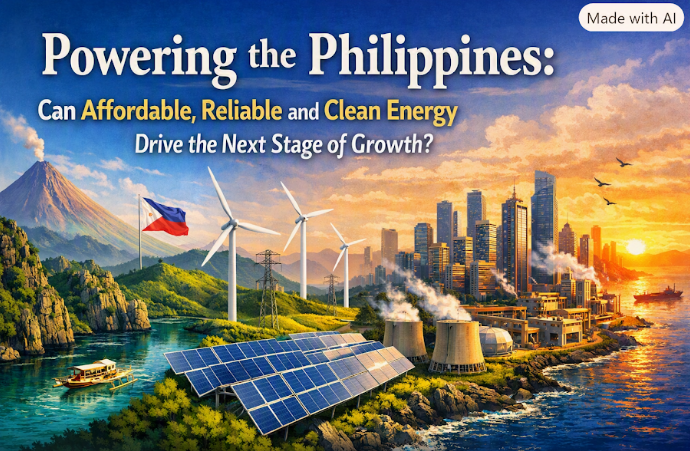
Being an archipelago is often presented as an infrastructure disadvantage.
It certainly makes connectivity more expensive.
But geography can also encourage innovation.
Instead of attempting to make every island dependent on a single centralized model, the Philippines can develop a combination of large interconnected grids and smaller, resilient energy systems.
Major metropolitan and industrial centres can be served by increasingly sophisticated transmission networks.
Smaller islands can use appropriately designed microgrids.
Remote communities can combine solar, batteries and other local resources.
Commercial and industrial consumers can adopt rooftop solar, storage and energy-efficiency measures.
This is not a rejection of the national grid. It is recognition that one architecture may not fit an entire archipelago.
The Philippines could become a laboratory for a more flexible model of energy development—centralized where scale matters and decentralized where geography makes decentralization more economical.
Energy efficiency is the cheapest power plant
There is another source of energy that receives less attention than it deserves: the electricity that does not have to be generated.
Energy efficiency in buildings, factories, transport systems, appliances and public infrastructure can reduce demand while maintaining the same level of economic activity.
Better cooling systems are particularly relevant in a tropical country. Efficient motors, industrial equipment, lighting, building design and demand-management systems can all reduce pressure on the grid.
For households, energy efficiency can mean a lower monthly bill.
For businesses, it can mean lower operating costs.
For the country, it can mean less investment required in additional generation capacity.
The cleanest and cheapest unit of electricity is often the one that does not need to be produced.
Energy security is economic security
The Philippines’ dependence on imported fossil fuels creates another vulnerability.
When global fuel prices rise, the impact does not remain in the energy sector. It can spread through transport costs, food prices, manufacturing expenses, household budgets, and the balance of payments.
Renewable energy changes this equation because sunlight, wind, and geothermal resources do not have to be imported every time electricity is generated.
The transition therefore has an economic-security dimension.
It is not simply about reducing carbon emissions.
It is about reducing exposure to external price shocks.
That is particularly important for an economy seeking greater resilience in an increasingly uncertain global environment.
ASEAN gives the Philippines a special opportunity in 2026
The timing is unusually important.
The Philippines is ASEAN Chair in 2026 under the theme “Navigating Our Future, Together.” Energy is already an important part of that regional agenda. ASEAN has begun implementing its ASEAN Plan of Action for Energy Cooperation 2026–2030, while work is advancing on the Enhanced ASEAN Power Grid, multilateral power trade and regional interconnection.
The Philippines therefore has an opportunity to bring its domestic energy experience into the regional conversation.
The ASEAN Power Grid is not simply an infrastructure project. It can become an instrument of energy security.
When countries with different energy resources can trade electricity, regional systems become more flexible. A country with surplus renewable generation at one time can potentially support another country experiencing a shortage.
This is particularly important as Southeast Asia’s electricity demand continues to rise.
The Philippines could use its Chairmanship to promote a practical ASEAN energy agenda built around three principles: Affordability, reliability, and sustainability.
That could mean accelerating regional electricity interconnections, developing common standards for storage and grid technologies, strengthening disaster-resilient infrastructure, encouraging private investment in renewable energy, and improving the regulatory environment for cross-border electricity trade.
The Philippines does not need to present itself as having solved the energy problem.
It can lead ASEAN more credibly by showing how it is trying to solve its own.
Asia’s next industrial competition will also be an energy competition
The global competition for investment is changing.
Manufacturers increasingly want reliable electricity, competitive prices and lower-carbon production.
Countries that can offer all three will have an advantage.
This creates a significant opportunity for the Philippines.
A cleaner and more reliable electricity system could help attract investment into manufacturing, digital infrastructure, electric mobility, data centres, food processing and other energy-intensive industries.
It could also help existing Philippine businesses become more competitive.
The objective should therefore not be to treat renewable energy as a separate “green sector.”
Renewable energy should become part of the country’s industrial strategy.
A solar project creates construction and engineering activity. A stronger grid creates infrastructure demand. Battery storage creates opportunities for new services and skills. Offshore wind can stimulate ports, maritime services and specialized manufacturing. Energy efficiency can create new markets for technology and professional services.
The transition can therefore generate jobs—not merely reduce emissions.
But the transition must not leave ordinary Filipinos behind
There is an important social dimension.
A sophisticated energy transition means little if electricity remains unaffordable for ordinary families.
The benefits of renewable energy should therefore not be measured only in gigawatts installed or billions of pesos invested.
They should also be measured in:
- lower household electricity bills;
- more reliable electricity for small businesses;
- better opportunities for rural communities;
- lower operating costs for farmers and manufacturers;
- more jobs for Filipino workers,
- and cleaner, more resilient communities.
Energy policy ultimately has to return to the household.
If the transition produces impressive investment statistics but ordinary consumers do not see greater affordability and reliability, public support will inevitably weaken.
The transition must be economically credible as well as environmentally responsible.
The Philippines should build an energy system, not merely energy projects
The central challenge is now becoming clearer.
The Philippines does not lack energy projects.
It needs better integration among them.
A solar farm without transmission may not deliver its full value.
A wind project without adequate grid capacity may face delays.
A battery without an appropriate market structure may remain underutilized.
A geothermal plant cannot compensate for weaknesses elsewhere in the system.
A modern energy strategy must therefore bring together generation, transmission, storage, distribution, efficiency, regulation and consumers.
This also means maintaining competition and transparency in electricity markets and ensuring that investment in new capacity is matched by investment in the networks needed to deliver that capacity.
Renewable-energy auctions are an important step. But auctions alone cannot transform the energy system.
The country needs a long-term investment pipeline that gives developers, utilities, financiers and consumers confidence about where the system is going.
Three tests for the energy future
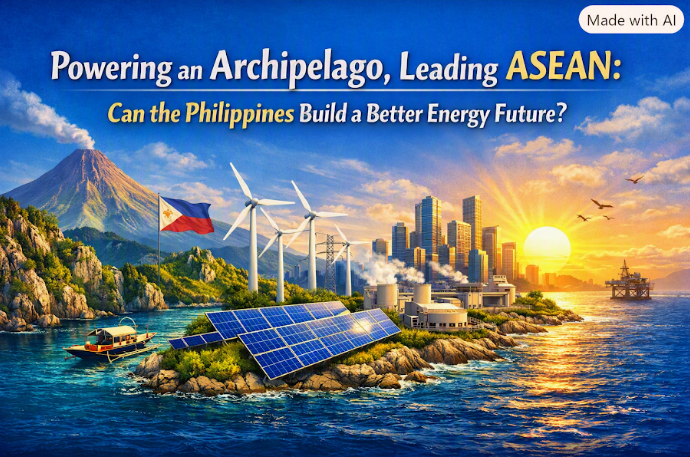
The Philippines’ energy transition can ultimately be judged by three simple tests.
Is electricity affordable?
If not, manufacturing and household welfare will continue to suffer.
Is electricity reliable?
If not, businesses cannot plan, investors hesitate and communities remain vulnerable.
Is electricity sustainable?
If not, the country remains exposed to fuel-price shocks and the environmental costs of a fossil-fuel-dependent system.
These three objectives should not be treated as competing choices.
The real policy challenge is to make them reinforce one another.
Cheaper renewable generation can improve affordability.
Better transmission and storage can improve reliability.
A more diversified domestic energy system can improve both sustainability and energy security.
That is the real energy transition the Philippines needs.
From energy bottleneck to development advantage
The Philippines stands at an interesting point in its energy journey.
The country has many of the ingredients needed for a major transformation: geothermal expertise, abundant solar resources, growing wind potential, hydropower opportunities, an expanding renewable-energy investment pipeline and a large domestic market.
It also has a powerful reason to act.
Electricity is too important to economic development to remain vulnerable to high costs, imported-fuel shocks, inadequate transmission and unreliable supply.
The answer is not to abandon conventional generation overnight. Nor is it to assume that every renewable project is automatically economical or environmentally benign.
The answer is a disciplined transition—one that uses the most suitable technologies, strengthens the grid, expands storage, improves efficiency, encourages competition and protects consumers.
The Philippines’ ASEAN Chairmanship in 2026 adds another dimension to this opportunity. Regional energy cooperation is moving from broad aspirations toward practical work on interconnection, power trading, resilience and the Enhanced ASEAN Power Grid.
The Philippines can use this moment to demonstrate something larger than a successful energy transition.
It can demonstrate how an archipelagic developing economy can turn geographical fragmentation into distributed resilience, renewable resources into competitive advantage, and energy cooperation into regional economic opportunity.
Ultimately, the Philippines should judge every major energy decision by three questions:
Is it affordable?
Is it reliable?
Is it sustainable?
If the answer to all three is increasingly yes, energy will cease to be merely a constraint on Philippine development.
It can become one of its greatest enablers.
The real breakthrough will not be measured simply in gigawatts of renewable capacity.
It will be measured in lower electricity bills, fewer interruptions, stronger businesses, better jobs, more resilient communities, and greater economic opportunity.
That is what it would mean to truly light the archipelago.
And that is how the Philippines can turn an energy bottleneck into an ASEAN advantage.