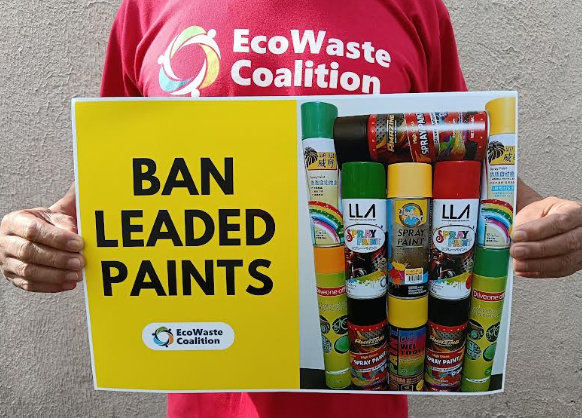

QUEZON CITY — Confirmatory analyses contracted by the EcoWaste Coalition and undertaken by SGS, a global testing company, verified the presence of toxic lead in 27 paint samples imported from China and Thailand that are offered for sale in the domestic market, including e-commerce sites. Dismayed by this egregious breach of the law, the group called on the authorities to adopt stronger measures to reinforce the lead paint ban and thus protect public health.
As per laboratory test results, the 27 paints representing 11 brands were analyzed to contain lead in excess of 90 parts per million (ppm) making them patently illegal to import, distribute and sell in the Philippines, noting the country’s successful completion of the phase-out deadlines for lead-containing decorative paints in December 2016 and lead-containing industrial paints in December 2019 in accordance with the DENR-issued Chemical Control Order (CCO) banning lead in paints and similar surface coatings.
Of the 27 paints, 19 were analyzed to contain lead above 10,000 ppm of which four had staggering lead concentrations exceeding 100,000 ppm, including two products bearing a “No Pb” pictogram despite evidence to the contrary (one product contains 117,000 ppm and the other has 138,000 ppm). Pb is the chemical symbol for lead from its Latin name plumbum.
“The discovery of lead in more imported paints sold locally points to the urgent need to enhance enforcement measures to address gaps and ensure that the lead paint ban is effectively implemented for public health and safety,” said Manny Calonzo, campaigner, EcoWaste Coalition. “We call on the authorities to jointly carry out such measures, including tightening customs controls, intensifying compliance monitoring, charging and penalizing violators, and nominating lead chromates for listing in the Rotterdam Convention, to reinforce the ban on lead, a multi-system toxicant, in paints and similar surface coatings.”
“We urge the government of the Philippines to join Cameroon, Morocco and Switzerland in advocating for the inclusion of lead chromates in the Rotterdam Convention as the treaty’s Prior Informed Consent (PIC) Procedure will help in controlling the global trade of this key ingredient in lead paint production,” said Jeiel Guarino, Global Lead Paint Elimination Campaigner, International Pollutants Elimination Network (IPEN). “If listed, companies that export lead chromates or paints containing them will no longer be allowed to export these goods to a country that has not consented to import them.”
The list of 27 paints found to contain lead includes:
Boston Spray Paint: antirust substrate gray (2,380 ppm);
Collfria Spray Paint: orange red (3,050 ppm);
Colorz Aerosol Spray Paint: medium yellow (57,100 ppm), jade green (35,600 ppm) and flash red (1,900 ppm);
Colorz Chisai Acrylic Spray Paint: canary yellow (56,100 ppm), antirust brown (27,000 ppm), orange red (22,800 ppm), , medium gray (3,790 ppm);
JMJAFA Spray Paint: deep yellow (94,700 ppm);
King Sfon Aerosol Spray: leaf green (62,100 ppm);
Koby Spray Paint: forest green (96,700 ppm);
Nikko Spray All Purpose Quick Drying High Gloss Acrylic: antirust
primer red (8,340 ppm);
Standard Aerosol Spray Paint: medium yellow (182,000 ppm), light green (107,000 ppm);
Standard JR Spray Paint: medium yellow (138,000 ppm), art yellow (117,000 ppm), willow green (79,900 ppm);
Tiger Quick Drying Lacquer Spray Paint: orange (78,000 ppm);
Yatibay Acrylic Spray Paint: blackish green (16,900 ppm); and
YiAD Paint: orange (63,900 ppm), yellow (57,300 ppm), light green (45,500 ppm), green (39,000 ppm), pink (3,560 ppm), blue (5,290 ppm), light sky blue (3,900 ppm).
None of these violative paints is manufactured, imported or distributed by affiliates of the Philippine Paint & Coatings Association, Inc. (PPCAI), a partner of the Global Alliance to Eliminate Lead Paint, together with the Pacific Paint (Boysen) Philippines, Inc., Department of Environment and Natural Resources – Environmental Management Bureau (DENR-EMB), IPEN and the EcoWaste Coalition.
Coinciding with International Lead Poisoning Prevention Week, from October 19 to 25, the EcoWaste Coalition will release an updated Public Notice on Lead-Containing Paints that it has co-published with PPCAI and IPEN to alert and guide consumers in making informed purchasing decisions.
Chemical Control Order
EcoWaste Coalition welcomes progress in crafting a CCO on cancer-causing benzene
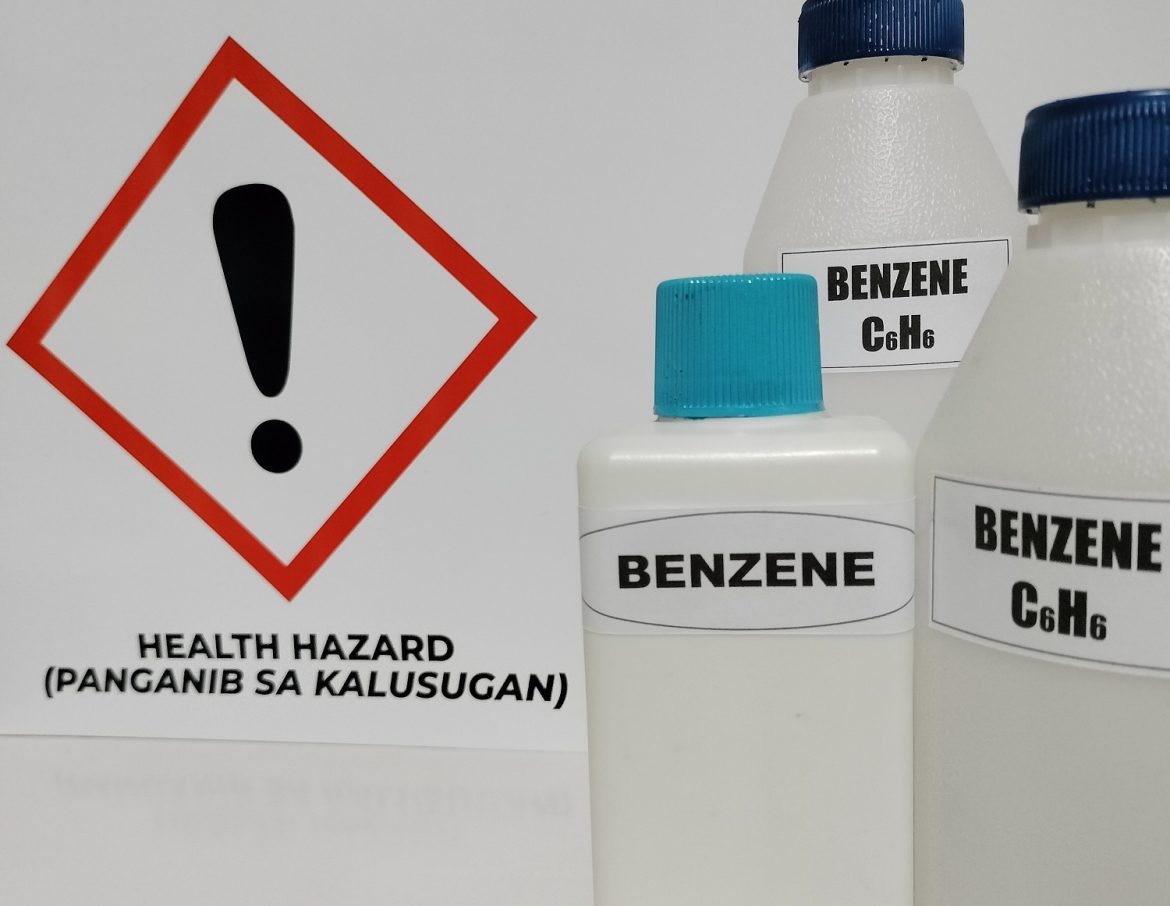
QUEZON CITY — The toxics watchdog group EcoWaste Coalition welcomed the progress in the ongoing efforts to develop a Chemical Control Order (CCO) regulating benzene, a known carcinogen, by the Department of Environment and Natural Resources – Environmental Management Bureau (DENR-EMB).
As one of the 10 chemicals or groups of chemicals of major public health concern as identified by the World Health Organization (WHO), the group expressed optimism that the finalization and eventual promulgation of the CCO will contribute to the effective control on the use of benzene with the end view of reducing occupational and environmental exposure to this category one carcinogen, or a substance that can cause cancer in humans as per the International Agency for Research on Cancer (IARC).
The EcoWaste Coalition particularly welcomed the posting of the revised draft CCO for benzene on the EMB website for further public comments. “Unless no technically and economically feasible alternative for replacement is available,” the CCO “prohibits the importation, manufacture or use of benzene and benzene-containing mixtures in the following applications: paints, varnishes, coatings, solvents, and thinners; glues, contact cement and rubber goods; solutions for textiles, fabrics and leathers; inks and dyes; cleaning and degreasing agents; and toys and other children’s products.”
The group in November 2023 submitted pertinent comments to strengthen the original draft CCO, noting that its development and promulgation was in line with the newly adopted Global Framework on Chemicals – For a Planet Free of Harm from Chemicals and Waste (or the GFC), which seeks to “prevent or, where prevention is not feasible, minimize harm from chemicals and waste to protect the environment and human health, including that of vulnerable groups and workers.”
To better understand how benzene is regulated in other countries, the group reached out to partner groups in Asia-Pacific and in Europe. Relevant information on current regulatory controls provided by colleagues from India, Malaysia, South Korea, Australia, and the European Union was compiled and provided to the DENR-EMB.
As reflected in the revised draft CCO, the DENR-EMB has positively considered some of the suggestions provided by the EcoWaste Coalition, such as the following:
1. Prohibition on benzene and benzene-containing mixtures in “toys and other children’s products” to protect Filipino children who are particularly susceptible to risks and harms caused by benzene and other hazardous chemicals;
2. Replacement of the word “may” with “shall” in the provision tasking the DENR-EMB to develop a phase-out plan for the allowed uses of benzene as this will indicate the government’s commitment to green chemistry and show support to the GFC target on “the transition to safer and more sustainable chemical alternatives.”
3. Inclusion of “online marketplace and electronic commerce systems” in the section on liability to address the problem with the digital trade of controlled chemicals, particularly by unauthorized persons or entities.
4. Creation of a new section on “Coordination with Other Government Agencies” for better alignment of benzene-related policies and programs. This will, according to the group, “create better linkage across diverse sectors” (another GFC target), especially among government regulators.
Since the draft prohibition only applies “unless no technically and economically feasible alternative for replacement is available,” the EcoWaste Coalition reiterated its earlier proposal that juridical applicants should be required to provide information to the DENR-EMB on the risks and benefits of the proposed use of benzene and possible alternatives. Adding this in the “General Requirements and Procedures” will support the GFC target on “better transparency and access to information regarding chemicals and their associated risks,” the group said.
Finally, the EcoWaste Coalition suggested a periodic review of implementation of the CCO, with the participation of stakeholders, to assist the DENR-EMB in assessing the effectiveness of the order and the necessary measures to improve compliance and enforcement.
As stated by the WHO: “Human exposure to benzene has been associated with a range of acute and long-term adverse health effects and diseases, including cancer and haematological effects. Exposure can occur occupationally, in the general environment and in the home as a result of the ubiquitous use of benzene-containing petroleum products, including motor fuels and solvents. Active and passive exposure to tobacco smoke is also a significant source of exposure.”
“Public health actions are needed to reduce the exposure of both workers and the general population to benzene,” the WHO emphasized.
EcoWaste Coalition calls on stores to remove illegal lead-containing paints from shelves
QUEZON CITY — In a bid to uphold the law and protect public health, the toxics watchdog group EcoWaste Coalition appealed to socially responsible retail establishments to cease and desist from selling imported paints laden with lead, a potent neurotoxin and endocrine-disrupting chemical banned in paint manufacturing.
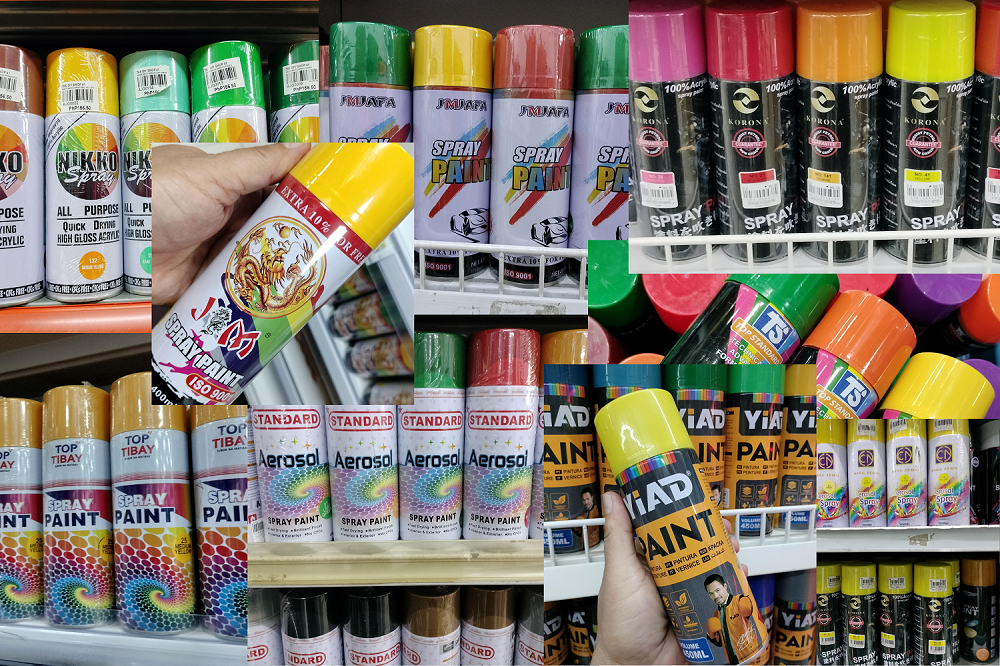
The group, a strong advocate for a society free of harm from chemicals and waste, issued the clarion call after monitoring the local sale of leaded spray paints from China and Thailand in at least 47 general merchandise, hardware and home improvement stores in Region III (Bulacan, Pampanga), Region IV-A (Batangas, Cavite, Laguna, Rizal) and the National Capital Region (12 cities).
According to the investigation conducted by the group from June 10 to Aug. 12, 47 of the 70 stores visited were found selling one or more spray paint brands that have been analyzed to contain lead in excess of 90 parts per million (ppm), the maximum limit set by the Chemical Control Order (CCO) on lead and its compounds.
The CCO promulgated by the Department of Environment and Natural Resources (DENR) in 2013 banned lead-based raw materials in the production of paints and similar surface coatings, and phased out lead-containing decorative paints on Dec. 31, 2016, and lead-containing industrial paints on Dec. 31, 2019.
Among the lead-containing paints found on store shelves were products already flagged by the Food and Drug Administration (FDA) due to their lead content such as the medium yellow JM Spray Paint, canary yellow Koby Spray Paint, grass green and light yellow Nikko Spray All Purpose Quick Drying High Gloss Acrylic, and Jialing red and orange yellow Standard Aerosol Paint.
The group further found leaded YiAD Paint, an aerosol paint made in China, on sale in some chain stores. Manufactured in May 2025, this paint prominently features the image and signature of boxing icon Manny Pacquiao on the front label. The former senator has yet to issue a statement disassociating himself from lead-containing YiAD Paint.
“We are appalled by the proliferation of imported lead-containing paints in the domestic market as if the lead paint ban is not in effect,” said Manny Calonzo, campaigner, EcoWaste Coalition. “The unlawful importation has not eased, as evidenced by our discovery of highly leaded paints with 2024 and 2025 as manufacturing dates, which are being offered for sale to consumers who are not informed of the risks. Government regulators need to flex their muscles and enforce the ban.”
“As for store owners, we appeal to them to shun imported paints unless independently verified as compliant with product safety standards such as the 90 ppm lead content limit. In keeping with their corporate social responsibility, we advise them to ask for third-party certificates of analysis and conformity from their suppliers before making such paints available to their valued customers,” he added.
“To help the Philippines in enforcing the lead paint ban, we request the DENR to nominate lead chromates, the most common lead-based pigments used in paint manufacturing, for listing under the Rotterdam Convention,” suggested Jeiel Guarino, Global Lead Paint Elimination Campaigner, International Pollutants Elimination Network (IPEN). “An affirmative decision by the Conference of the Parties will list lead chromates and lead paints as hazardous chemicals subject to the treaty’s Prior Informed Consent (PIC) Procedure. If listed, companies that export lead chromates or paints containing them will no longer be permitted to export these commodities to a country that has not consented to import them.”
During its market investigation, the EcoWaste Coalition found on the shelves leaded spray paints bearing the names Aeropak, Anton, JM, JMJAFA, King Sfon, Koby, Korona, Nikko, Silvestre, Sinag, Standard, Standard JR, Top Standard, Top Tibay, Yatibay, and YiAD.
Based on the studies conducted by the group, the said paint brands have one or more colors containing lead above the 90 ppm limit as per X-Ray Fluorescence (XRF) and laboratory analyses.
Some of the above named paints can be found in the “Public Notice on Lead-Containing Paints” co-published by the EcoWaste Coalition, Philippine Paint & Coatings Association, Inc. (PPCAI) and IPEN to guide consumers and retailers on paint products with lead content.