


The Philippines is added to the CIVICUS Monitor Watchlist as civic freedoms continue to deteriorate nearly four years into President Ferdinand Marcos Jr’s administration. Civil society organisations have raised growing concerns about intensified efforts to stifle demonstrations, criminalise protesters, and target activists.
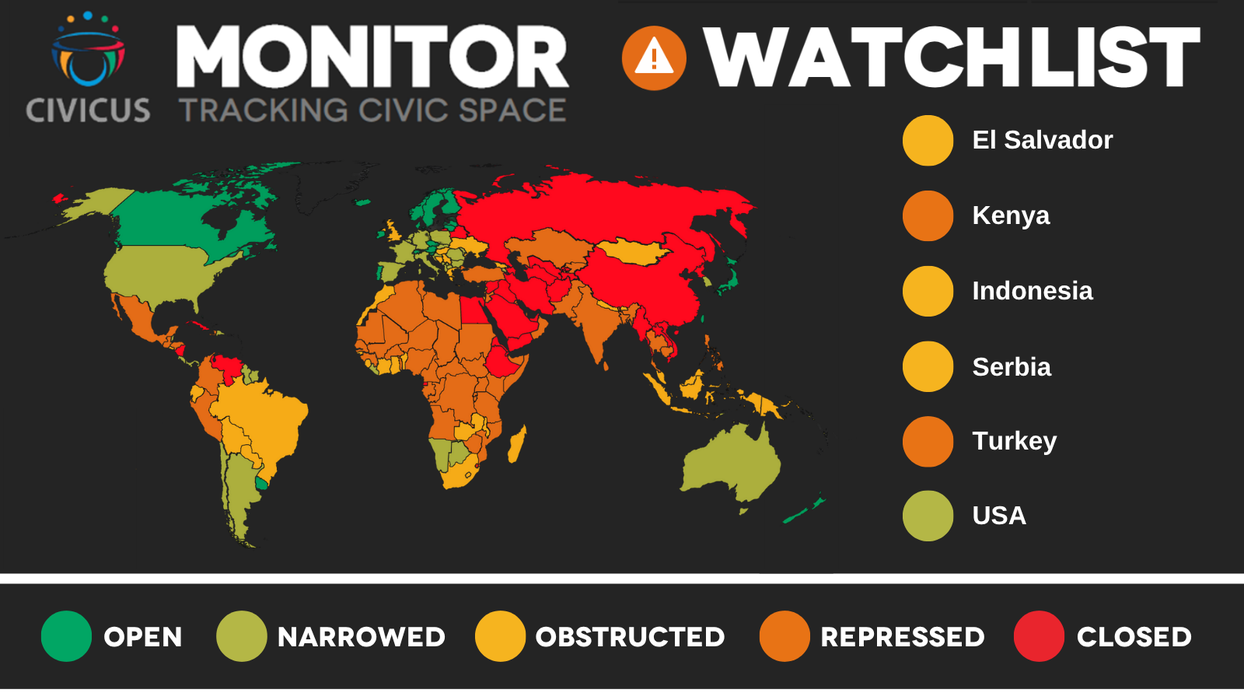
The CIVICUS Monitor currently rates the Philippines as “Repressed”, the second worst rating a country can receive, indicating severe restrictions to the freedoms of expression, peaceful assembly, and association. Alongside the Philippines, the latest Watchlist also includes Benin, Ecuador, Iran, and Georgia, all countries where there has been a recent and rapid decline in civic freedoms.
“There is a deeply troubling pattern of state actions against protests that is restricting the democratic space and stifling fundamental freedoms,” said Josef Benedict, CIVICUS Monitor Asia researcher. “It is creating a chilling effect for many in the Philippines who seek to speak out and organise.”
In September 2025, police responded to anti‑corruption demonstrations with widespread repression, including excessive force and arbitrary arrests. More than 200 people, among them 91 children, were detained and denied access to lawyers and their families. Numerous protesters reported being punched, kicked, and beaten with batons, treatment that may amount to torture or ill-treatment.
The authorities have also weaponised the legal system to pursue protesters and activists. In November 2025, the Department of Justice initiated criminal proceedings against 97 protesters, including charges of sedition and inciting to sedition under the Cybercrime Prevention Act of 2012. Subpoenas were issued to prominent movement leaders such as Renato Reyes Jr, President of BAYAN, as well as several student activists, in what civil society groups describe as a growing campaign of judicial harassment.
On 25 February 2026, police arrested human rights defenders Edel Parducho and Three Odeña during a march commemorating the 40th anniversary of the People Power Revolution. Earlier in the year, anti‑mining protesters in Nueva Vizcaya and farmers involved in long‑standing land disputes in Laguna were also arrested, underscoring the increasing use of law enforcement to stifle community organising and environmental activism.
Human rights defenders, land rights advocates, and labour organisers remain particularly at risk. In November 2025, defenders in Negros Occidental and Cagayan Valley, both affected by typhoons Tino and Uwan, were arrested or attacked. Meanwhile, authorities have escalated the use of fabricated terrorism‑financing charges. Among those detained in December 2025 were activist Carmilo Tabada, formerly with FARDEC, and Michael Cabangon, a Cordillera‑based labour leader and cultural worker. Reports of red‑tagging continue to proliferate, with environmental lawyer Antonio La Viña targeted by a retired military officer in December 2025, and seven organisers and labour leaders publicly vilified in Bicol in February 2026.
Journalists face similar persecution. In January 2026, independent journalist Frenchie Mae Cumpio and human rights defender Marielle Domequil were convicted of terrorism‑financing charges after nearly six years of pre‑trial detention. A regional trial court denied their petition for bail the following month, raising further concerns about the misuse of counter‑terror laws to silence dissent.
“During a period when public accountability is urgently needed, authorities are choosing to use restrictive laws to criminalise activists and journalists rather than address legitimate public concerns,” said Benedict. “The international community must not remain silent but call on the Philippine government to adhere to its international human rights obligations to ensure the right to freedom of expression and peaceful assembly and to drop all charges against activists.”
