



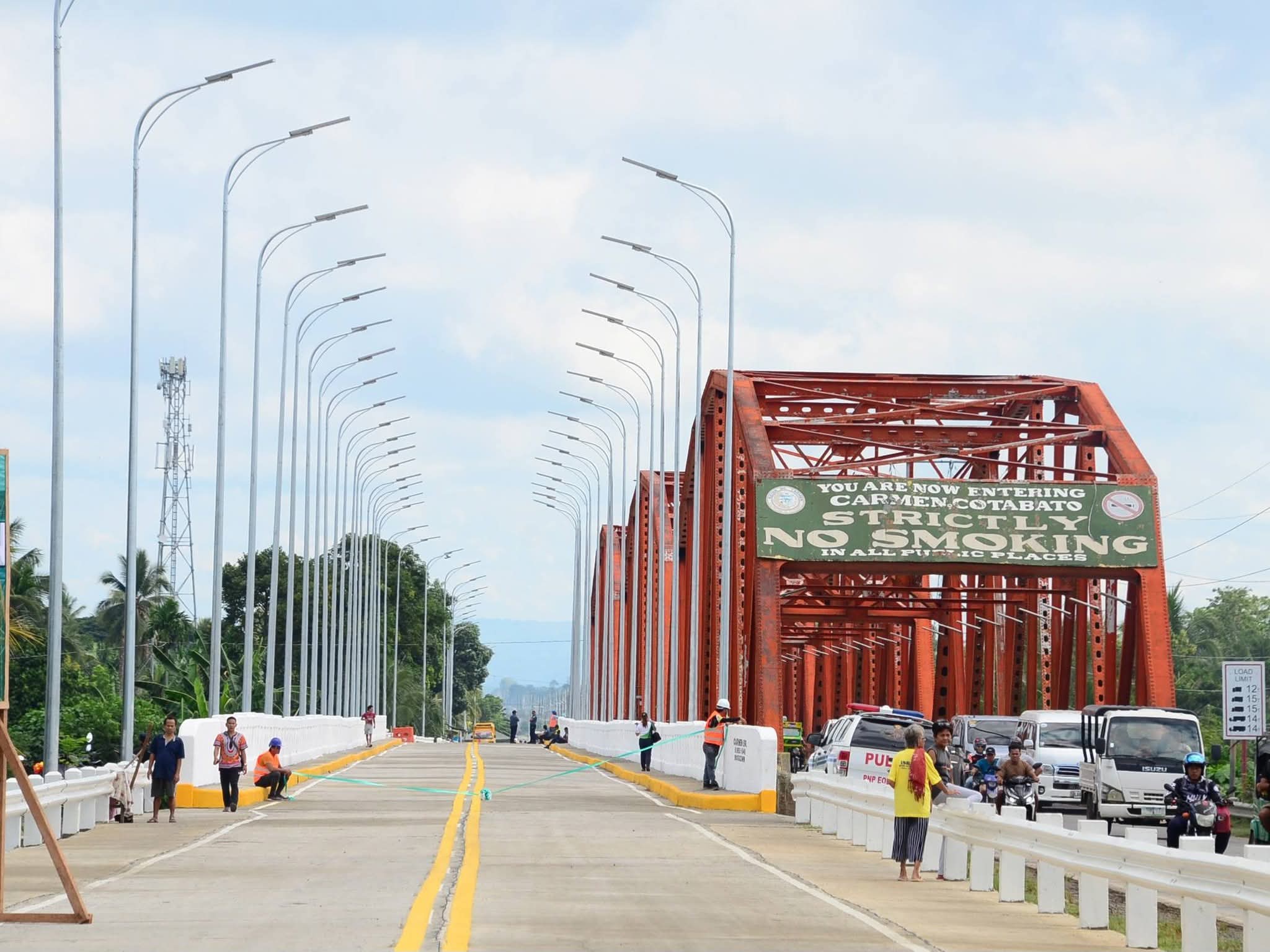
THE INAUGURATION of the Carmen Parallel Bridge in Carmen and the Lumayong Parallel Bridge in Kabacan, both in North Cotabato on Monday, May 4, 2026 is seen to boost inter-regional connectivity.
North Cotabato Governor Emmylou Taliño-Mendoza said the widening of bridges enhance accessibility between Region 10 and Region 12 along the Bukidnon-Cotabato corridor.
Built alongside the old Lumayong and old Carmen bridges, the two new structures will double the traffic-bearing capacity of the Kabacan-Carmen crossing.
“These bridges will improve mobility, expand regional access and make transportation more efficient and convenient,” Mendoza said.
The governor added this project also supports stronger economic growth citing Carmen’s role as home to the country’ s palm oil processing operators and coconut refineries.
The Univanich Carmen Palm Oil Corporation operates a major palm oil mill in Carmen, serving local planters, a major player in the palm oil industry in the country.
“Both municipalities, Kabacan and Carmen, play a strategic role in Trigon agri-industrial development zone of Cotabato province and serve as a gateway along the northern highlands corridor of Region 12,” Mendoza said.
While the project commenced in December 2020, it took some time to fund the completion which received its funding in 2024 and officially completed in 2026.
Cayamombao D. Dia, Department of Public Works and Highways Region 12 regional director, presented that Lumayong Parallel Bridge spans 180 linear meters with a total cost of P233.482 million, while the Carmen Parallel Bridge stretches 240 linear meters at a total cost of P266.375 million— bringing the combined government investment to approximately P499.857 million.
“This reflects the government ‘s substantial commitment to improve inter regional infrastructure in Mindanao,” Dia said.
The official added building a new independent bridge deck alongside the existing one to create a four-lane crossing, improve road safety and reduce dependence on structurally aging infrastructure to ensure efficient movement of people and goods.
Construction was carried out in two phases where Phase 1, covering the foundation and substructure components commenced on December 18, 2020, and Phase 2, which covered the superstructure and ancillary works including cement road surfaces, railings, slope protection, and solar streetlights for night-time safety, commenced on September 17, 2024.
Ollie Dagala, director of the Investment Promotion and Public Affairs Office of the Mindanao Development Authority, representing Secretary Leo Tereso A. Magno, said the bridges describe them as lifelines across major agricultural hubs in Mindanao.
He noted that the old, narrow crossings had long posed heavy traffic and safety risks, particularly for trucks hauling corn, sugar, and other farm products.
“With the new bridges, transport of goods is expected to be faster, reducing post-harvest losses and translating to better income for farmers and improved food security in the region,” he said.
For Wahab Kadalim, a tricycle driver for 10 years, and resident of Kabacan, the opening of the bridge will ease traffic congestion that affects their livelihood.
“Karon kay medyo arang arang na kay ma open na man ang tulay, okay na kaayo ang biyahe,” he said.
The governor announced that the rehabilitation of the old parallel bridges is targeted for completion between 2027 and 2028.

